

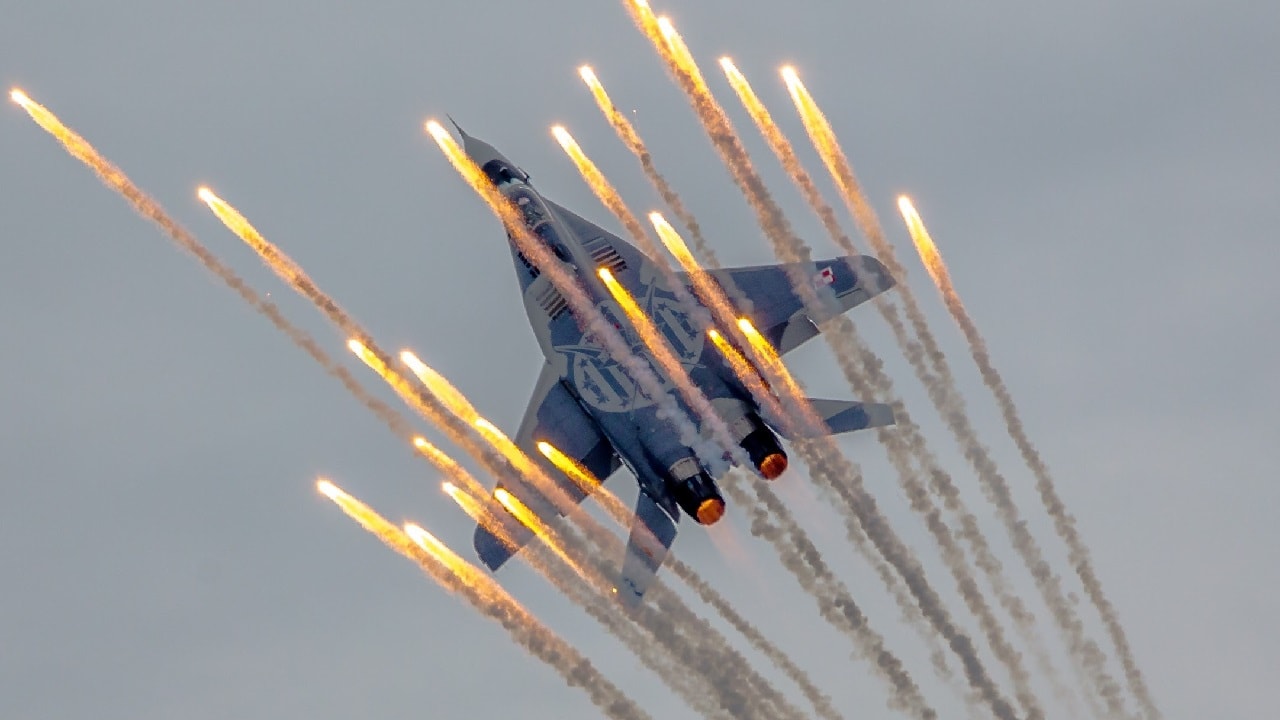
Key Points and Summary – Born in the late 1970s to counter F-15s and F-16s, the MiG-29 paired agile aerodynamics (LERX, twin tails) and twin RD-33s with IRST, a helmet sight, and the R-73 to dominate the merge.
-Built for austere bases with FOD doors and rugged gear, it spread from Warsaw Pact fleets to India, Algeria, Syria and more—and later flew in NATO colors.
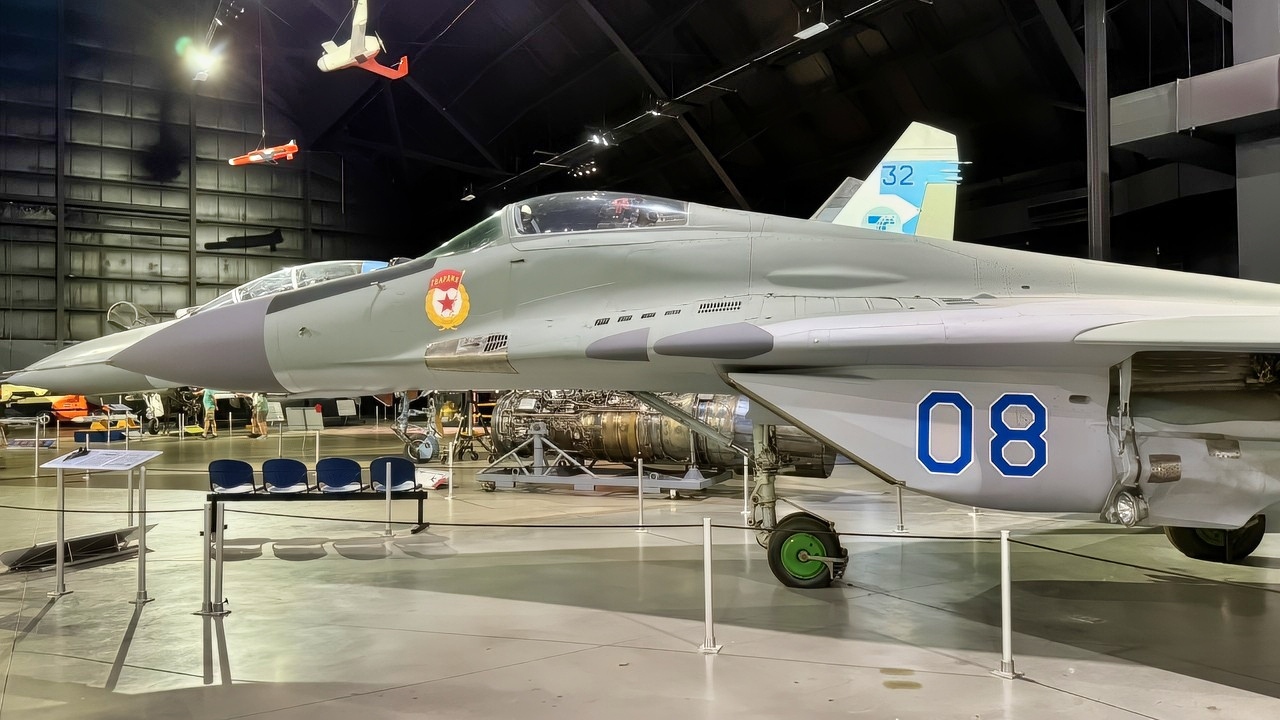
Real MiG-29 at USAF Museum in Dayton. Image Credit: National Security Journal.
-Upgrades (SMT/M/M2/K, India’s UPG) addressed range, sensors, and multirole weapons; MiG-35 adds modern avionics and AESA.
-Combat from Iraq and Serbia to Ethiopia–Eritrea and today’s Ukraine—where Fulcrums fire HARMs—shows a durable, adaptable design whose high-off-boresight doctrine reshaped air combat.
-BONUS – The author visited the U.S. Air Force Museum and got close to a display MiG-29 Fulcrum. Two of the pictures from that visit are included in this article.
MiG-29: The Soviet “Fulcrum” That Refused To Go Away
In the 1970s the Soviet Union faced an uncomfortable arithmetic problem. Across the inner-German border and in the Far East, U.S. forces were fielding F-15 Eagles and the lighter F-16 Fighting Falcons—aircraft with powerful radars, modern missiles, and high reliability. Moscow’s answer was a two-tier fighter force: a long-range heavyweight (what became the Su-27) paired with a frontline lightweight that could launch from austere bases, protect ground forces, and help seize local air superiority. That “lightweight” would become the MiG-29—a nimble, twin-engine fighter designed to fight with teeth on Day 1 of a NATO–Warsaw Pact war and keep flying from rough concrete on Day 10.
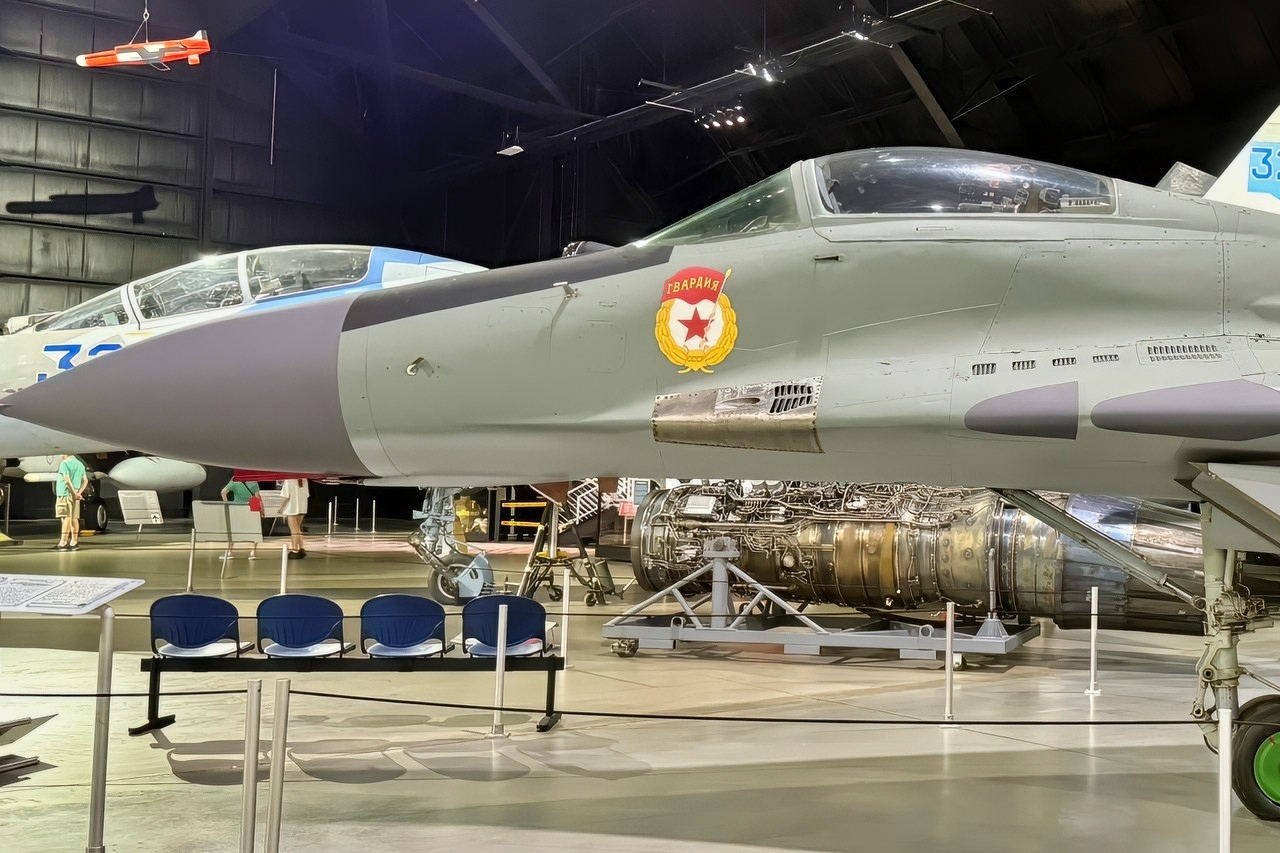
MiG-29 National Security Journal Photo Taken in July, 2025.
The goals were explicit: out-turn Western light fighters, survive thanks to twin engines and rugged gear, and carry a modern short- and medium-range missile mix guided by an onboard pulse-Doppler radar and infrared search-and-track (IRST). Equally important in Soviet doctrine: the jet had to be maintainable in the field. Large panels, quick-change line-replaceable units, and forgiving engine handling were not luxuries—they were survival features.
The Design: Blended Lift, Twin Tails, And A Pilot’s Airplane
Aerodynamically, the MiG-29 sits between classic fighters and the larger Su-27. Its most distinctive features are the blended leading-edge root extensions (LERX) that generate strong vortices at high angles of attack, feeding the wing and keeping lift alive through high-alpha maneuvers. Twin canted tails and a broad lateral spacing of the engine nacelles contribute to directional stability and allow a generous weapons bay between the inlets.
Notable design choices:
Engines: Two RD-33 turbofans gave good thrust-to-weight and quick acceleration. Early versions smoked noticeably and demanded careful maintenance, but twin powerplants offered redundancy—a reassurance over austere terrain or at low altitude.
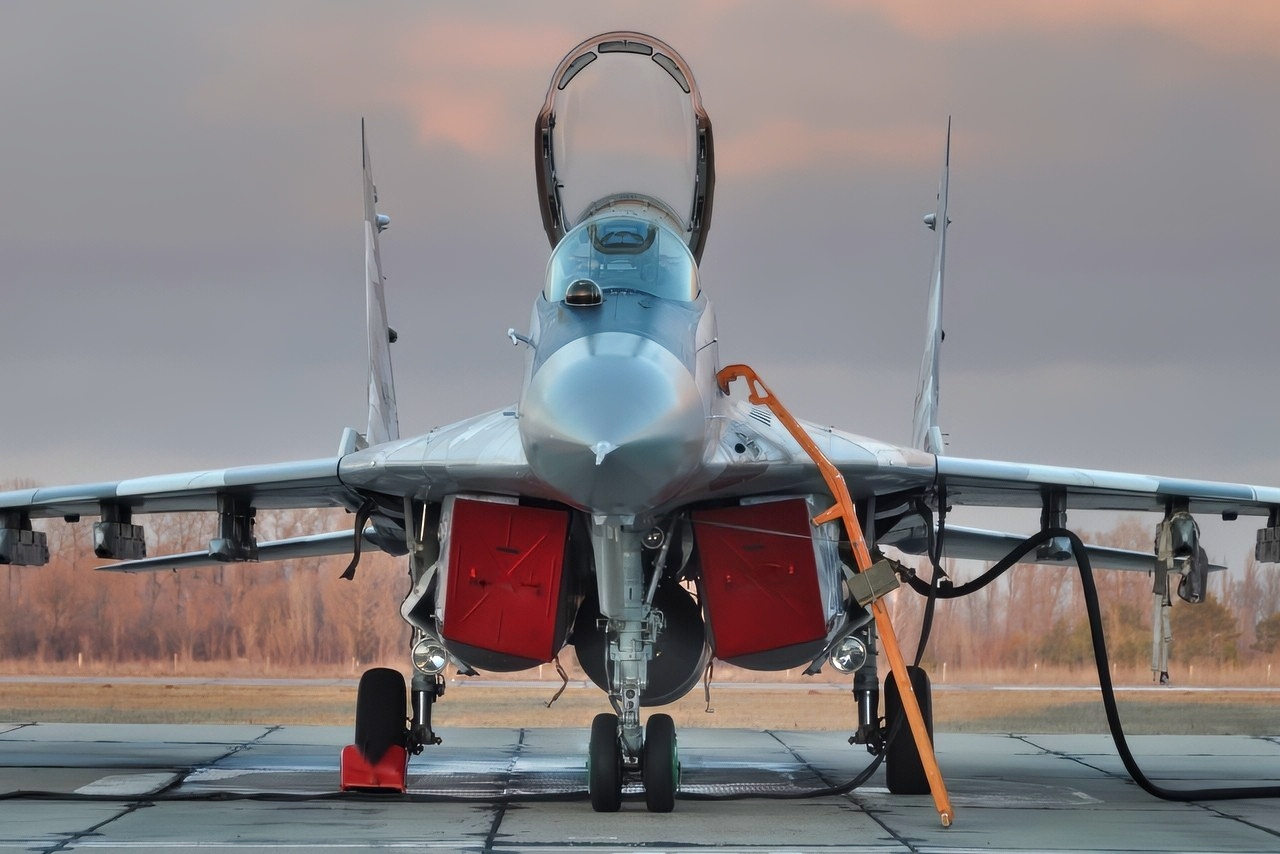
MiG-29 Fighter. Image Credit: Creative Commons.
Inlets For The Battlefield: The MiG-29’s FOD-reducing intake doors close on takeoff roll, drawing air through louvers in the wing roots to reduce debris ingestion—clear proof the airplane was intended to operate from dirty or damaged runways.
Cockpit & Sights: A head-up display paired with the KOLS IRST and the helmet-mounted sight let pilots “slave” sensors and missiles to a high off-boresight target—lethal in a knife fight with the R-73 (AA-11 Archer).
Radar: The early N019 “Rubin” pulse-Doppler set was modest in look-down/shoot-down performance compared with Western peers, but adequate for the intended frontline intercept and close-in fight. Later variants improved range, reliability, and multi-target handling.
The result was a pilot’s airplane: crisp roll rates, strong instantaneous turn, and forgiving post-stall behavior that let skilled aviators cash in the airframe’s high-alpha tricks. In the visual merge, early MiG-29s were—and remain—formidable.
Influences And The Enemies It Meant To Beat
Soviet aerodynamicists borrowed from proven domestic practice—LERX, twin tails, and energy-maneuverability theory already evident in Su-27 studies—while responding directly to Western trends. The F-15 defined the high end the Soviets had to counter; the F-16 and YF-17/F/A-18 defined the agile “lightweight” class. The MiG-29’s helmet-sight + IR missile pairing answered a real Western gap in the 1980s (NATO would not widely field an Archer-class off-boresight weapon and helmet cueing until much later). Where the West leaned into big multimode radars and long sticks, the MiG-29 bet on agility and cueing to win the last thirty seconds of the fight.

MiG-29 Fighter. Image Credit: Creative Commons.
Production And Early Service: From Fulcrum-A To S
The MiG-29 entered Soviet service in the early 1980s, with initial production 9-12 airframes (often called Fulcrum-A) optimized as day/night, all-weather frontline fighters. Export versions for Warsaw Pact partners (9-12A) and for non-Pact nations (9-12B) carried downgraded avionics. The 9-13 (a.k.a. MiG-29S) added a dorsal “hump” for extra fuel and electronic gear, support for longer-range R-27E missiles, and improved ECM. This was the classic late-Soviet MiG-29 seen at Western airshows after the Cold War—still short-legged by U.S. standards, but quick-silver in a turning fight.
The Export Story: From Pact Partners To Global Clients
The MiG-29’s affordability and agility made it a natural export. Warsaw Pact air forces—East Germany, Poland, Czechoslovakia, Bulgaria, Hungary, Romania, Slovakia—received small to medium lots, creating a shared training and spares ecosystem. Beyond Europe, the type spread to India, Syria, Algeria, Eritrea, Sudan, Serbia/Yugoslavia, Iraq, Iran (limited and special-case), Azerbaijan, Uzbekistan, Kazakhstan, and others. After German reunification, the Luftwaffe kept ex-East German MiG-29s for a decade, then transferred most of them to Poland—airframes that would later help Kyiv when Warsaw re-exported Fulcrums to Ukraine with Berlin’s approval.
Outside Europe, India became the most important non-Russian operator. Over time New Delhi funded deep upgrades, creating a MiG-29 UPG standard with new avionics, radar, navigation, and engines—evidence that the basic airframe still repaid investment decades after first flight.

MiG-29 Fighter. Image Credit: Creative Commons.
The Upgrade Path: SMT, M/M2, K/KUB, UPG—And Finally MiG-35
Three intertwined problems dogged early Fulcrums: range, radar reliability, and aging analog systems. The solutions arrived as a family of upgrades:
MiG-29SMT: The most visible change is the enlarged dorsal spine—more internal fuel plus space for new avionics. SMT packages often include HOTAS controls, glass cockpits, GPS/INS, improved helmet-mounted cueing, and compatibility with modern guided air-to-surface weapons, turning a short-legged interceptor into a more useful multirole jet. (A headline-making hiccup: Algeria returned SMTs in 2008 over quality concerns; those airframes were absorbed by Russia.)
MiG-29M/M2: Heavier structural and systems updates, re-profiled inlets, new multimode radars (e.g., Zhuk-ME family), and improved engines—all steering the Fulcrum toward modern multirole expectations.
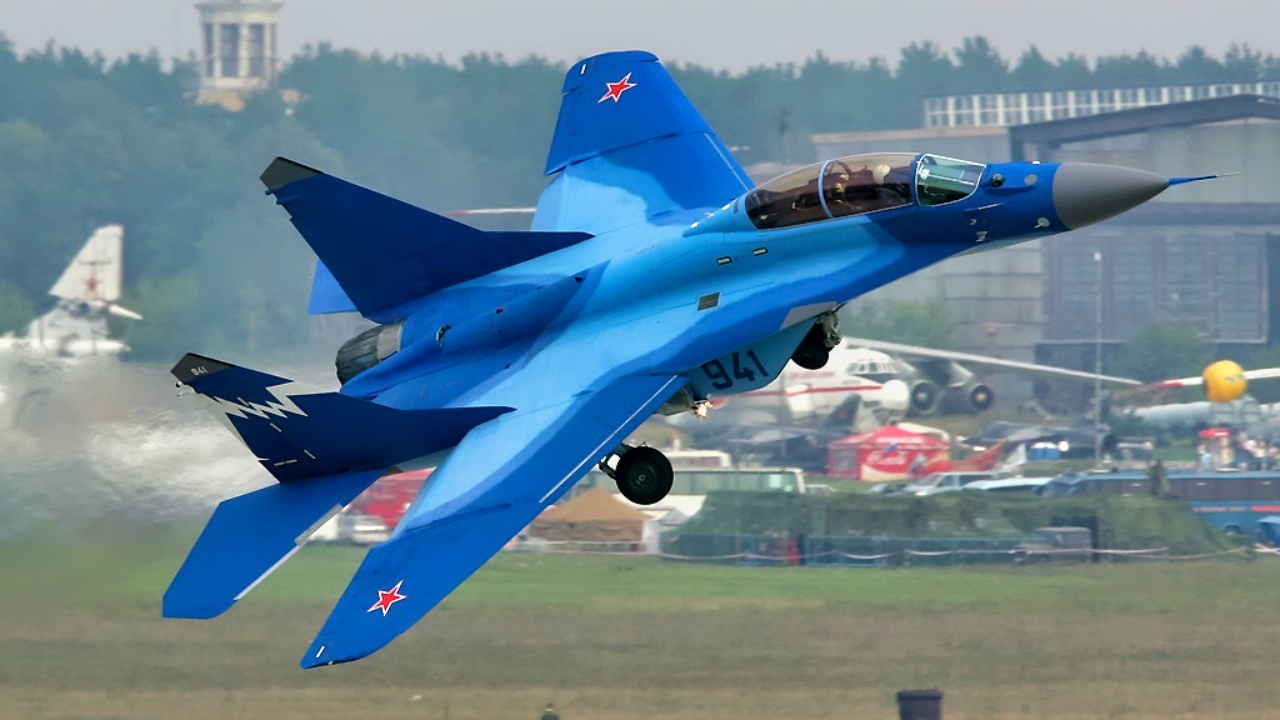
MiG-29K. Image Credit: Creative Commons.
MiG-29K/KUB: The carrier-capable variant, redesigned for naval operations with folding wings, beefed landing gear, and corrosion protection, chosen by India and later Russia for STOBAR carriers.
MiG-29UPG (India): A national standard close to M/M2 in capability: Zhuk-ME radar, new EW suite, digital cockpit, and RD-33 Series 3 engines—illustrating how far an early Fulcrum can be pushed with the right funding.
MiG-35 is the tip of this spear. Externally similar to late-model Fulcrums, it swaps in new avionics architecture, an optional AESA radar (Zhuk-A/AE), an advanced IRST, and upgraded EW and datalinks. On paper it is the most capable Fulcrum-family fighter yet. In practice, orders have been small, with Russia inducting limited numbers while prioritizing other programs and customers waiting on price-performance—and on whether promised AESA sets and weapons arrive at scale.
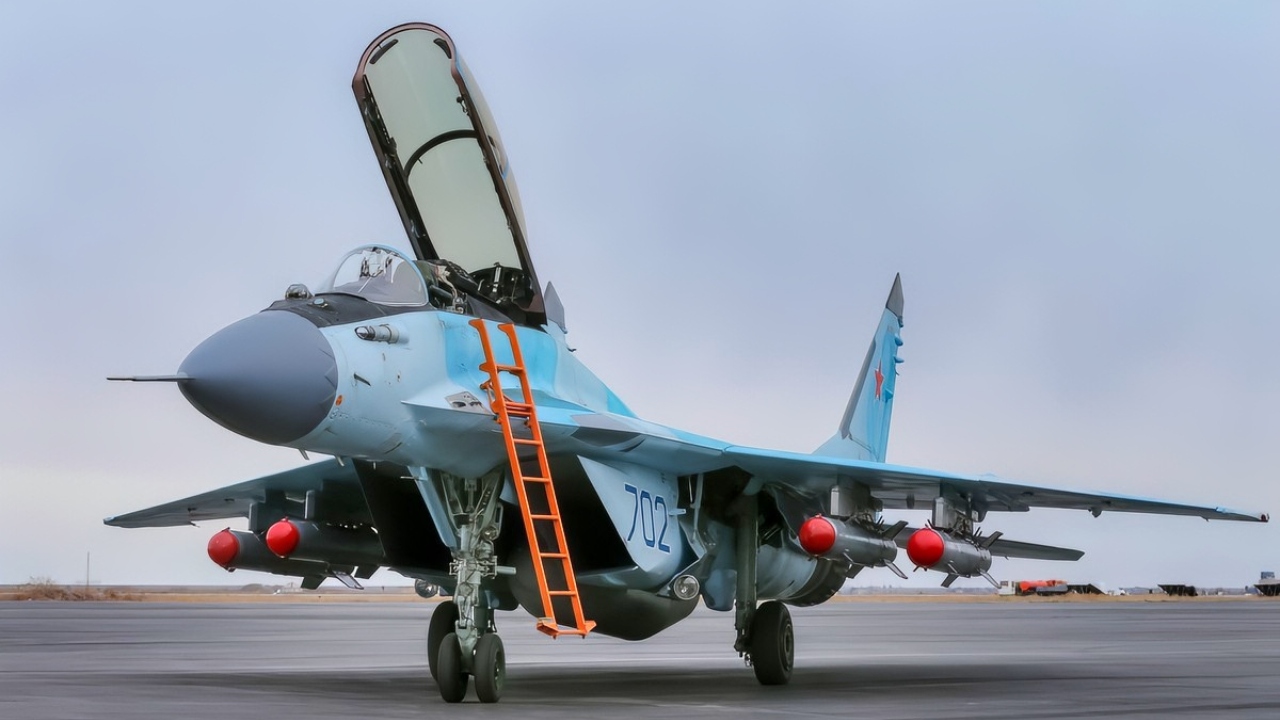
MiG-35 On the Runway. Image Credit: Creative Commons.
How It Flew In The Warsaw Pact—And Then In NATO
In the 1980s, Fulcrums in Eastern Europe trained for low-altitude intercepts against NATO strike packages, realistic close-in merges, and runway survival tactics (short-field ops, dispersal). After the Cold War, a few MiG-29s served unusual second lives in NATO hands. Germany used them as aggressors, giving Western pilots a hard-to-fake look at high-off-boresight R-73 + helmet-sight tactics. When Berlin sold most of its Fulcrums to Poland, the jets continued to fly with NATO markings—proof that the MiG-29’s core handling and weapons still mattered even in alliance training.
At War: From The Gulf To The Balkans—And Beyond
Iraq, 1991. MiG-29s saw limited action in the Gulf War. The Iraqi Air Force faced a Western coalition with AWACS, overwhelming numbers, and superior BVR missiles. A handful of air-to-air engagements ended badly for the Iraqis, and much of the force redeployed or dispersed early.
Yugoslavia, 1999. In Operation Allied Force, Serbia’s small and maintenance-starved MiG-29 fleet flew against a NATO armada with full AWACS coverage and jamming support. Several Fulcrums were lost in air-to-air combat (to F-15s and F-16s) and to strikes on the ground, illustrating a hard truth: an agile airframe cannot substitute for reliable radars, good tactics, and integrated command-and-control.
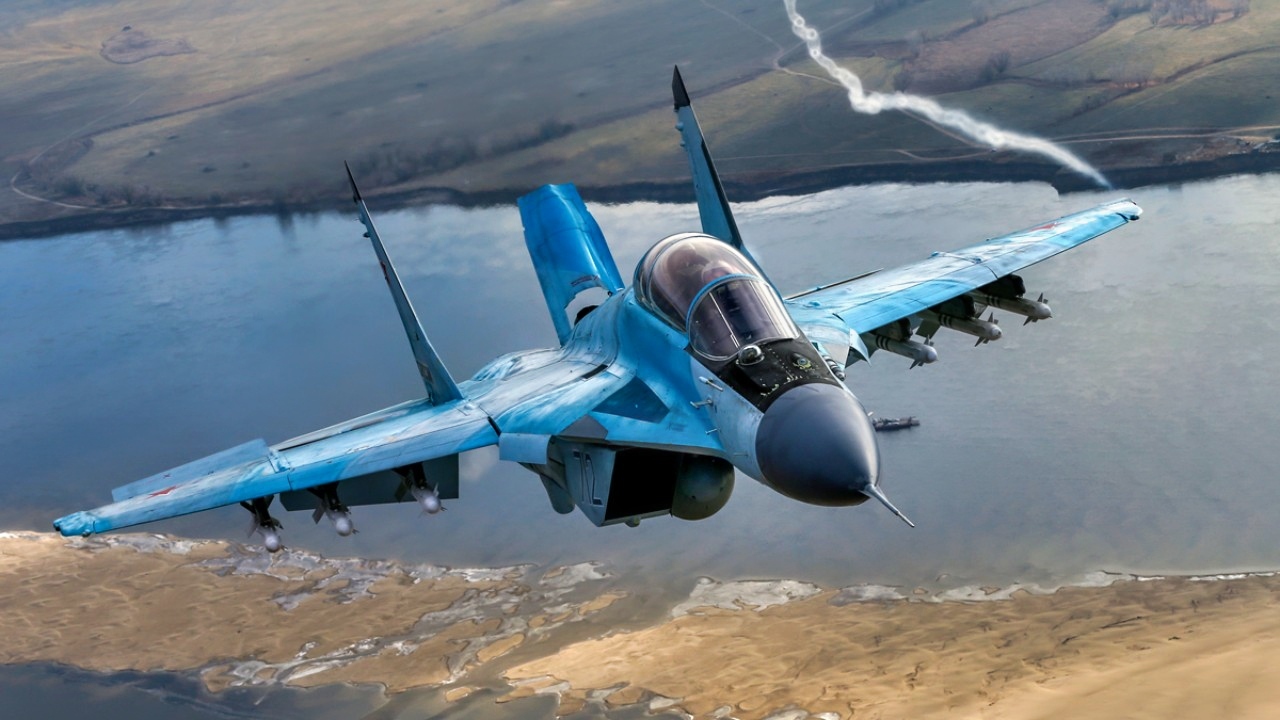
MiG-35 Russian Air Force Fighter. Image Credit: Creative Commons.
Ethiopia–Eritrea, 1998–2000. In a rare Fulcrum vs. Flanker duel, Eritrean MiG-29s met Ethiopian Su-27s. The latter’s larger radar, longer-range missiles, and training edge told; Flankers scored multiple kills, a data point often cited in debates about the two Soviet designs.
Syria And Others. Syrian MiG-29s saw limited combat utility amid civil-war realities and Russian intervention; other operators used the type primarily for air policing and deterrence.
Ukraine: A Second Life In The Harshest Test
The full-scale Russian invasion in 2022 dragged the MiG-29 back to center stage. Ukraine entered the war with a modest Fulcrum fleet and a pressing need to keep the skies contested and suppress enemy radars. Two pivotal developments followed:
Western Missiles On Soviet Rails. With outside help, Ukraine integrated AGM-88 HARM anti-radiation missiles onto MiG-29s—a remarkable cross-ecosystem adaptation that let Fulcrums go “SAM hunting” despite lacking the full Western sensor suite that usually pairs with HARM.
Reinforcements From NATO Stocks. Poland and Slovakia transferred MiG-29s from their inventories, with Berlin green-lighting re-export of ex-German airframes via Poland—an unusual instance of NATO-to-Ukraine fighter transfer that kept a Soviet-designed type in the fight on Kyiv’s side.
Operationally, Ukrainian Fulcrums have flown air defense, point protection, and standoff SEAD/DEAD using Western weapons within limits, while dodging long-range Russian SAM envelopes and beyond-visual-range threats. Losses and attrition have been real, but the aircraft have proven adaptable, and the pilot cadre—already comfortable with the jet’s handling—has squeezed surprising value from hybrid loadouts.
How It Handles: Strengths And Compromises
Strengths that made (and make) the MiG-29 dangerous:
Close-In Lethality: The helmet-sight + Archer pairing was years ahead of most of NATO in the 1980s and still matters today.
High-Alpha Control: The LERX and tail design grant authority deep into post-stall, letting a practiced pilot point the nose where it counts.
Field Resilience: FOD doors, rugged gear, and twin engines suit austere operations—the design’s original purpose.
Limits that shaped its reputation:
Short Legs (Early Models): Internal fuel and thirsty engines gave the jet limited range; SMT/M spines and new engines help, but the stereotype was earned.
Radar And Avionics: Early N019 sets were maintenance-intensive, with modest BVR performance; modernized Zhuk-family radars and digital cockpits fix much—but only where funded.
Sustainment: Operators without deep spares pipelines, robust depot support, and engine expertise have struggled to keep availability high.
Who Bought It, Who Kept It, Who Moved On
Customers fell into three buckets:
Pact And Ex-Pact: Poland, Bulgaria, Hungary, Romania, Slovakia, East Germany—some flew the type into the 2010s; several retired or transferred jets to Ukraine as they shifted to F-16s or F-35s.
Big Non-Aligned Users: India modernized extensively (UPG), keeping Fulcrums relevant in mixed fleets alongside Su-30MKIs and Rafales.
Smaller Clients: Serbia, Algeria (briefly, then returned SMTs), Syria, Eritrea, Sudan, and others—often with small fleets and variable readiness.
An irony of history: a frontline Soviet fighter designed to fight NATO eventually wore NATO roundels and then, in the 2020s, returned to frontline war—this time on Ukraine’s side.
MiG-35: Fulcrum’s Ambitious Heir
The MiG-35 aims to fix everything critics note about the baseline Fulcrum: range, sensors, weapons, networking, and survivability. It promises an AESA radar, a modern EW/ECM suite, IRST with better resolution, precision-guided weapons, and a refined cockpit and data backbone.
On the ground, reality is mixed. A small number have reportedly joined the Russian Aerospace Forces, but large serial orders have not materialized publicly, and the design competes for attention and funds with the Su-30/34/35 family and next-gen projects. If MiG-35 reaches maturity at scale, it would represent the capstone of the Fulcrum line: same handling DNA, twenty-first-century sensors. If not, it may remain a niche bridge between classic MiG-29 upgrades and a future Russian light fighter.
Variants In A Nutshell
9-12/9-12A/9-12B (Fulcrum-A): Early production; export downgrades common.
9-13 (MiG-29S): Added fuel/electronics in a dorsal “hump,” better missile options.
MiG-29SM/SMT: Multirole upgrades—fuel, radar, glass cockpit, EW, weapons.
MiG-29M/M2: Deeper structural and systems refresh; new radar/engines.
MiG-29K/KUB: Naval STOBAR variant with folding wings and reinforced gear.
MiG-29UPG: Indian deep-upgrade standard.
MiG-35: The intended top-end family successor.
How It Stacks Against U.S. Contemporaries
Against the F-16C/D and early F/A-18, a clean-configured MiG-29 is a handful in a visual fight, especially with Archer/helmet cueing. Against F-15C or later, the equation usually favors the Eagle’s BVR radar/missile reach, situational awareness, and support network (AWACS, datalinks). Modernized Fulcrums with better radars and R-77 (AA-12)-class active missiles narrow the gap; pilot training, EW support, and networking typically decide the rest.
Culture And Training: The Human Variable
Stories from joint exercises after the Cold War all rhyme: when well-maintained and flown by current pilots, Fulcrums can surprise Western opponents, especially in initial merges. When maintenance lags and radars drift out of tune, or when pilots lack flight hours and tactical mentors, the jet’s strengths never show. That split explains why the MiG-29 carries two reputations: killer in a phone booth, victim at range. Both can be true, depending on the squadron.
MiG-29 Legacy: A Fighter That Bridged Eras
What did the MiG-29 change?
High-Off-Boresight Normalized. The jet made helmet-sight + agile missile a baseline expectation; NATO copied the lesson with JHMCS + AIM-9X years later.
Austere Ops As A Design Driver. FOD doors, field maintainability, and twin-engine resilience influenced thinking on how to keep fighters combat-useful when bases break.
Upgradeability Matters. The SMT/UPG/M pathways show how an 80s airframe can be digitally reborn—a template several nations followed with their fleets.
Geopolitical Chameleon. Few aircraft types have worn so many flags across alliances—and then returned to frontline war in the country that built them and the one that broke away from it.
In aviation history, the MiG-29 stands as the last great Soviet frontline dogfighter—born to beat the Eagle and Falcon in the merge, evolved into a multirole utility player, and still relevant enough to matter in Europe’s biggest war since 1945. Whether the MiG-35 becomes a worthy heir or a footnote, the Fulcrum’s mark is secure: it forced everyone else to learn the helmet-cued, high-alpha language—and in the right hands, it still speaks it fluently.
About the Author: Harry J. Kazianis
Harry J. Kazianis (@Grecianformula) is Editor-In-Chief and President of National Security Journal. He was the former Senior Director of National Security Affairs at the Center for the National Interest (CFTNI), a foreign policy think tank founded by Richard Nixon based in Washington, DC. Harry has over a decade of experience in think tanks and national security publishing. His ideas have been published in the NY Times, The Washington Post, The Wall Street Journal, CNN, and many other outlets worldwide. He has held positions at CSIS, the Heritage Foundation, the University of Nottingham, and several other institutions related to national security research and studies. He is the former Executive Editor of the National Interest and the Diplomat. He holds a Master’s degree focusing on international affairs from Harvard University.
More Military
The X-40A Space Plane Has a Message for the U.S. Military
The Mach 6.7 X-15 Space Plane Has a Message for the U.S. Air Force
Japan Almost Built a 90,000-Ton Battleship
USS Ronald Reagan – The Navy’s Best Aircraft Carrier?
Russia’s Mach 2.83 MiG-31 Foxhound Has a ‘Hypersonic’ Message for NATO


