
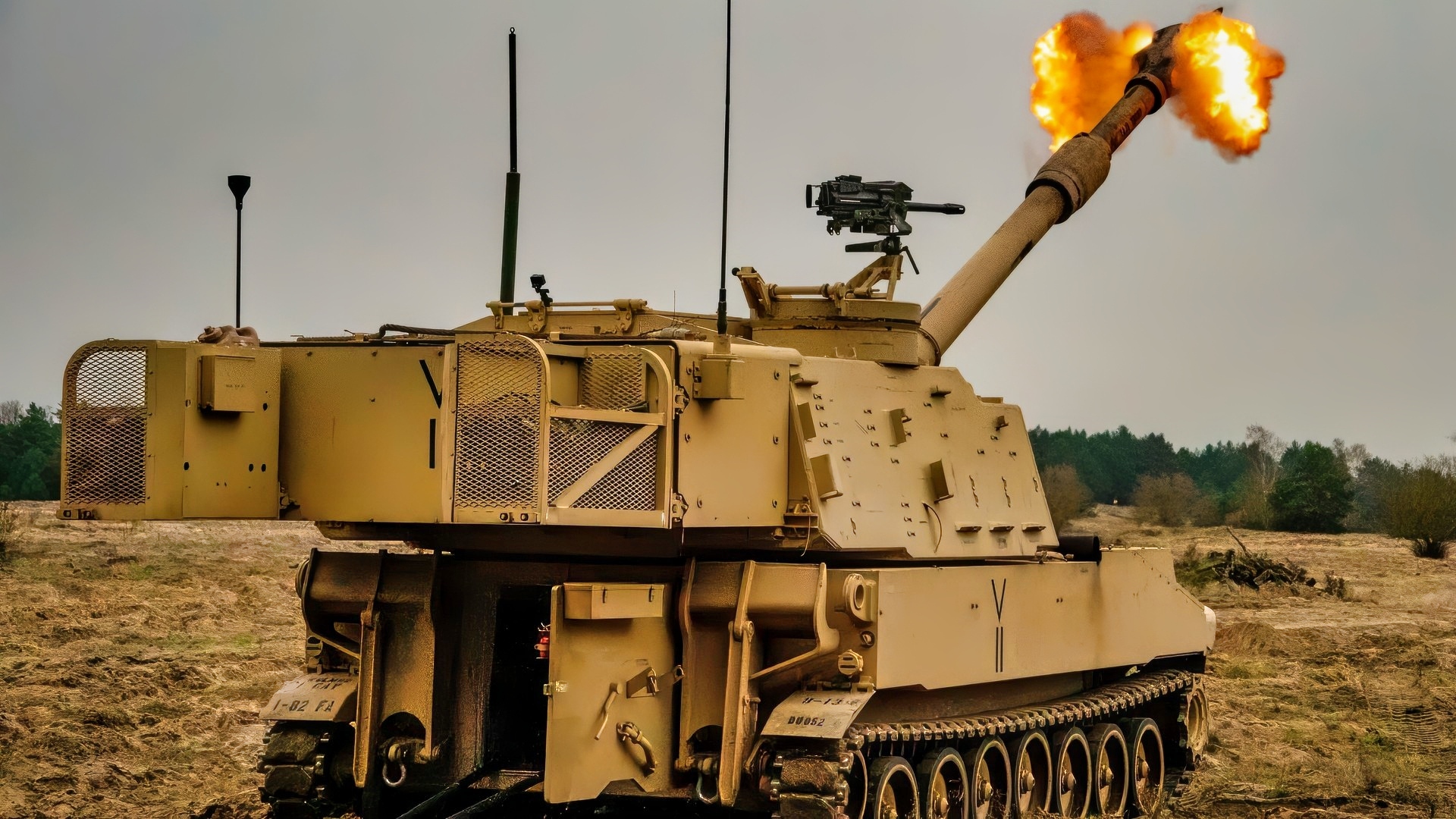
The XM2001 Crusader was supposed to become the U.S. Army’s next-generation artillery system: a heavily automated 155mm self-propelled howitzer capable of firing faster, farther, and more accurately than the aging M109 Paladin fleet it was designed to replace.
Instead, it became one of the most famous canceled weapons programs in modern Pentagon history after Defense Secretary Donald Rumsfeld abruptly killed the project in 2002 during the early months of the post-9/11 “military transformation” era.

NATO Artillery Test. Image Credit: NATO.

Finnish artillery units fire Howitzers At Rovajärvi exercise area In northern Finland. Image Credit: NATO.

Finnish artillery units fire Howitzers At Rovajärvi exercise area In northern Finland. Image Credit: NATO Flickr.
At the time, Crusader represented one of the Army’s biggest modernization efforts, with projected costs reaching roughly $11 billion. Supporters argued the system would revolutionize U.S. artillery firepower.
Critics inside the Pentagon, led by Rumsfeld, argued it was a Cold War-era concept built for large armored wars in Europe and too heavy for the faster, lighter military the United States wanted after the September 11 attacks.
The cancellation of the project triggered a major political fight between the Pentagon, the Army, Congress, and defense contractors – but it also exposed a deeper debate that still exists today: how much heavy artillery America actually needs for future wars.
XM2001 Crusader Was Designed To Replace The Paladin
The Crusader program originated from the Army’s long-running effort to modernize self-propelled artillery dating back to the Cold War. The system evolved from the Advanced Field Artillery System program and eventually became the XM2001 Crusader self-propelled howitzer paired with the XM2002 armored ammunition resupply vehicle. The prime contractor was United Defense, while General Dynamics served as a major subcontractor.
The Army envisioned Crusader as a major leap beyond the capabilities of the M109A6 Paladin.
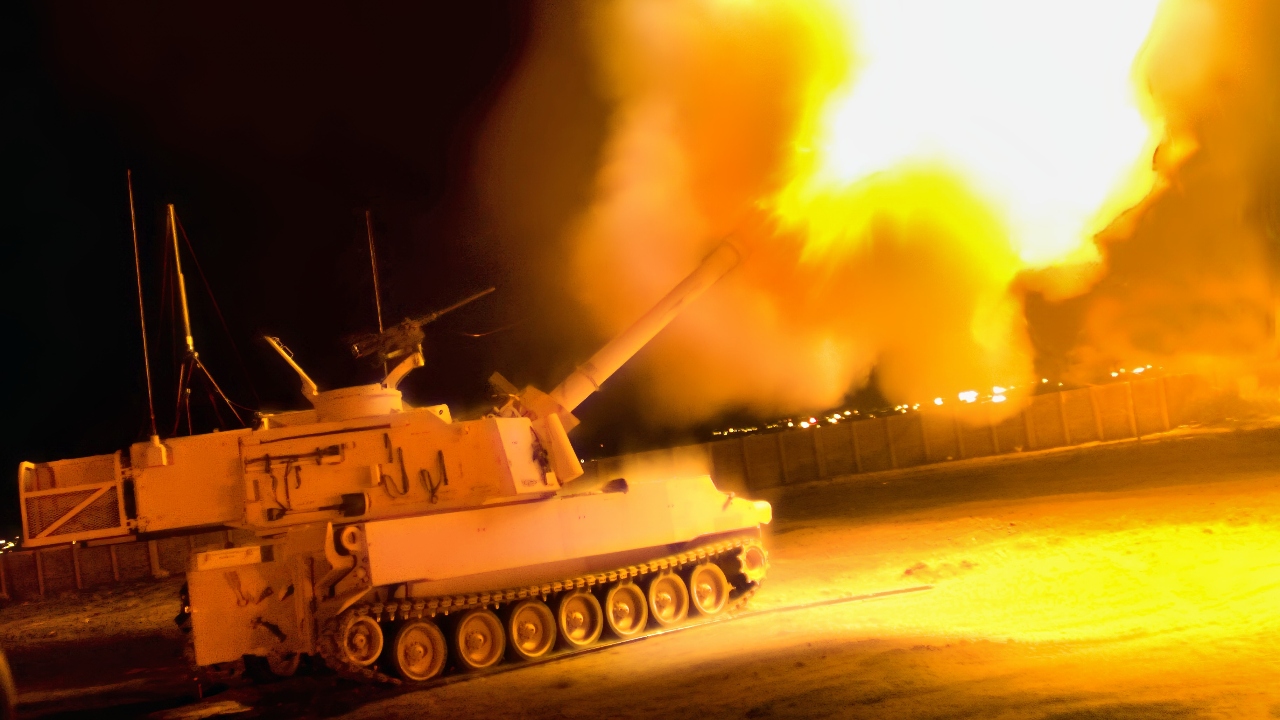
From a gun that shot at trees to an $18 billion boondoggle, these are the 5 worst and most disastrous weapon systems in U.S. Army history. Image Credit: U.S. Army.
The vehicle used an automated loading system that dramatically reduced the requirements to just three soldiers. It was designed to fire between 10 and 12 rounds per minute for short periods, far exceeding the Paladin’s sustained rate of fire. It could also fire within roughly 30 seconds after stopping.
The system’s 155mm cannon was expected to strike targets more than 40 kilometers away using rocket-assisted ammunition, while the automated resupply vehicle could transfer dozens of rounds in minutes without exposing crews to enemy fire.
Crusader was also heavily protected compared to many foreign self-propelled artillery systems of the era.
Unlike lighter, wheeled-artillery concepts that later became popular, Crusader was designed to survive alongside M1 Abrams tanks in high-intensity mechanized warfare. Early versions reportedly weighed around 60 tons, but redesign efforts aimed to reduce the weight to the 40-ton range.
Crusader was expected to be fielded around 2008.

FORT MOORE , Ga. Maneuver Center of Excellence hosts the 2024 Armor Week media day on Harmony Church Mar. 14, 2024. The event featured live-fire demonstrations with the M1 Abrams Main Battle Tank, and an opportunity to get up close and hands-on with M1 Abrams and M2 Bradley Fighting Vehicle. Armor Week, April 29 to May 3, and the 2024 Sullivan Cup competition requires mastery of individual tasks, technical and tactical competence, and the ability to demonstrate an array of maneuver, sustainment, and gunnery skills. The competition focuses primarily on the performance of the Soldiers functioning as a crew. (U.S. Army photo by Patrick A. Albright)
Rumsfeld Saw Crusader As A Cold War Weapon
The system’s problems were not really technical. It was a capable weapon. The issue was that Crusader arrived at exactly the moment Rumsfeld was attempting to fundamentally reshape the U.S. military.
Following the September 11 attacks and the opening stages of the War on Terror, Rumsfeld aggressively pushed the idea of “transformation,” a Pentagon-wide effort focused on lighter forces, rapid deployment, precision-guided weapons, networking, unmanned systems, and reduced logistical burdens.

The 1-148th Field Artillery Regiment is the latest unit in the Idaho Army National Guard to upgrade its combat capability as modernization efforts across the U.S. Army and Army National Guard take shape. Image Credit: Creative Commons.
Heavy armored formations designed for large conventional wars were increasingly viewed inside the Pentagon as outdated.
Crusader immediately became a symbol of the old Army Rumsfeld wanted to move away from.
Its weight became one of the Pentagon’s main criticisms. Congressional Research Service analysis noted that Crusader’s roughly 40-ton weight made it far heavier than many of the future systems envisioned under the Army’s emerging transformation plans. Transporting the system by air was also more difficult than transporting lighter vehicles.
Rumsfeld argued that the future battlefield would increasingly prioritize precision fires rather than large volumes of conventional artillery bombardment, and he repeatedly described Crusader as not sufficiently “transformational” when questioned about whether the Pentagon should continue to invest billions of dollars in what he saw as legacy-style weapons.
On May 8, 2002, the Pentagon officially terminated the program. It became the first major weapons cancellation personally associated with Rumsfeld’s transformation agenda.
A Pentagon Civil War Ensued
The decision sparked immediate backlash inside both the Army and Congress.
Many lawmakers whose states benefited from jobs related to the Crusader fought aggressively to save the system. PBS reported that the industrial network behind Crusader involved more than 100 contractors and suppliers across 27 states.
The Army itself also resisted the cancellation. During Senate testimony, Army Chief of Staff Gen. Eric Shinseki openly stated the operational requirement for Crusader still existed, creating visible tension between Army leadership and civilian Pentagon leadership.
The internal dispute became so politically toxic that Army congressional liaison official Kenneth Steadman eventually resigned after opposing the cancellation decision, but the Rumsfeld decision prevailed, and the program ended permanently.
Today, the Pentagon is again prioritizing mass firepower, signing agreements this week to potentially procure more than 10,000 low-cost cruise missiles under the new Low-Cost Containerized Munitions program, following recent wars that exposed serious concerns about U.S. missile stockpiles, industrial capacity, and sustained strike capability in prolonged conflicts.
About the Author: Jack Buckby
Jack Buckby is a British researcher and analyst specializing in defense and national security, based in New York. His work focuses on military capability, procurement, and strategic competition, producing and editing analysis for policy and defense audiences. He brings extensive editorial experience, with a career output spanning over 1,000 articles at 19FortyFive and National Security Journal, and has previously authored books and papers on extremism and deradicalization.


