

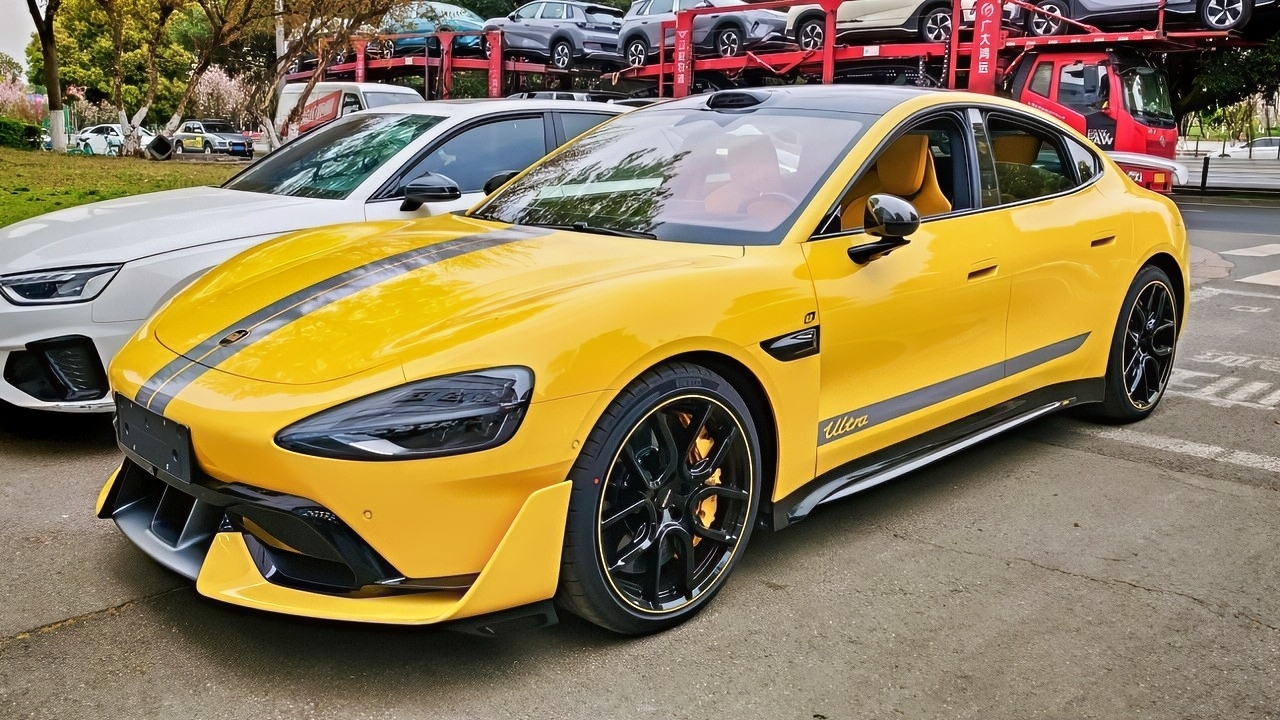
For months, conservatives have fretted that Donald Trump may agree to open the U.S. auto market to cheap Chinese electric vehicles as part of a larger trade agreement with China. The concern is largely economic: cheap, state-subsidized Chinese EVs decimating American automakers, auto jobs lost throughout the Midwest, Detroit taking one more punch that it simply can’t recover from. It’s understandable, of course, but it only scratches the surface of the bigger problem. The threat isn’t what Chinese EVs would do to Ford’s profits. It’s what they’d do to America’s industrial base if we ever need it to fight a long conventional war against a peer adversary.
The defense-industrial logic behind that claim tends to get lost whenever this conversation shifts — as it almost always does — to trade politics.
In December 1941, the United States lacked a military-industrial base capable of fighting the war it had just entered. Detroit changed that. Ford, GM, Chrysler, and hundreds of smaller manufacturers converted their assembly lines to produce tanks, aircraft engines, jeeps, and artillery shells — and did so at a pace no other nation could replicate. By 1944, American factories were outproducing every other belligerent combined. That capacity didn’t materialize out of nowhere — it emerged because America had a deep, mature, technically sophisticated commercial auto sector, with the tooling, workforce skills, supply chains, and engineering talent that war production requires. The arsenal of democracy ran on commercial industrial depth.
That principle still holds. The technology on which it turns is simply different now.
The U.S. military is currently in the middle of a significant electrification push across its ground vehicle and logistics fleet. The Army’s Optionally Manned Fighting Vehicle program — its primary next-generation armored platform — is being designed from the outset around a hybrid-electric architecture. Autonomous ground systems, central to the Army’s vision for future land warfare, are battery-powered.
Forward-operating drone platforms, which proved decisive in Ukraine and are now being scaled for potential Indo-Pacific scenarios, run on the same lithium-ion and emerging solid-state battery technology being developed for commercial EVs. These are not merely analogous technologies — in many cases, they are the same ones, produced by the same manufacturers and dependent on the same supply chains.
This is where the Chinese EV question becomes a warfighting question. Battery manufacturing capacity cannot be conjured on demand. Building it requires sustained commercial investment, years of workforce development, and supply chain maturation driven by market-scale demand signals. If there is no viable domestic EV sector generating that demand, there is no industrial base available to surge for military production when it matters.
Commercial and military ecosystems are not identical, and wartime production has historically adapted across sectors in ways that defy peacetime assumptions. But in electrified warfare systems specifically, the distance between commercial and military production is collapsing — a drone battery cell and an Army autonomous ground vehicle draw on the same chemistry, the same refining inputs, and, increasingly, the same manufacturing processes. The adaptation window in a peer-competitor conflict may be far shorter than the one the U.S. enjoyed after Pearl Harbor.
The semiconductor precedent should make any strategist uncomfortable here. Through the 1990s, the prevailing logic held that offshoring semiconductor manufacturing was acceptable as long as design and intellectual property stayed American. That logic seemed reasonable and proved catastrophic. The COVID chip shortage and the TSMC dependency crisis exposed what the theory obscured: you cannot retain engineering expertise, process knowledge, or supply chain resilience if you abandon the manufacturing ecosystem. The CHIPS Act was an attempt at remediation — expensive, belated, and still incomplete. The EV and battery sector is running the same experiment, with higher strategic stakes and less time to correct course.
The critical mineral dimension compounds the problem. China controls roughly 60 percent of global lithium refining capacity and more than 70 percent of cobalt processing — the steps that convert raw materials into battery-grade inputs. A hollowed-out domestic EV sector eliminates the demand that would otherwise drive investment in alternative supply chains. Without that demand signal, there is no economic case for building the processing infrastructure the military would need in a wartime supply disruption. This is a structural vulnerability — one that deepens with every year the U.S. fails to build a genuinely competitive battery manufacturing base.
None of this means tariffs alone are the answer. They are necessary but not sufficient. Keeping Chinese EVs out of the American market buys time — but only if that time is used to build genuine domestic capacity in battery manufacturing, critical mineral processing, and the adjacent technologies feeding into autonomous and electrified military systems. That rebuilding effort is expensive, politically grueling, and measured in decades rather than election cycles, which is precisely why allowing further erosion now carries costs that no future administration will find easy to absorb. Protecting the industry and building the industry are two different tasks, and the second is considerably harder.
What is not acceptable is opening the American market to Chinese EVs as a trade concession without a parallel industrial strategy. That would combine both errors simultaneously: accelerating the erosion of domestic capacity while extracting nothing durable in return. With the Trump-Xi summit now underway in Beijing, that risk is not abstract.
Conservatives worried about cheap Chinese EVs are right to worry. They just need to worry about the right thing. The disaster isn’t a cheaper car on an American lot. It’s discovering, somewhere in the second year of a war over Taiwan, that U.S. forces cannot sustain drone production, cannot replace degraded autonomous systems, and cannot field the electrified logistics fleet the campaign requires — because the industrial base that would have made all of that possible was quietly traded away at a summit in Beijing.
About the Author: Dr. Andrew Latham
Andrew Latham is a professor of international relations and political theory at Macalester College in Saint Paul, MN. You can follow him on X: @aakatham.


