


France has officially named its next-generation nuclear-powered aircraft carrier France Libre, after the Free French resistance movement led by Charles de Gaulle in World War II. Displacing between 78,000 and 80,000 tons, France Libre will be the largest warship ever built in Europe. The carrier will be powered by two K22 nuclear reactors, equipped with General Atomics’ Electromagnetic Aircraft Launch System and Advanced Arresting Gear, and carry more than 30 aircraft including Dassault Rafale M fighters and E-2D Advanced Hawkeyes. Cost runs around 11.6 billion U.S. dollars. Entry into service is projected for 2038, replacing the aging Charles de Gaulle. But is this all a good idea for Paris?
France’s Libre: A New Nuclear-Powered Aircraft Carrier
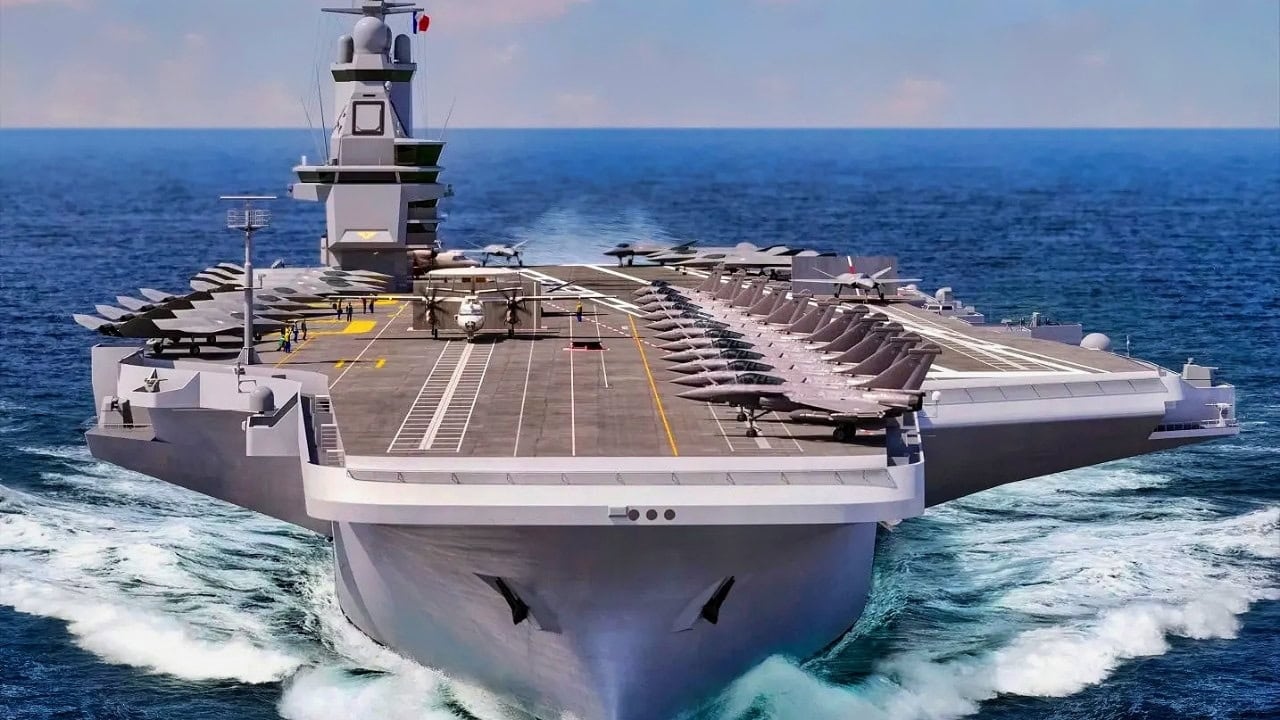
PANG France Aircraft Carrier. Image Credit: Creative Commons.
It’s finally happening. The Europeans are, after decades of dithering, investing significantly in their national defenses. Thank goodness. Mission accomplished, President Trump.
There’s just one big problem with this.
For starters, investment in national defense across the continent varies. What’s more, the Europeans appear to now be at risk of overspending on systems that they don’t really need.
France’s Sudden Military Awakening
Just look at the French. Under President Emmanuel Macron, the French military is undergoing a serious modernization and expansion. At any point in the last 30 years, this could have been done.
But the French were too busy, apparently, to be bothered.
It was only when the Americans elected a man who appeared hostile to maintaining the status quo that the French galvanized and began enhancing their defenses. Of course, this new militarization is being done somewhat to spite the Americans rather than to uphold long-standing agreements between the two nations.
Nevertheless, Americans should be pleased that their European partners are finally doing something to uphold their end of the NATO bargain.
Enter France Libre
Here’s the real problem, though. Countries, especially France, are investing in systems that are no longer relevant on the modern battlefield and are, therefore, not worth the cost. France is investing in their first new aircraft carrier in decades.
The current carrier is the aging Charles de Gaulle, and Paris wants to replace it with the Porte-Avions Nouvelle Génération (PANG) carrier. Recently, the French officially dubbed it “France Libre.” This carrier would be capable of operating in the Indo-Pacific and Middle East, while preserving France’s status as an independent global military project.

Charles de Gaulle Aircraft Carrier. Image Credit: Creative Commons.

The French Marine Nationale aircraft carrier FS Charles De Gaulle (R91), and the aircraft carrier USS John C. Stennis (CVN 74) are underway in formation in the Red Sea, April 15, 2019. The John C. Stennis Carrier Strike Group is deployed to the U.S. 5th Fleet area of operations in support of naval operations to ensure maritime stability and security in the Central Region, connecting the Mediterranean and the Pacific through the western Indian Ocean and three strategic choke points. (U.S. Navy photo by Mass Communication Specialist Seaman Joshua L. Leonard)
France Libre references the Free French resistance movement led by Charles de Gaulle during the Second World War. Paris is presenting the great ship as a symbol of national sovereignty, industrial independence, and global power projection. Macron has explicitly linked this project to France’s desire to remain a first-tier military power capable of operating independently of the United States.
The Ship is Enormous (By European Standards)
The carrier will displace between 78,000 and 80,000 tons, making it the largest warship ever built in Europe. Two K22 nuclear reactors will power the vessel. France Libre is expected to have more than 30 combat aircraft, as well as helicopters and drones.
Approximately 2,000 personnel will serve aboard this boat. Like the new Gerald R. Ford-class aircraft carriers and the newest Chinese carriers, France Libre will possess an electromagnetic aircraft launch system (EMALS) from General Atomics. Just as with the newest (problematic) American carrier, France Libre will have advanced arresting gear (AAG) for more efficient, safer landings.
Paris intends for this monstrosity to enter service around 2038.
The ship will operate upgraded Dassault Rafale M fighters initially before transitioning to the mythical Franco-German-Spanish FCAS/Next Generation Fighter system. The carrier will also deploy E-2D Advanced Hawkeye aircraft and future naval drones.
Why France Wants This Carrier
French leaders rightly believe the world is returning to an era of great-power competition. So, Paris wants a navy capable of operating independently in the Mediterranean, the Indian Ocean, the Indo-Pacific, the Persian Gulf, the Atlantic, and even the African littorals. French strategists assess that aircraft carriers remain one of the few tools allowing a middle-sized power to rapidly project force without relying on foreign bases.
This capability has been repeatedly demonstrated by the aging Charles de Gaulle, which has conducted French military operations in Afghanistan, Libya, Syria, and throughout the Middle East and North Africa. In fact, this ancient carrier is being deployed to the Middle East again in light of the recent Iran War.
But Charles de Gaulle has little life left in her. France Libre will serve the French Navy until the end of the century.
Why the Program is So Controversial
Yet, France is about to commit a catastrophic strategic error. Lacking the size and budget of the United States Armed Forces, France must be much more selective in the exquisite systems it procures.
By throwing everything they have into this single aircraft carrier, Paris is essentially bogging down the French military budget for at least a generation, even as there are other priorities and cheaper systems that can be fielded to deploy French military power into distant regions.
Especially in light of the rise of anti-access/area-denial (A2/AD) systems. These are systems specifically designed to undermine traditional power-projection platforms. Weapons like hypersonic missiles, drone swarms, anti-ship ballistic missiles (ASBMs), submarines, and long-range strike systems all mean that the aircraft carrier is increasingly obsolete.
An 80,000-ton vessel is a vanity project rather than a serious attempt at great-power projection across vast distances. Just think of the money and manpower that the ships will be soaking up from much more relevant, cheaper programs. Aircraft maintenance and nuclear infrastructure will also be costly.
Sure, having a carrier will make the French feel good about being a declining, medium-sized power. In a high-end war against a superior adversary, though, the carrier would become an extremely vulnerable target because of its susceptibility to attack from A2/AD systems.
Why spend more than 10 billion euros (11.6 billion in US dollars) on one ship when unmanned systems, submarines, missiles, and distributed fleets will dominate the future battlefield?
Understanding the Real Intention
The real intention of this program is, sadly, far less impressive than one might think. It’s about demonstrating to America that France is a serious player and they’re tired of being bullied by the Trump administration.
Paris wants to showcase that they, too, can build impressive combat systems.
What the French are missing is that the Americans are about to lose their massive investment in the carrier platform if a great-power war breaks out between the United States and China.
Heck, they might lose that investment in the ongoing war with Iran. France should instead work to blaze entirely new paths in defense procurement.
After all, we are in the age of multipolarity, where even declining middle powers, like France, can be dynamic and competitive–so long as they responsibly steward their finite resources into affordable, advanced, and strategically relevant systems.
That isn’t the carrier.
France’s Strategic Reality Check
Plus, there’s no way that France can use just one carrier effectively–and there’s no way that the French can afford to build and maintain more than one of these leviathans.
So, the French are creating enormous long-term strategic risks for themselves when they should be working to streamline their defensive systems and downsize their strategic objectives from global power projection (France is no longer a global power) to a regional force.
Why does Paris even care about the Indian Ocean or the Pacific Ocean? Their priorities must be the Mediterranean and the Atlantic.
Until France makes that key strategic pivot, it will waste their money, time, and resources on a vanity project that is unlikely to ever be relevant…and more likely to be sunk in the opening salvos of a major conflict.
About the Author: Brandon J. Weichert
Brandon J. Weichert is the Senior National Security Editor at 19FortyFive.com. Recently, Weichert became the editor of the “NatSec Guy” section at Emerald. TV. He was previously the senior national security editor at The National Interest. Weichert hosts The National Security Hour on iHeartRadio, where he discusses national security policy every Wednesday at 8 p.m. Eastern. He hosts a companion show on Rumble entitled “National Security Talk.” Weichert consults regularly with various government institutions and private organizations on geopolitical issues. His writings have appeared in numerous publications, among them Popular Mechanics, National Review, MSN, and The American Spectator. And his books include Winning Space: How America Remains a Superpower, Biohacked: China’s Race to Control Life, and The Shadow War: Iran’s Quest for Supremacy. Weichert’s newest book, A Disaster of Our Own Making: How the West Lost Ukraine, is available for purchase at any bookstore. Follow him via Twitter/X @WeTheBrandon.


