

The U.S. Navy’s new Trump-class BBG(X) nuclear-powered battleship will cost roughly $17 billion per hull and displace between 30,000 and 40,000 tons, making it the largest American surface combatant since World War II. The Navy plans 15 ships between fiscal years 2028 and 2055. Early concept material referenced approximately 128 vertical launch cells plus 12 Conventional Prompt Strike hypersonic tubes. By comparison, Russia’s modernized Kirov-class Admiral Nakhimov fields 80 UKSK cells for Kalibr, Oniks, and Zircon hypersonic missiles plus 96 long-range air defense cells — 176 total, more than any U.S. surface combatant in service.
The Trump-Class Might Already Be Outclassed by Russia’s Battlecruiser

Trump-Class Battleship. Image Credit: White House.

Trump-Class Battleship. Image Credit: White House.
The U.S. Navy’s newly confirmed Trump-class nuclear-powered battleship program is already drawing comparisons to Russia’s Kirov-class battlecruisers, but one major question is beginning to emerge around the future warship: how heavily armed will it actually be?
The Navy confirmed this week that its future BBG(X) “Trump-class” battleship will use nuclear propulsion as part of its newly released 30-year shipbuilding plan – the first time in decades that the United States has pursued a nuclear-powered surface combatant outside of aircraft carriers.
Navy officials say that the ship will provide longer endurance and higher sustained speed, as well as sufficient electrical power for future weapons such as lasers and railguns.
The ship is expected to displace somewhere between 30,000 and 40,000 tons, making it potentially the largest U.S. surface combatant built since World War II.
Current estimates place the cost of the lead vessel at roughly $17 billion, with the Navy planning to procure up to 15 ships over Fiscal Years 2028-2055.
The proposed design is comparable to Russia’s nuclear-powered Kirov-class battlecruisers, but questions remain about how many missile cells the Trump-class will actually carry.
Russia’s modernized Admiral Nakhimov alone is expected to field approximately 176 vertical launch cells once it completes its lengthy upgrade program, making it arguably the most heavily armed surface combatant in the world
Russia Has Already Built a Nuclear Battlecruiser
Long before the Trump-class even existed as an idea, the Soviet Union had already pursued the concept of a massive nuclear-powered missile warship specifically designed to threaten U.S. carrier strike groups.
The Kirov-class battlecruisers, officially designated Project 1144 Orlan, entered Soviet service beginning in the late 1970s and remain the world’s only operational nuclear-powered surface combatants.
At roughly 28,000 tons fully loaded, the ships remain among the largest surface warships built outside the aircraft carrier category.
Although much of the original Soviet fleet has been retired, Russia continues to modernize Admiral Nakhimov, which is expected to become the most heavily armed Kirov ever fielded.
Reports so far indicate that the ship will carry 80 UKSK missile launch cells capable of firing Kalibr land-attack missiles, Oniks anti-ship missiles, and Zircon hypersonic weapons, alongside 96 long-range air defense missile cells. That produces a combined total of roughly 176 launch cells.
Compare that with existing American surface combatants, and it’s clear what a powerhouse Nakhimov is on paper.
Current Arleigh Burke Flight III destroyers carry 96 Mk 41 VLS cells, while the aging Ticonderoga-class cruisers field 122. China’s modern Type 055 destroyers carry only 112 cells.
The Kirov’s missile loadout, therefore, still exceeds nearly every major surface combatant currently operating anywhere in the world.
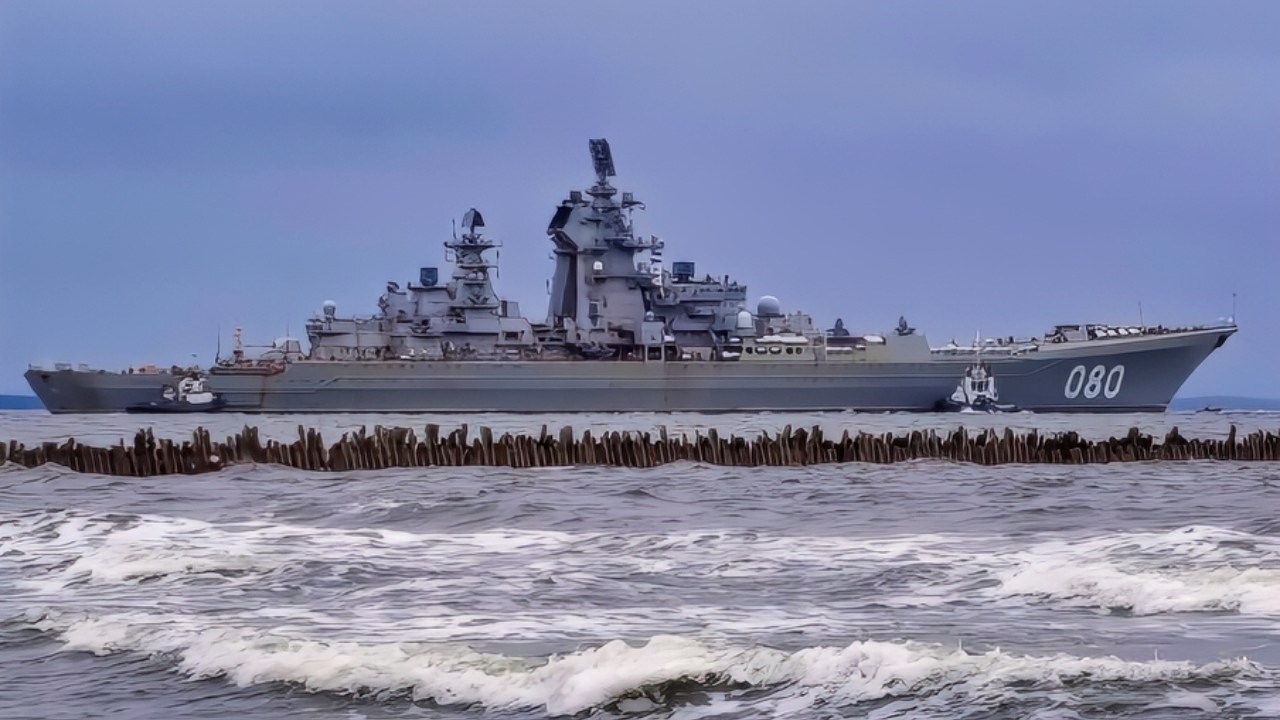
Kirov-Class Warship from Russia X Screenshot
What the Navy Wants the Trump-Class to Become
The Trump-class, based on what we know so far, appears to be something far larger than a traditional destroyer replacement.
Navy planning documents and comments made during official announcements have indicated that the ship is envisioned as a heavily armed missile arsenal vessel capable of carrying hypersonic weapons, advanced air defense systems, future directed-energy weapons, and potentially even nuclear-armed cruise missiles.
Nuclear propulsion also offers several major operational advantages for the vessel. Unlike conventionally powered destroyers, nuclear-powered ships can maintain high speeds for prolonged periods without requiring frequent refueling. They also generate enormous electrical power, something increasingly seen as essential for future naval combat systems such as railguns, large radars, and high-energy laser defenses. The program is coming at a critical time, too, as pressure mounts in the Pacific.
China’s naval modernization has accelerated dramatically over the past decade, with the PLA Navy now fielding large numbers of modern destroyers at a pace the United States has struggled to match. The Chinese Type 055 destroyer in particular is increasingly seen as one of the world’s most capable surface combatants, and it will be deployed alongside the new Type 003 Fujian supercarrier and the subsequent, nuclear-powered Type 004 and Type 005.
Meanwhile, the Navy’s own DDG(X) destroyer program continues to progress after years of delays, while the Zumwalt-class program collapsed from 32 planned ships to just three vessels after severe cost overruns and technical problems.

DDG(X) U.S. Navy. Image Credit: Creative Commons.
How Armed Will the Trump-Class Be?
The Trump class will be the most advanced battleship in history – but we don’t know how many missile cells it will feature.
Modern naval warfare is now heavily centered around missile saturation, and surface combatants are expected to simultaneously carry long-range air defense interceptors, anti-ship missiles, land-attack cruise missiles, ballistic missile defense interceptors, anti-submarine weapons, and potentially hypersonic strike systems.
That’s a lot, and it means vertical launch system capacity matters enormously.
MORE – ‘She Can Shoot Down an F-22’: China’s J-20 Stealth Fighter Has Arrived
MORE – China’s J-35A Stealth Fighter Has a Message for the U.S. Air Force
Yet despite the scale and projected cost of the Trump-class, the Navy has still not publicly disclosed how many VLS cells the ship will carry.
Some early concept material associated with the program referenced approximately 128 VLS cells alongside 12 Conventional Prompt Strike hypersonic launch tubes, though the final design has not been confirmed.
If those numbers are accurate, however, the Trump-class would ultimately carry significantly fewer missile cells than Russia’s modernized Kirov-class battlecruisers despite costing substantially more.
That comparison will be difficult to ignore as the Navy attempts to justify one of the most ambitious surface combatant programs in modern U.S. history.
About the Author: Jack Buckby
Jack Buckby is a British researcher and analyst specializing in defense and national security, based in New York. His work focuses on military capability, procurement, and strategic competition, producing and editing analysis for policy and defense audiences. He brings extensive editorial experience, with a career output spanning over 1,000 articles at 19FortyFive and National Security Journal, and has previously authored books and papers on extremism and deradicalization.


Adam
May 20, 2026 at 9:43 am
This is just fear mongering. There’s only 1 Kirov in service right now, and we know how Russia takes care of their ships. Russian ship-building capability is also virtually non-existent, so good luck making more.
Either way, battleships have been mostly obsolete for 80 years.
I doubt the Russian navy could threaten a European power, let alone the US.
What enemy is this designed to fight? Are they that afraid of the PLAN?
Paul
May 20, 2026 at 9:45 pm
Pretty spurious comparison– if BBG gets built (big if) it ostensibly will have a railgun for high velocity/high volume fire, as well as directed energy for offense and defense. Regardless of the odds of this being built to spec it’s clearly not designed as a missile-only platform.
JJ
May 21, 2026 at 12:50 pm
This news should’ve been titled: Grumpy, Senile Grandpa Needs More Recognition 🙄
Anyway, Trump should know that battleships are no longer the future of warfare, and they haven’t been for a pretty long time now.
That said, it’d be fun watching a Chinese ballistic carrier killer taking down Trump’s big chunk of scrap metal. But, of course, we all know Trump’s dreamy program will go straight to the trash as soon as he’s out of the picture in a couple of years.