

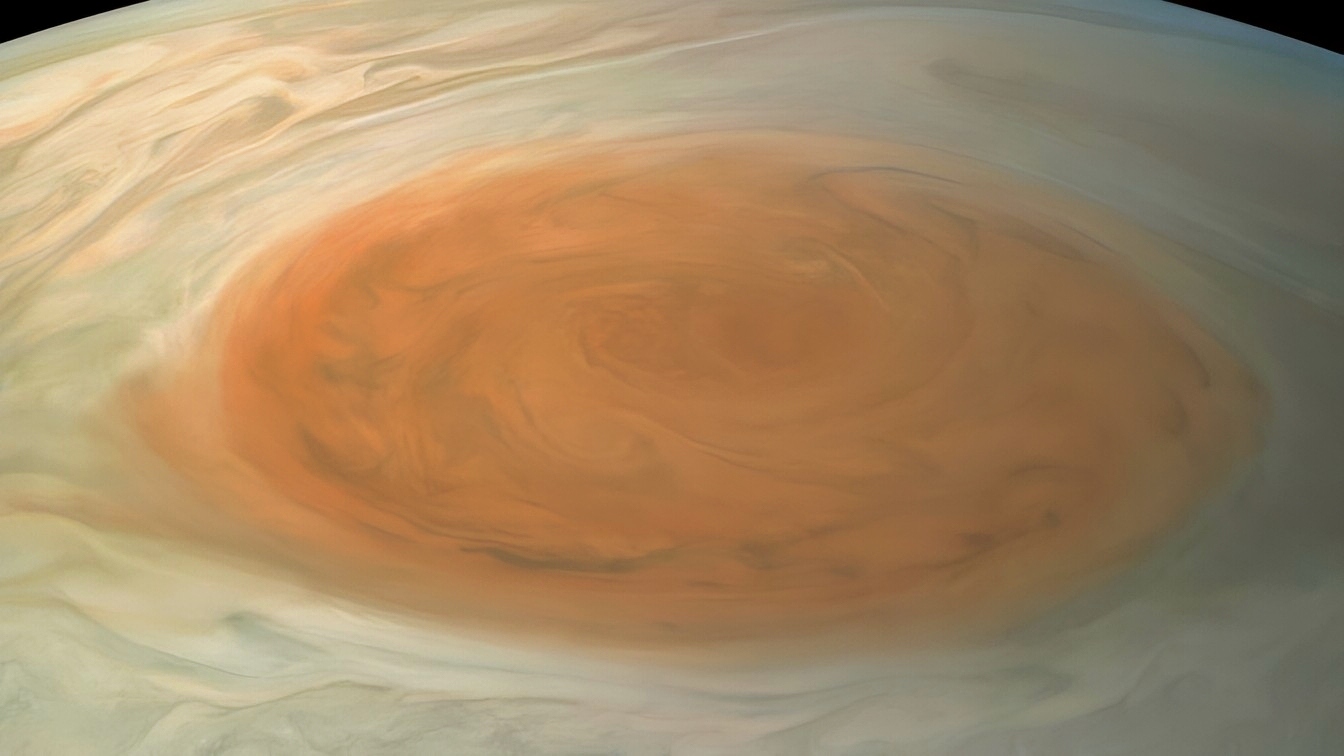
NASA’s Galileo spacecraft launched aboard Space Shuttle Atlantis on October 18, 1989 and reached Jupiter on December 7, 1995 after a six-year journey involving gravity-assist flybys of Venus and Earth. It became the first spacecraft to orbit an outer planet. Galileo’s atmospheric probe endured deceleration forces of nearly 228 Gs and temperatures of 15,000°C while measuring winds exceeding 400 mph inside Jupiter. The orbiter found strong evidence of a global liquid-water ocean beneath Europa’s ice and revealed Io as the most volcanically active body in the Solar System. NASA deliberately crashed Galileo into Jupiter on September 21, 2003 to prevent Earth microbes from contaminating Europa.
Galileo Crashed Into Jupiter On Purpose
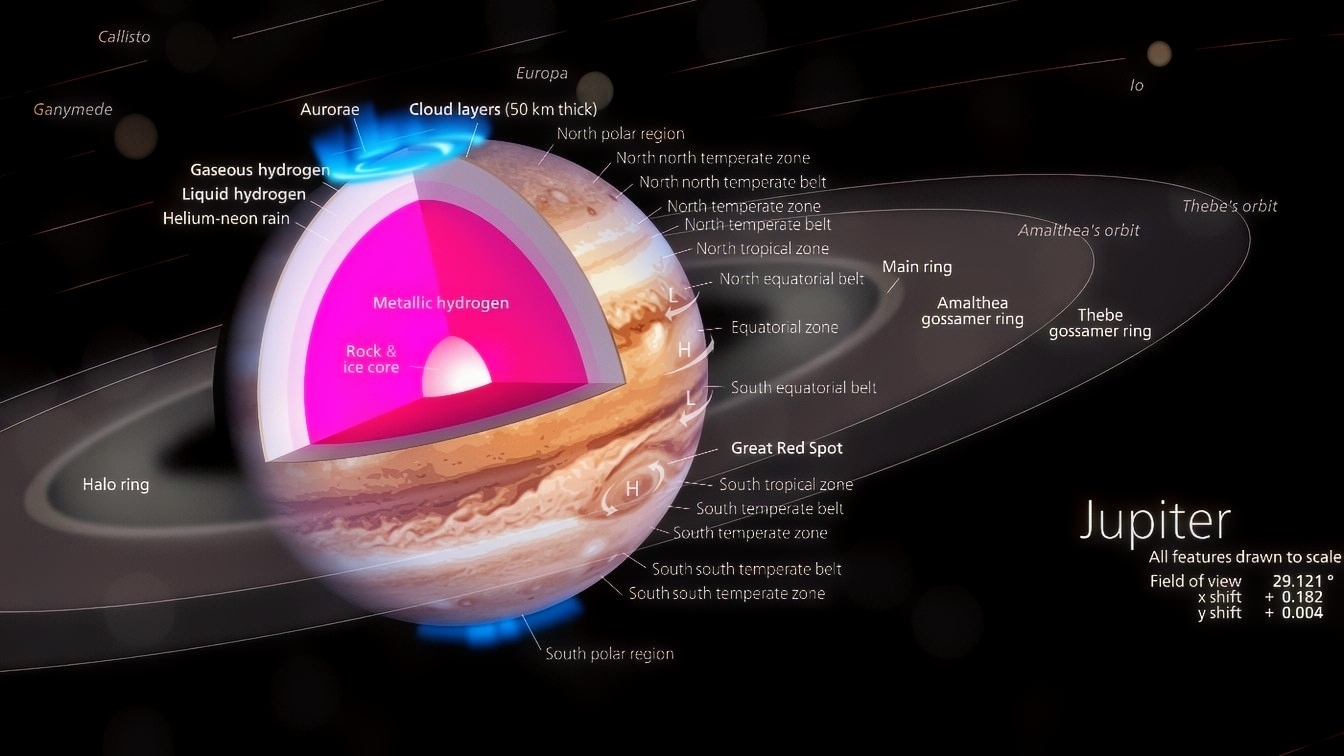
Jupiter. Image Credit: Creative Commons.
By the 1980s, NASA had sent several space probes past the planet Jupiter, but no probe had yet been sent to study the gas giant or its moons.
The spacecraft Galileo was built for that specific purpose. Designed to release probes into Jupiter’s atmosphere, Galileo was the first spacecraft to study the largest planet in the Solar System as well as its surrounding moons.
When its mission came to an end, the probe was intentionally destroyed in Jupiter’s atmosphere to avoid any potential contamination on its moons, which may be able to support life.
Designing the Galileo Spacecraft
Galileo’s design was highly sophisticated for its time, consisting of two main components: an orbiter and a separate atmospheric probe.
The orbiter was equipped with a wide range of scientific instruments, including cameras, spectrometers, and sensors to study magnetic fields, plasma, and charged particles, allowing it to analyze Jupiter, its magnetosphere, and its moons in detail.
It relied on radioisotope thermoelectric generators for power, since sunlight is too weak at Jupiter’s distance to use solar panels effectively.
The spacecraft also featured a large high-gain antenna intended to transmit large amounts of data back to Earth, although it famously failed to deploy properly after launch.
The attached atmospheric probe was designed to detach from the orbiter and descend into Jupiter’s atmosphere, protected by a heat shield and equipped with instruments to measure temperature, pressure, chemical composition, and wind speed during its brief transmission period.
Together, this dual-structure design allowed Galileo to perform both long-term orbital observations and direct atmospheric sampling, making it one of the most versatile deep-space missions ever built.
Launch and Transit to Jupiter
Galileo was launched aboard the Space Shuttle Atlantis on October 18, 1989.
Unlike earlier missions such as Pioneer and Voyager, which only flew past Jupiter briefly, Galileo was intended to remain in orbit and conduct a detailed investigation.
The spacecraft consisted of two main parts: an orbiter that would circle Jupiter and study its moons over time, and an atmospheric probe that would descend into Jupiter’s thick clouds to gather direct measurements.
The journey to Jupiter lasted over six years. Due to lessons learned following the Challenger disaster, Galileo could not be launched on a direct path. Instead, scientists used a series of gravity-assist maneuvers involving flybys of Venus and Earth to gradually build up speed.
Along the way, Galileo carried out important scientific observations.
It passed through the asteroid belt and made history by becoming the first spacecraft to closely observe an asteroid, encountering Gaspra in 1991 and later Ida in 1993. During the Ida flyby, Galileo discovered Dactyl, the first known moon orbiting an asteroid.
Arrival and Initial Probe Launch
Galileo finally reached Jupiter on December 7, 1995. As it approached the planet, it released its atmospheric probe, which plunged into Jupiter’s clouds at tremendous speed.
The probe experienced deceleration forces of nearly 228 Gs and reached temperatures of 15,000°C (27,000°F). Despite these insane forces, it transmitted data for nearly an hour as it descended deeper into the atmosphere, measuring temperature, pressure, chemical composition, and wind speeds.
Scientists found that winds exceeded 400 miles per hour and that the atmosphere contained less water than expected, challenging existing theories about Jupiter’s formation. Eventually, the probe was destroyed by the intense heat and pressure deep within the planet.
After releasing the probe, the orbiter successfully entered orbit around Jupiter, making Galileo the first spacecraft ever to orbit an outer planet.
This marked the beginning of its primary mission phase, which lasted from 1995 to 1997 and was later extended multiple times due to its scientific success.
Observation of Jupiter’s Moons
During its time orbiting Jupiter, Galileo conducted detailed studies of the planet and its four largest moons: Io, Europa, Ganymede, and Callisto. Each of these moons was revealed to be far more complex and interesting than previously thought.
Io was found to be the most volcanically active world in the Solar System, with massive eruptions and lava flows driven by tidal heating caused by Jupiter’s immense gravity. These observations showed that Io’s surface is constantly changing, making it a dynamic and extreme environment.
Europa, in contrast, appeared as a smooth, icy world crisscrossed with cracks and ridges. Galileo’s measurements provided strong evidence that a global ocean of liquid water exists beneath Europa’s frozen surface.
This discovery was one of the most important in the spacecraft’s mission, as it suggested that Europa could potentially support life. Ganymede was observed to possess a magnetic field, which suggested that the moon had an internal structure similar to Earth’s.
Castillos, scientists observed, was a particularly old moon with impact craters dating back billions of years and showed signs of a subterranean ocean.
Mission End
In addition to studying the moons, Galileo gathered extensive data about Jupiter itself.
The spacecraft examined the planet’s atmosphere, including its swirling clouds and massive storms like the Great Red Spot. It also studied Jupiter’s magnetosphere, the largest and most powerful in the Solar System.
These observations revealed a highly dynamic environment shaped by interactions between the planet’s magnetic field, its moons, and the solar wind.
Galileo’s mission was extended several times, ultimately lasting nearly 14 years from launch to completion.
During its extended mission phases, the spacecraft focused particularly on Europa and Io, gathering additional data that deepened scientific understanding of the Jovian system. The mission came to an end on September 21, 2003, when NASA deliberately directed Galileo to plunge into Jupiter’s atmosphere.
This decision was made to prevent the spacecraft from accidentally contaminating Europa with Earth microbes, since Europa was considered a potentially habitable environment.
MORE – China Has Thousands of Missiles to Point at Navy Aircraft Carriers
MORE – Canada’s F-35 Purchase Could Get Squashed
About the Author: Isaac Seitz
Isaac Seitz, a Defense Columnist, graduated from Patrick Henry College’s Strategic Intelligence and National Security program. He has also studied Russian at Middlebury Language Schools and has worked as an intelligence Analyst in the private sector.


