


Out of all the submarine stories I have worked on in nearly twenty years of defense publishing and running various national security outlets or think tank programs, this might just be the most chilling. To this day, it gives me goosebumps. But, as one engineer told me a few weeks back who worked on nuclear submarines in Groton, Connecticut, for several decades, “U.S. Navy submarines are the best on Earth, and they can take a pounding as they were built to fight the Soviet Union to the death.” Case in point: The USS San Francisco (SSN-711), a Los Angeles-class nuclear-powered attack submarine, struck an uncharted seamount approximately 360 nautical miles southeast of Guam on January 8, 2005. The boat was traveling at flank speed — somewhere between 30 and 33 knots — at a depth of 525 feet. The collision was head-on.
The submarine was four days into a routine transit from Apra Harbor, Guam, to Brisbane, Australia, where her crew of 137 was scheduled for a port visit and liberty call. Commander Kevin Mooney, the boat’s commanding officer, had gone to lunch when the impact occurred. The control room watch team was running a normal submerged transit. The submarine was operating with passive sonar — listening, not transmitting — because no enemy threat was present and active sonar was generally reserved for combat operations.

Apra Harbor, Guam (Jan. 27, 2005) USS San Francisco (SSN 711) in dry dock to assess damages sustained after running aground approximately 350 miles south of Guam Jan. 8. USS San Francisco, a fast-attack submarine, is attached to Submarine Squadron 15. U.S. Navy photo by Photographer’s Mate 2nd Class Mark Allen Leonesio.
The route had been plotted on charts showing open ocean ahead. The charts were wrong.
How The USS San Francisco Hit An Underwater Mountain At Full Power — And Why The Submarine Came Home Anyway
The impact crushed the submarine’s forward ballast tanks. The sonar dome at the bow was destroyed. The forward bulkhead buckled inward. Crew members throughout the boat were thrown across compartments with enough force to break bones, dislocate shoulders, and inflict serious head injuries. Ninety-eight of the 137 men aboard were injured. Machinist’s Mate 2nd Class Joseph Allen Ashley, age 24, sustained fatal head injuries and died at the U.S. Naval Hospital in Guam two days later.
Why The Submarine Survived
The collision was the worst underwater submarine grounding the U.S. Navy has experienced in three decades. It also produced an outcome that submariners consider a study in how American submarine engineering is supposed to work when something goes catastrophically wrong.
The pressure hull held. The forward ballast tanks were destroyed but the watertight bulkhead immediately aft of them held. Compartmentation — the engineering principle of subdividing a submarine into multiple sealed sections so that flooding in one area cannot propagate to the rest of the boat — performed exactly as 1970s Los Angeles-class architecture had been designed to do. The nuclear reactor remained operational and unaffected. The boat retained enough buoyancy to surface.

The Los Angeles class submarine USS San Francisco (SSN 711) shown in dry dock is having repairs made on its damaged bow. A new large steel dome about 20 feet high and 20 feet in diameter was put in the place of the damaged bow. San Francisco ran aground 350 miles south of Guam Jan. 8, killing one crew member and injuring 23. U.S. Navy photo (RELEASED)
According to the U.S. Pacific Fleet’s initial release on the incident, the San Francisco was on the surface and making best speed toward Guam within hours of the collision. There were no reports of damage to the reactor plant. Military and Coast Guard aircraft were inbound to monitor the situation.
The damage-control teams below decks were doing the harder work. Triage stations were set up in cramped compartments to treat the injured. Sailors ran emergency procedures by muscle memory — pressurization checks, leak surveys, electrical isolation, and compartment-by-compartment damage assessment. The boat was moving, but barely.
Fifty-Two Hours Back To Guam
The San Francisco reached Apra Harbor on the morning of January 10, 2005, nearly fifty-two hours after the impact. The submarine’s best sustained speed on the surface transit was approximately 10 miles per hour — a fraction of what she had been capable of just days earlier. Crews from other submarines moored in Guam lined their decks in honors as the San Francisco came in, a submariner’s gesture rendered to a boat that came home under its own power.
The damage was visible from the dock. The forward ballast tanks were crushed. The sonar sphere was gone. As reporter Robert Hamilton later documented, the forward bulkhead had buckled inward, and the deck immediately aft of the bulkhead was visibly distorted. Total damage was eventually estimated at approximately $88 million.
What Actually Caused It
The Navy released its 124-page investigation report on May 9, 2005. The findings were direct.

(June 11, 2025) – The Los Angeles-class fast-attack submarine USS Annapolis (SSN 760) transits Apra Harbor, Naval Base Guam, June 11, 2025. Assigned to Commander, Submarine Squadron 15, based at Polaris Point, Naval Base Guam, Annapolis is one of five forward-deployed fast-attack submarines. Renowned for their unparalleled speed, endurance, stealth, and mobility, fast-attack submarines are the backbone of the Navy’s submarine force. Regarded as apex predators of the sea, fast-attack submarines serve at the tip of the spear, helping to reaffirm the submarine force’s forward-deployed presence in support of a free and open Indo-Pacific. (U.S. Navy photo by Lt. James Caliva)
The seamount had not appeared on the chart in active use aboard the San Francisco.
Earlier coverage of the incident at the Australian Naval Institute and other defense outlets documented that the seamount did appear on other charts the submarine had aboard — including satellite-derived gravity anomaly data that identified the feature as a “potential hazard” approximately two miles from the actual collision point.
The institutional failure was the navigation team’s reliance on a single primary chart. The official Pacific Fleet release on the investigation completion concluded that the submarine’s leaders and watch teams had failed to develop and execute a safe voyage plan. The voyage plan had not been built around the worst-case interpretation of conflicting cartographic data. The submarine had transited at flank speed through an area where multiple data sources suggested potential undersea hazards.
A post-mortem published the same year by the Naval Submarine League framed the broader institutional issue. Lessons from earlier submarine groundings had effectively been forgotten. Procedures that previous generations of submarine officers had learned the hard way were not being consistently institutionalized in modern training.

(Dec. 10, 2010) The Los Angeles-class attack submarine USS Houston (SSN 713) takes part in a photo exercise as part of Keen Sword 2011. Keen Sword is a joint, bilateral exercise designed to strengthen Japan-U.S. military operations. (U.S. Navy photo by Mass Communication Specialist 3rd Class Casey H. Kyhl)
Cmdr. Mooney was relieved of command and issued a letter of reprimand. Six crew members went to non-judicial punishment hearings and received reductions in rank.
The Bow Transplant
The U.S. Navy faced a choice. Decommission a fully refueled boat with another 12 years of nuclear core life remaining, or attempt one of the most ambitious submarine repair projects in modern history.
The Navy chose to repair. The plan was to cut the entire bow section off the soon-to-decommission USS Honolulu (SSN-718) and transplant it onto the San Francisco at Puget Sound Naval Shipyard.
According to the official Navy release on the undocking, the project required cutting more than one million pounds of forward ballast tanks and sonar spheres off the Honolulu and attaching them to the San Francisco. In some areas, the structural mating had to be precise to within one-sixteenth of an inch. The submarine entered dry dock on December 5, 2006, and undocked on October 10, 2008 — nearly three years of yard work.
The cost was approximately $79 million. Refueling and overhauling the Honolulu’s reactor instead would have cost approximately $170 million. The math was straightforward.
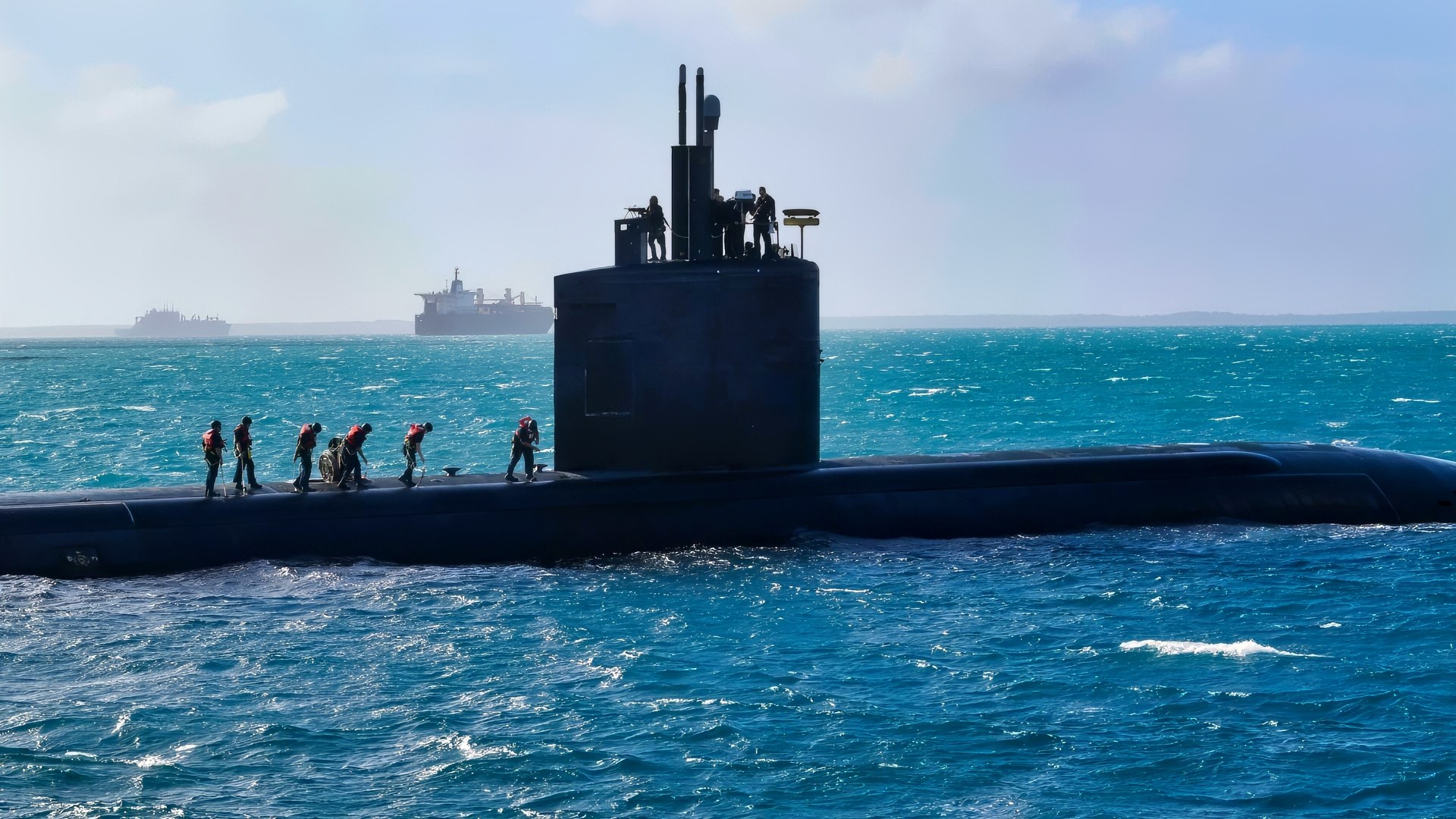
DIEGO GARCIA, British Indian Ocean Territory (Aug. 21, 2020) – USS Greeneville (SSN 772) enters Diego Garcia’s harbor Aug. 21, 2020. Sailors assigned to U.S. Navy Support Facility (NSF) Diego Garcia provided mail delivery and trash disposal for Greeneville. NSF Diego Garcia provides logistic, service, recreational and administrative support to U.S. and Allied Forces forward deployed to the Indian Ocean and Arabian Gulf. U.S. Navy Photos by Mass Communication Specialist Seaman Michael T. Porterfield. (Released)
The San Francisco completed sea trials in April 2009 and resumed fleet operations from Naval Base Point Loma in San Diego. Her post-repair operational record included multiple Western Pacific deployments across the next seven years. Her final operational deployment ended in October 2016. She was decommissioned in November 2016 and converted to a moored training ship at the Navy’s Nuclear Power Training Unit in Charleston, South Carolina — a final assignment that lets new submariners train aboard a boat that survived something no other modern American submarine has.
What The Navy Learned
The San Francisco grounding reshaped American submarine navigation procedures over the decade that followed. Voyage planning now requires cross-referencing all available cartographic sources rather than relying on a single primary chart. Watch teams must build what is referred to inside the submarine force as a comprehensive picture of bottom hazards using every available data source. Faster transits through areas with uncertain hydrographic data are restricted by procedural changes that did not exist in 2005.
The structural lesson is the simpler one. The American Los Angeles-class submarine, designed in the 1970s, absorbed a head-on collision with a mountain at full power and brought 136 of 137 men home alive. The pressure hull held. The compartmentation worked. The damage control training paid for itself across 52 hours of careful seamanship on the surface transit back to Guam. The submarine that hit the mountain is now a training boat in Charleston. The men who survived the impact still tell the story.
About the Author: Harry J. Kazianis
Harry J. Kazianis (@Grecianformula) was the former Senior Director of National Security Affairs at the Center for the National Interest (CFTNI), a foreign policy think tank founded by Richard Nixon based in Washington, DC. Harry has over a decade of experience in think tanks and national security publishing. His ideas have been published in the NY Times, The Washington Post, The Wall Street Journal, CNN, and many other outlets worldwide. He has held positions at CSIS, the Heritage Foundation, the University of Nottingham, and several other institutions related to national security research and studies. He is the former Executive Editor of the National Interest and the Diplomat. He holds a Master’s degree focusing on international affairs from Harvard University.


