

A little-known Cuban state-run organization is the main lifeline for the privileged elite of the Communist party and a circle of military officials around former president and defense chief Raúl Castro. With the US Trump Administration preparing to use all possible pressure points to force a change in the regime, this critical entity is now in Washington’s crosshairs.
Donald Trump’s Plan to Make Cuba Pay
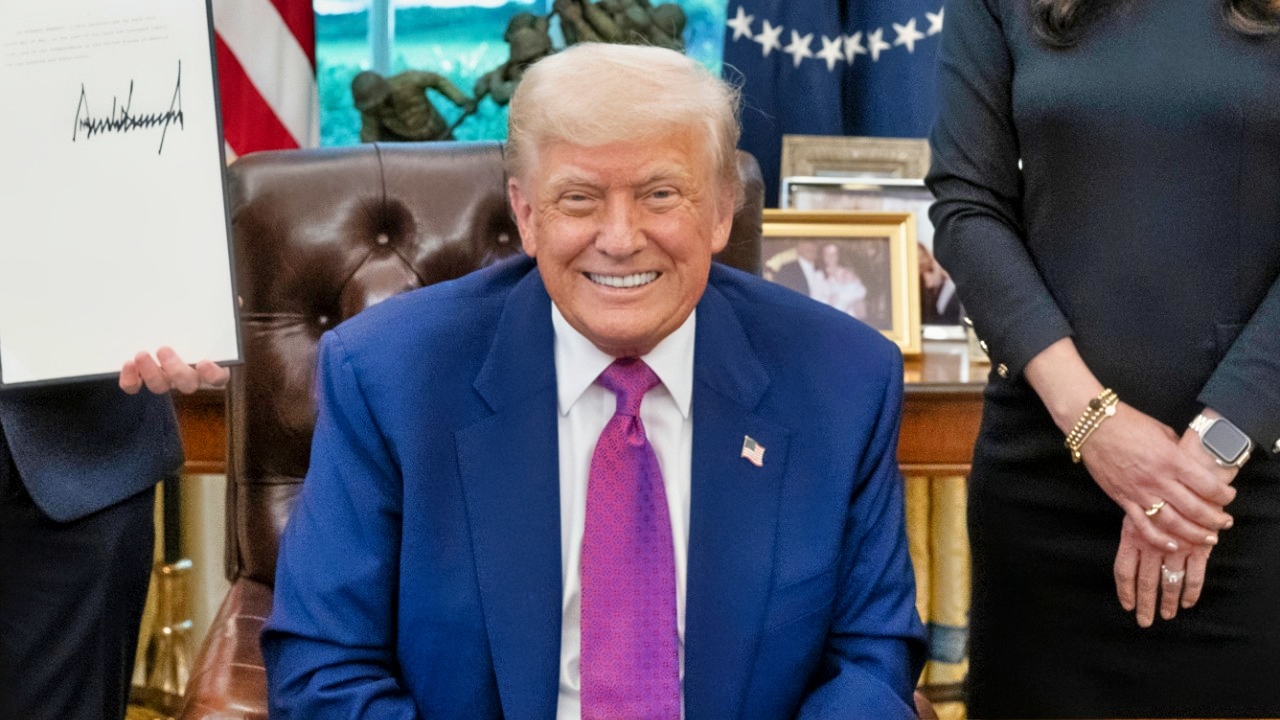
President Donald J. Trump holds a bill signing with members of Congress, Friday, May 9, 2025, in the Oval Office. (Official White House Photo by Molly Riley)

President Donald Trump is joined by Secretary of Commerce Howard Lutnick, Vice President JD Vance, British Ambassador Peter Mandelson, U.S. Trade Representative Jamieson Greer, and Secretary of Agriculture Brooke Rollins, while announcing a trade agreement with the U.K., Thursday, May 8, 2025, in the Oval Office. (Official White House Photo by Emily J. Higgins)
Cuba is not unique in this respect. Every totalitarian dictatorship has a “special export” company that handles international trading and makes real money in hard currency. They are the iron lung that keeps these regimes alive and provides a luxury lifestyle that the average citizen can only dream of. The company is also usually a monopoly to one degree or another and has connections to the military and intelligence services – sometimes personnel from one or both organizations run this company.
In Russia, this is the famous Rostec, run by the longtime Friend of Vlad, Sergei Chemezov. The two date back to the days when they were both KGB officers assigned to the East German backwater of Dresden.
And there are plenty of other examples around the world.
Until the country began making billions supplying Russian President Putin with munitions, missiles, and military manpower, the Democratic People’s Republic of Korea (DPRK) had used the secretive Office 39 that provides for the country’s well-heeled Korean Workers’ Party leadership. Iran has a coterie of trading companies controlled by the Islamic Revolutionary Guards Corps (IRGC). The People’s Republic of China (PRC) has the State-Owned Assets Supervision and Administration Commission, which oversees the communist nation’s state-owned enterprises (SOEs).
In the island communist nation of Cuba, the entity that falls into this category is Grupo de Administración Empresarial S.A., commonly known by its acronym, GAESA.
Those in the know in Cuba are well aware of the organization’s dealings, but officially, it almost does not even exist.
“It is a state within a state,” said a retired NATO nation military intelligence official who has visited the island several times. “All of the horror stories you read today about power blackouts 22 out of every 24 hours, food shortages, unavailability of decent medical supplies, people being told to fill their bathtubs to stock up on water before that service collapses, etc. GAESA makes sure that the nation’s senior leadership and other elites remain unaffected by these hardships.”
A Low Profile
A profile of the organization shows the degree to which GAESA is kept in the low-profile mode.
When state-run media talks about how “the new Government Program recently presented by the Cuban authorities aims to reduce inflation and the fiscal deficit, and to address monetary issues,” GAESA is never mentioned. “It does not even mention the GAESA military conglomerate or consider its key role in the national economy,” reads the profile.
Almost no details were known of the organization’s economic impact and status until last year, when the Miami-based, Spanish-language El Nuevo Herald published information based on a leak of financial statements. The balance sheets for 2023 and 2024 show that GAESA’s gross profits amount to 37 percent of Cuba’s GDP.
Therefore, more than one-third of the country’s total value added is generated within this military conglomerate. It also dominates the country’s most strategic and profitable economic sectors and controls most of the tourism industry; it uses its affiliates, CIMEX and TRD Caribe, to control retail and wholesale trade, and, through RAFIN S.A. and the Banco Financiero Internacional (BFI), it controls the Cuban financial system.
GAESA’s total revenues are also 3.2 times the annual revenues of the entire Cuban State Budget, and this military-run business conglomerate holds USD 14.5 billion in liquid dollar reserves. Yet, it is not subjected to audits by the state’s Office of the Comptroller General, nor does it report to any committees of the Cuban National Assembly, the federal parliament.
Washington Closing Its Grip
The Trump Administration has recently decided to clamp down on the organization, with the US Secretary of State Marco Rubio using the X platform to deliver a message to the Cuban people. Speaking in the native Cuban dialect of Spanish that he learned from his parents, the US chief diplomat laid bare the extent to which GAESA controls everything of value on the island and is the body responsible for keeping the population impoverished.
On 22 May, US Immigration and Customs Enforcement (ICE) in Miami arrested Adys Lastres Morera, the sister of the Cuban military officer who runs GAESA. The US State Department has revoked her green card, and she is being held in an ICE detention center. Rubio has said Lastres Morera was “managing real estate and living in Florida, while also aiding Havana’s communist regime.” A Miami Herald analysis of public records has revealed that she was the registered agent or manager for at least two Florida-based companies.
“The next shoe to drop will be how far the actions to strangle GAESA are pursued against companies working and cooperating with them here in the US,” said a leading figure in Miami’s Cuban exile community who spoke to National Security Journal. “Take a look at the companies that are on 8th Street in downtown and their links to GAESA and some of its senior executives.”
“There is a lot of work to be done there. Just do that, and you would see a real drop in the ability of the Cuban state to continue to condemn its people to the misery they face every day just trying to survive,” he stated.
About the Author: Reuben F. Johnson
Reuben F. Johnson has thirty-six years of experience analyzing and reporting on foreign weapons systems, defense technologies, and international arms export policy. Johnson is the Director of Research at the Casimir Pulaski Foundation. He is also a survivor of the Russian invasion of Ukraine in February 2022. He worked for years in the American defense industry as a foreign technology analyst and later as a consultant for the U.S. Department of Defense, the Departments of the Navy and Air Force, and the governments of the United Kingdom and Australia. In 2022-2023, he won two awards in a row for his defense reporting. He holds a bachelor’s degree from DePauw University and a master’s degree from Miami University in Ohio, with a specialization in Soviet and Russian studies. He lives in Warsaw.


