


If war between Taiwan and China erupted, the Chinese military would unleash wave upon wave of drones across multiple domains to deplete Taiwanese defenses and sap Taiwan’s finite supply lines. This attack would all be in advance of a massive Chinese invasion of Taiwan. The island is well defended and fortified, thanks to its decades-long alliance with the United States. Beijing understands that it must first drain those defenses and weaken the island’s resolve.
The first step would be for China’s military to salami slice the outlying Taiwanese islands of Matsu, Penghu, and Kinmen. Once China removed those tiny outlying islands from Taipei’s control, the Chinese People’s Liberation Army Navy (PLAN) would likely impose a stiff blockade around the island, cutting the island off from the rest of the world, daring the Americans and their regional allies to attack the Chinese flotilla assembled outside Taiwan.
China’s A2/AD Trap In the First Island Chain

China UUV Drones. Image Credit: X Screenshot.
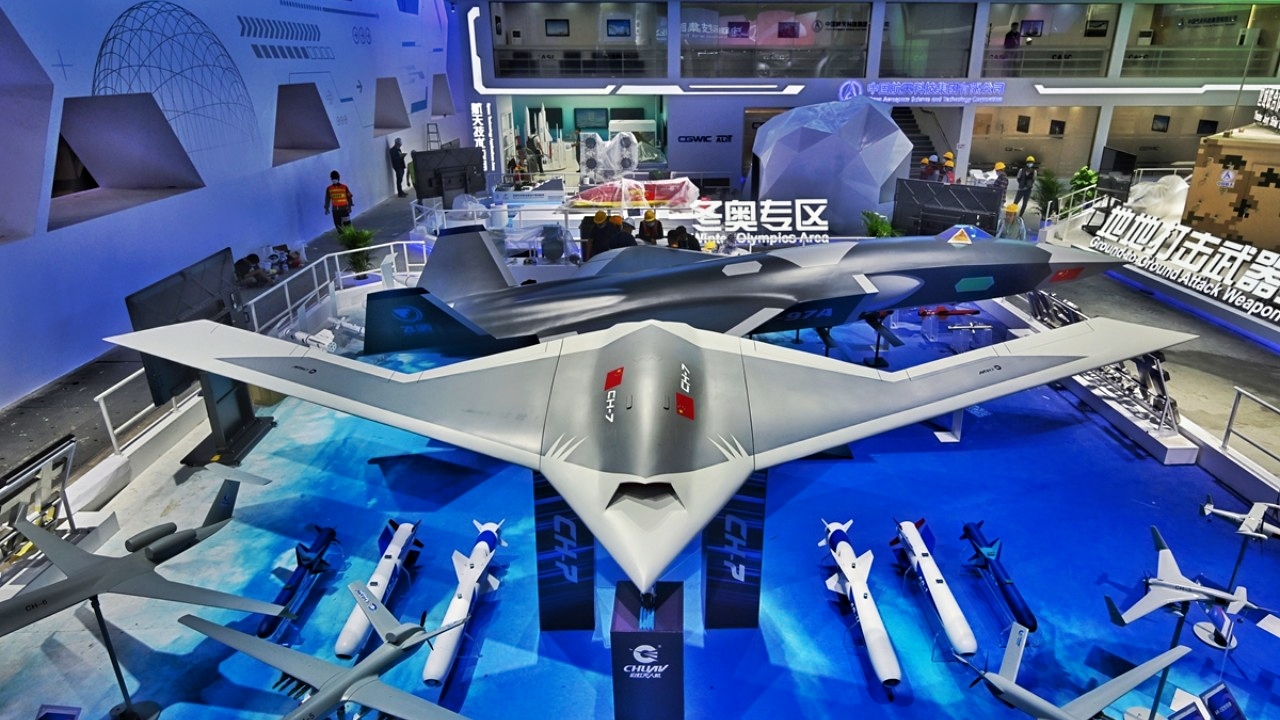
CH-7 Drone from China. Image Credit: Chinese Government

CH-7 Drone from China. Image Credit: Creative Commons.
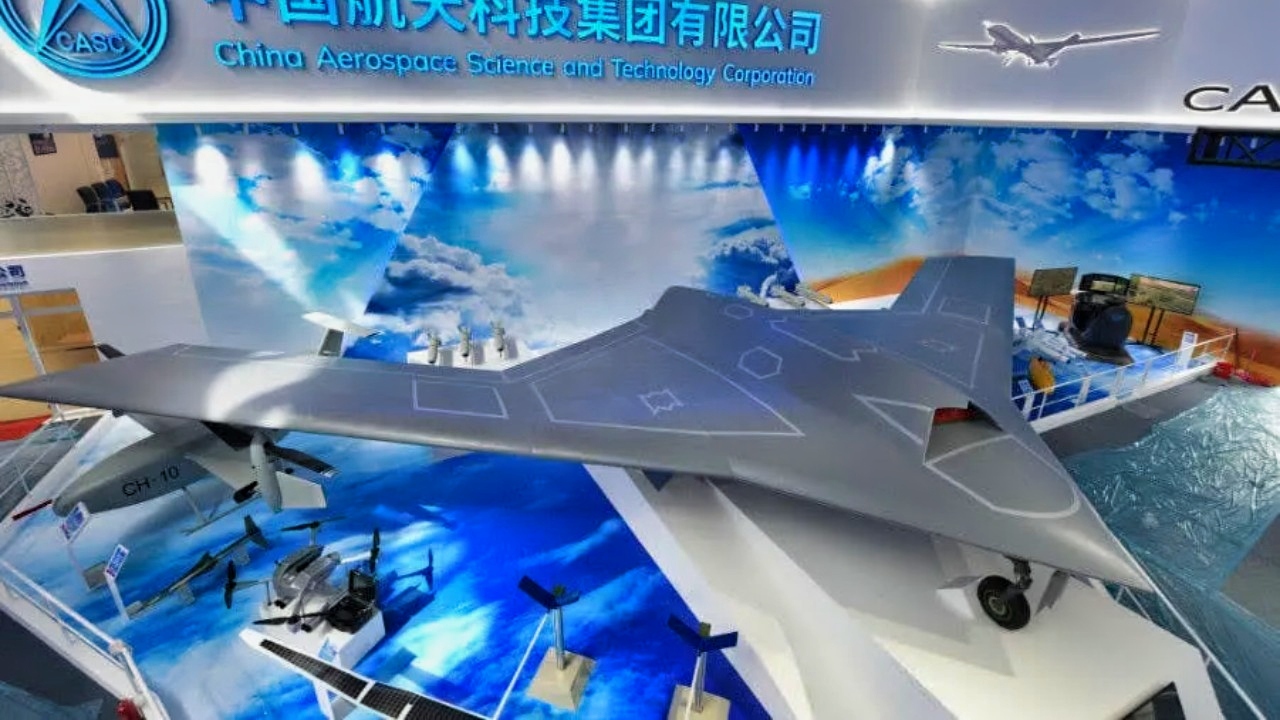
CH-7 Drone from China. Image Credit: Creative Commons.
All the while, the Chinese anti-access/area-denial (A2/AD) network that covers the First Island Chain (the regions extending from the Kamchatka Peninsula through Japan and Taiwan down to the Philippines) can sink any American aircraft carrier that gets within range or destroy any of the American airbases in the region, notably the facilities on Guam.
As those outside elements figured out what to do about the Chinese blockade, Beijing’s forces would deploy massive drone swarms against Taiwan’s defenses.
Because of their alliance with the West, Taipei enjoys access to advanced air defense systems as well as other top weapons platforms. But these systems are expensive and are not available in large numbers. Therefore, if China drained the capacity of those systems or outright destroyed them at the outset of any fight, Taiwan’s defenses would break. It’d be up to Taiwanese people to fight the massive Chinese invasion force.
How China Plans to Exhaust Taiwan’s Air Defenses
China’s military intends to use waves of attritable drones (and some older jet fighters converted into unmanned systems) to overwhelm the exquisite Western-provided air defenses of Taiwan.
By getting Taiwan’s air defenses to exhaust expensive surface-to-air interceptors on cheap, expendable unmanned systems, China gets the Taiwanese to blow through their limited supply of air defenses before the Chinese warplanes and bombers attack.
Those manned, more expensive planes will then have a much easier time hitting targets on the island because the attritable drones depleted the expensive Western air defenses of Taiwan.
This level of depletion occurred to some extent in the Ukraine War, but was far more pronounced in the ongoing Iran War. The Chinese have taken copious notes of the US-Israeli and Iranian experiences with drones and depletion of critical air defenses in the Iran War. They are dutifully applying those lessons to China’s own war plan for taking Taiwan over.
AI Drones, Maritime Swarms, and China’s Robotic Army
More advanced drones equipped with artificial intelligence (AI) would coordinate large-scale electronic warfare (EW) and intelligence, surveillance, and reconnaissance (ISR) mission sets against Taiwanese defenders.
Don’t forget undersea and surface drones that would engage in minelaying operations at strategic chokepoints, further to block the island from the rest of the world. In fact, China could use these drones to blockade more distant areas, such as the Bashi Channel, to further slow any potential Western military response.
China’s maritime drones could serve as decoys, luring Taiwanese defenders into tracking them while larger, high-value PLAN warships operated unmolested.
Then, there’s the growing army of advanced military ground robots that the Chinese are developing. These systems are AI-equipped and come in various forms, such as four-legged dogs, and some are even humanoid. These ground drones will scout ahead, clear any obstacles, and carry supplies for initial frontline troops.
Taiwan’s Hellscape Defense Plan
Taiwan will not be completely helpless, of course. Taiwan’s military, in conjunction with the United States Armed Forces, has a plan codenamed “Hellscape.”
This lovely-sounding defense plan aims to turn the besieged island into a porcupine. The US military has based this defense strategy on lessons learned from the war in Ukraine. Taiwan’s defenders must make their island into an impenetrable kill box. If Taiwan is to stop a Chinese invasion, it must sink or deactivate enough of China’s PLAN invasion fleet that Beijing abandons the endeavor entirely.
Taiwan’s military has divided the plan into four geographical zones off the Taiwanese coast. Employing long-range drones and missile barrages, Taiwan’s plan is similar to China’s. Like China’s plan to use drones against Taiwanese defenses, Taiwan’s “Hellscape” model intends for their drone and missile swarms to overwhelm the defenses of China’s invasion fleet.
If some of that fleet survived and continued toward the island, then smaller, kamikaze drones fired in dense waves, and uncrewed naval boats would deploy against whatever remained of China’s invasion fleet.
It’s the best of bad options for Taiwan.
Taiwan May Not Be Ready In Time
As with so many great ideas in the West today, though, it’s coming far too late in a very dangerous game. Taiwan is deploying the initial phases, but the full-scale network will not be ready until closer to 2030, with some analysts believing the bulk of the system will be online by 2027, the year that US intelligence believes China could reliably launch an invasion of the island.
Even then, Taiwan will be poorly prepared for the kind of pummeling China intends to inflict on it. Further, very technically, China is ready to blockade and invade Taiwan this year.
Why Xi Jinping May Decide Not to Invade
Here’s where things get interesting (and somewhat hopeful for those who don’t want to see a regional war). While it looked, over the last few years, as though Beijing was leaning hard toward attacking Taiwan, there are now changes afoot on the island and within the wider global system that might hold Beijing’s hand.
Pro-engagement voices within Taiwan’s political system, notably among young people, are gaining prominence. These voices are also skeptical of Taipei’s closeness with Washington. As time progresses, those young people will become the dominant players in Taiwan’s political scene. All of which favor China in its goal of reintegrating Taiwan.
Plus, the Iran and Ukraine Wars have demonstrated that larger powers struggle against entrenched smaller foes. Contrary to his image as a revolutionary Marxist at heart, President Xi Jinping is pragmatic and cautious. He saw Russia become bogged down in Ukraine (although, to be clear, Russia is still winning but at great cost).
Similarly, Xi has watched as the Americans humiliated themselves once more in the geopolitical quicksand of the Middle East in the Iran War.
And the Iran War has proven that American power is imploding. So, over the next decade, if China plays its cards right, Beijing will likely have a much freer hand to operate in its part of the world as they see fit.
Xi’s ultimate goal is to have Taiwan’s productive and economic power absorbed into the People’s Republic of China.
Why risk destroying the island in a costly war–possibly damaging his own political power in the process–if the specter of the American threat is vanishing and the next generation of Taiwanese is far friendlier to China than is the current generation of Taiwanese?
A War That Would Bring Hell on Earth
For all the plans of China’s drone war and the “Hellscape” that American strategists intend to visit upon Taiwan, it seems less likely in light of the Ukraine and Iran Wars that China will risk invading Taiwan over the next five years, not more likely.
And that’s a good thing because the kind of conflict described in the paragraphs above would truly bring hell on Earth, not only for China and Taiwan, but for the world (because there’s no way that war would remain localized).
About the Author: Brandon J. Weichert
Brandon J. Weichert is a Senior National Security Editor. Recently, Weichert became the editor of the “NatSec Guy” section at Emerald. TV. He was previously the senior national security editor at The National Interest. Weichert hosts The National Security Hour on iHeartRadio, where he discusses national security policy every Wednesday at 8 p.m. Eastern. He hosts a companion show on Rumble entitled “National Security Talk.” Weichert consults regularly with various government institutions and private organizations on geopolitical issues. His writings have appeared in numerous publications, among them Popular Mechanics, National Review, MSN, and The American Spectator. And his books include Winning Space: How America Remains a Superpower, Biohacked: China’s Race to Control Life, and The Shadow War: Iran’s Quest for Supremacy. Weichert’s newest book, A Disaster of Our Own Making: How the West Lost Ukraine, is available for purchase at any bookstore. Follow him via Twitter/X @WeTheBrandon.


Madam DeFarge
May 25, 2026 at 6:24 pm
China has been actively war gaming on how to take Taiwan in 30 minutes or less for years. They figure if they take it that fast the US will not respond.