


Tanks are officially evolving from heavy Cold War-era brawlers into networked, semi-autonomous battlefield systems that are built for drone-saturated combat zones rife with lethal anti-tank munitions. This evolution was a long coming. And the Russians were the first major power to make the shift (because they have been engaged in a major war in Ukraine since February 22, 2022).
Now, the Western powers are doing their best to catch up to the adaptations their rivals are making in the arena of tank warfare.

K3 Tank from South Korea National Security Journal Photo.

K3 Full Scale Model National Security Journal Photo.

K3 Detailed Model View Image by National Security Journal.
Some Western tanks are more realistic in their adaptations to the dynamic modern battlefield than others. Take, for instance, the next-generation M1E3 Abrams Main Battle Tank (MBT) versus South Korea’s K3 “stealth tank” concept MBT. Whatever issues the Americans may be struggling with regarding the United States’ ailing defense industrial base, their tank is far more realistic–and useful–on the modern battlefield than the South Korean system.
The Big Picture: Two Very Different Design Philosophies
The M1E3 Abrams and South Korean K3 are not merely upgrades to older-generation tanks (despite the M1E3 Abrams retaining the name of its iconic predecessor). These two systems represent two fundamentally different categories of military thought.
America’s M1E3 Abrams is a far more pragmatic redesign of the Abrams MBT. The United States Army concluded that the older M1A2 SEPv4 modernization path had become too heavy, too fuel-hungry, and too complex to sustain. So the Army pivoted toward a lighter, more modular, hybrid-electric tank optimized for survivability and logistics.
South Korea’s K3, on the other hand, is basically an entirely new concept. And, in fact, we saw what amounts to a small model of the K3 last year at a defense expo in Poland. We present the photos we took in this article.
Dubbed a “future tank” concept, the system is designed by South Korea’s Hyundai Rotem. South Korean defense planners envision the K3 as more of a stealthy robotic combat node than a traditional MBT. The K3 is designed to reduce radar, thermal, and acoustic signatures while integrating artificial intelligence-assisted targeting, autonomous systems, and hydrogen propulsion.
That last part is key.
It’s also an outgrowth of Hyundai’s heavy investment in hydrogen fuel technology for its civilian car fleet. In fact, both the United States and South Korea have looked at developing more sustainable fuel-driven tanks. The M1E3 comes equipped with hybrid-electric propulsion (unlike your hybrid-propulsion car, though, the engine is unlikely to stop every time the driver stops the tank at a road crossing or as part of an ambush, because of the Abrams’ “performance hybrid” system).
The M1E3 Abrams: America’s Attempt to Save the Tank
Since the M1 Abrams remains one of the most iconic, combat-proven MBTs in history, the Americans are understandably unwilling to part with it so easily. Still, one of its greatest weaknesses is the tank’s weight. The latest variants, for example, exceed 70 tons. That weight creates enormous logistical burdens and makes rapid deployment of these systems (to say nothing of maintaining them in rough combat conditions) difficult.
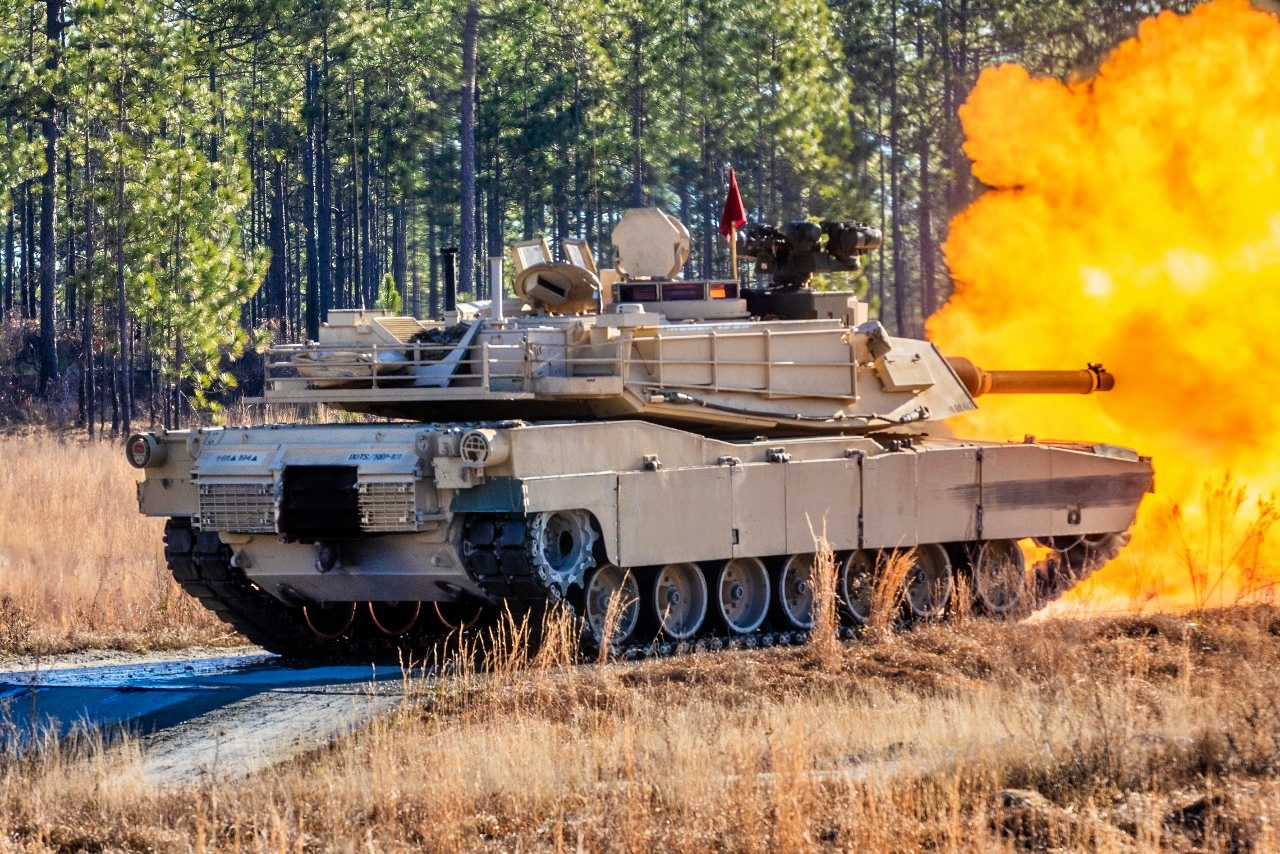
Soldiers from Echo Company, 1st Battalion, 81st Armor Regiment, 194th Armored Brigade, conduct gunnery training with the M1 Abrams tank, Jan. 14, 2025, at Brooks Range, on Fort Benning, Georgia. (U.S. Army photo by Joey Rhodes II)
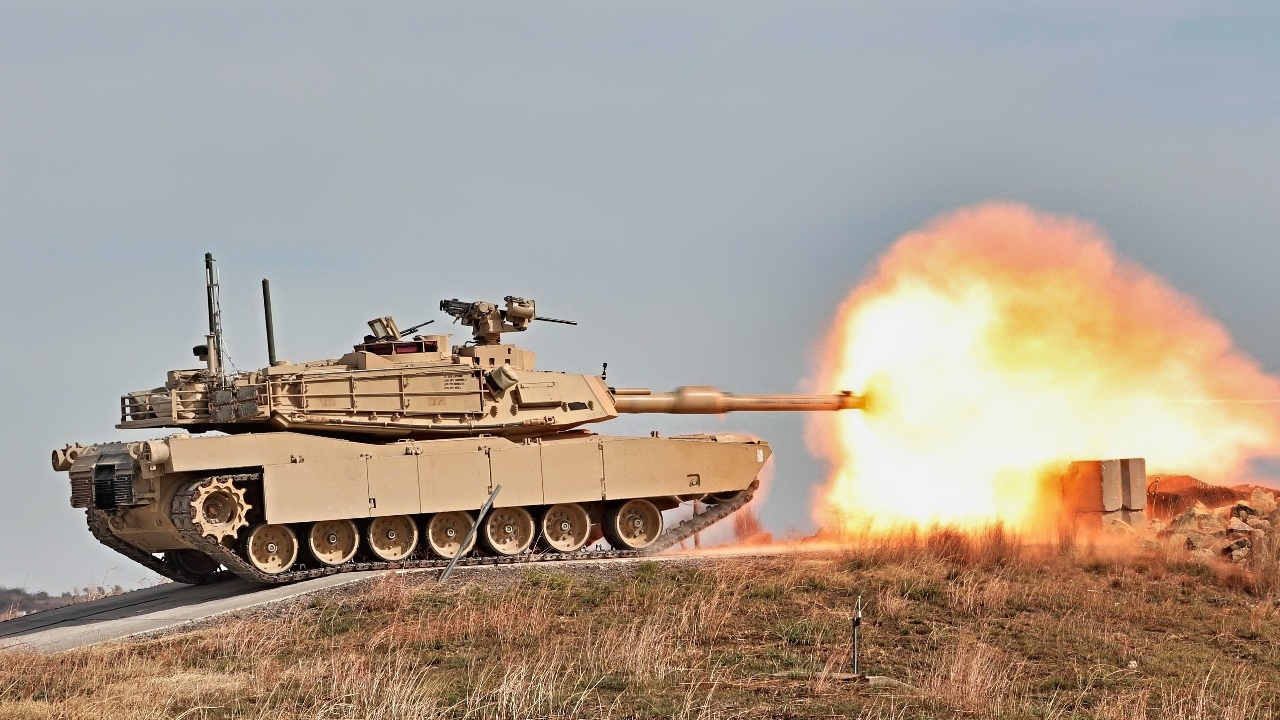
An M1A1 Abrams tank operated by Soldiers with the 2nd Battalion, 70th Armored Regiment, 2nd Armored Brigade Combat Team, 1st Infantry Division, fires over a barricade at the Douthit Gunnery Complex on Fort Riley, Kansas, Oct. 20, 2022. The tank crew was conducting gunnery qualification. (U.S. Army photo by Sgt. Jared Simmons)

CINCU, Romania – U.S. Army Soldiers of 1st Battalion, 66th Armored Regiment, 3rd Armored Brigade Combat Team, 4th Infantry Division, setup their M1 Abram Tanks during Getica Saber 17, July 10, 2017. Getica Saber 17 is a U.S.-led fire support coordination exercise and combined arms live fire exercise that incorporates six allied and partner nations with more than 4,000 Soldiers. Getica Saber 17 runs concurrent with Saber Guardian 17, a U.S. Army Europe-led, multinational exercise that spans across Bulgaria, Hungary and Romania with more than 25,000 service members from 22 allied and partner nations. Image Credit: US Military.
The M1E3 is supposed to fix that.
Key Features of the M1E3
-Hybrid-electric propulsion,
-Reduced weight,
-Unmanned turret,
-Three-person crew,
-Active Protection Systems (APS),
-AI-assisted targeting (and networking),
-Open digital architecture
-Counter-drone integration
-Lower thermal/electromagnetic signature
Point number three is especially important for the M1E3 Abrams. The unmanned turret. As with many modern tank concepts, the crew sits lower in the hull, while ammunition is separated from personnel. This dramatically improves survivability if the tank armor is penetrated by enemy fire.
What’s more, the US Army is apparently obsessed with reducing sustainment burdens. As noted above, maintaining America’s current crop of Abrams MBTs is an onerous task under the best of conditions. These tanks are notorious gas guzzlers, thanks to their mighty gas turbine engines. Big Green wanted hybrid-electric propulsion to significantly reduce logistical strain–notably in a Pacific conflict (because fuel supply lines would be vulnerable to Chinese missiles and drones).
Rather than simply up-armoring the new Abrams, the Pentagon turned its new MBT into a digitally integrated battlefield platform.
The K3: South Korea’s “Stealth Tank”
Seoul has designed what might be the most insane tank concepts currently under development. South Korea has designed its K3 to have more in common with the United States Air Force’s B-21 Raider long-range stealth bomber than with another tank.
Its sleek, angular body is part of Hyundai Rotem’s plan for reducing the tank’s radar and thermal detectability.
Key Features of the K3:
-Hydrogen fuel-cell propulsion,
-Extremely low thermal signature,
-Near-silent operation,
-130mm smoothbore cannon,
-AI-assisted fire control,
-Unmanned turret,
-Autoloader,
-Secondary 30mm cannon,
-Drone integration,
-Advanced stealth shaping
Let’s expand on the first bullet point. The hydrogen fuel-cell. Because traditional diesel engines produce massive heat and noise signatures that drones can easily detect, Hyundai Rotem believes that the new hydrogen fuel cell could drastically reduce K3’s battlefield visibility. If Hyundai Rotem’s designers are correct, this new tank could both improve fuel efficiency and enable silent maneuver operations.
One of the most dangerous aspects of the Ukraine War for MBTs has been the fact that the MBTs from both sides of the conflict struggle in traditional tank warfare roles. The drones and anti-tank munitions are simply stymying conventional tank warfare doctrine. Rapid changes in how modern armies deploy tanks have occurred, driven by complicating factors on the modern battlefield. But the new system the South Koreans have crafted for themselves might enable more silent maneuvering.
Since the role of the tank in the post-Ukraine War modern battlefield is more akin to mobile infantry and a rolling sensor node, this might be the fix Western armies need to once more dominate tank battles.
Plus, the K3’s 130mm is another important feature when compared to other systems in use. NATO tanks are standardized with 120mm smoothbore guns. But NATO rivals, Russia and China, are aware of these designs.
Thus, Western tanks will undoubtedly require greater penetration power. South Korea smartly added the 130mm smoothbore cannon, rather than the 120mm, to their K3. Over time, all Western MBTs will embrace this size cannon because the Chinese and Russians will undoubtedly have adapted their forces to defend against NATO 120mm smoothbore cannons.
Does Stealth Even Matter for Tanks?
The debate in the tank community ultimately redounds to this question. Stealth works well for aircraft because aircraft operate at long ranges against radar systems. Tanks usually fight in cluttered environments filled with dust, heat, drones, infantry sensors, and close-range surveillance. K3’s stealth shaping is, from an engineering perspective, undoubtedly impressive. It doesn’t appear as a significant advantage worth the costs involved.
Nevertheless, the K3 offers several advantages, including a reduced thermal signature, a lower acoustic profile, AI-assisted situational awareness, and greater network integration. In Ukraine (and any future ground war), tanks are found obliterated by widely available, cheap drones spotting thermal signatures from miles away. A quieter, cooler tank could theoretically become dramatically more survivable.
In that way, then, the K3 is purpose-built for the new age of tank warfare.
Which Tank Wins?
At least for now, the M1E3 Abrams wins simply because it is the more realistic platform. The Army is understandably interested in fielding a system that is deployable in the near-term, whereas the K3 is a pure concept tank right now. The M1E3 is more of an iterative evolution of its predecessors, whereas the South Korean K3 is a quantum leap (that might not work as advertised).
For instance, the most interesting feature about the K3–the hydrogen fuel cell propulsion–is the most unknown variable in the design. What, precisely, would be needed to sustain this tank’s propulsion system in an extended combat role? What happens if an enemy weapon penetrates the hydrogen fuel cell?
There are other complicated aspects of the K3 that make its utility in near-term deployment doubtful. If, however, South Korean engineers could resolve these complications and quandaries, then the K3 would become the first “post-modern” tank. It’d be less of an armored vehicle and more of a stealthy robotic combat node integrated into an AI-driven battlefield network.
But that quantum leap from Cold War-era armor concepts is still far away. For now, the M1E3 Abrams is likely the most promising Western tank under development.
About the Author: Brandon J. Weichert
Brandon J. Weichert is Senior National Security Editor. Recently, Weichert became the editor of the “NatSec Guy” section at Emerald. TV. He was previously the senior national security editor at The National Interest. Weichert hosts The National Security Hour on iHeartRadio, where he discusses national security policy every Wednesday at 8 p.m. Eastern. He hosts a companion show on Rumble entitled “National Security Talk.” Weichert consults regularly with various government institutions and private organizations on geopolitical issues. His writings have appeared in numerous publications, among them Popular Mechanics, National Review, MSN, and The American Spectator. And his books include Winning Space: How America Remains a Superpower, Biohacked: China’s Race to Control Life, and The Shadow War: Iran’s Quest for Supremacy. Weichert’s newest book, A Disaster of Our Own Making: How the West Lost Ukraine, is available for purchase at any bookstore. Follow him via Twitter/X @WeTheBrandon.


