


Key Points and Summary – South Korea’s K3 is a next-gen MBT from Hyundai Rotem with ADD/DTaQ, slated for 2030 prototypes and 2030s service to replace the K2.
-Some experts have made the point it looks stealth, some even saying it resembles the B-21 Raider stealth bomber currently in low-rate production in America.

K3 Tank from South Korea National Security Journal Photo.
–National Security Journal took photos of a recent demo model of the K3 at an arms expo in Poland. We present those photos in this article (thanks to Reuben F. Johnson).
-It pairs a hybrid diesel–hydrogen powertrain—moving to all-hydrogen by 2040—to cut thermal/acoustic signatures and extend range.
-A 130mm smoothbore in an unmanned, AI-driven turret delivers 5 km direct fire, backed by 8 km ATGMs, a modular RWS, and onboard recon drones.
-A three-person armored capsule boosts survivability, with a future two-crew goal.
-Modular armor, APS, DIRCM, drone jamming, and 360° VR situational awareness round out protection, with ~80 km/h mobility and autonomy—budget permitting.
Meet the New K3 ‘Stealth Tank’?
South Korea’s K3 Main Battle Tank (MBT) is a next-generation armored vehicle currently under development by Hyundai Rotem in collaboration with the Agency for Defense Development (ADD) and the Defense Agency for Technology and Quality.

K3 Full Scale Model National Security Journal Photo.
Designed to replace the formidable K2 Black Panther, the K3 is envisioned as a revolutionary platform that integrates cutting-edge technologies into one deadly package. The tank is expected to enter service in the 2030s, with its first prototypes planned for 2030.
South Korea’s Next-Generation Tank
The K3 was born out of strategic necessity. South Korea’s defense planners have recognized that while the K2 remains one of the most advanced tanks in the world, it faces increasing challenges from new threats.
These include North Korea, the widespread use of drones, and the prevalence of top-attack munitions. These threats have prompted a reevaluation of armored vehicle design, leading to the conceptualization of the K3 as a platform that can survive and thrive in future combat environments.
The first thing that caught many experts’ attention was the K3’s revolutionary new powerplant. Initially, the tank will utilize a hybrid configuration combining diesel and hydrogen fuel cells. By 2040, the goal is to transition to a fully hydrogen-powered system, making the K3 the world’s first MBT to operate entirely on hydrogen.

K3 Detailed Model View Image by National Security Journal.
This shift offers several advantages. Hydrogen propulsion significantly reduces the tank’s acoustic and thermal signatures, making it harder to detect on the battlefield. It also improves fuel efficiency and operational range, allowing the tank to remain active for longer periods without refueling. Additionally, hydrogen fuel cells produce only water as a byproduct, making them more environmentally friendly
Better Firepower
The K3’s armament also departs from its predecessor’s design. It will be equipped with a 130mm smoothbore gun, a substantial upgrade from the 120mm gun used on the K2. This larger caliber allows for greater penetration power and extended range, with direct fire capabilities reaching up to 5 kilometers.
The gun is compatible with next-generation kinetic energy penetrators and high-explosive rounds, including enhanced variants of Poongsan’s K279 series. Mounted on an unmanned, fully automated turret, the gun benefits from an AI-powered fire control system capable of autonomous threat detection and engagement. This system enables the tank to identify and neutralize targets with minimal human intervention, dramatically increasing combat efficiency and crew safety.
In addition to its main gun, the K3 will feature anti-tank guided missiles with an effective range of up to 8 kilometers. A remote weapon station will be capable of mounting various calibers, from 12.7mm machine guns to 30mm autocannons. The tank will also be equipped with autonomous drones for reconnaissance and targeting support, further enhancing its situational awareness and battlefield versatility.
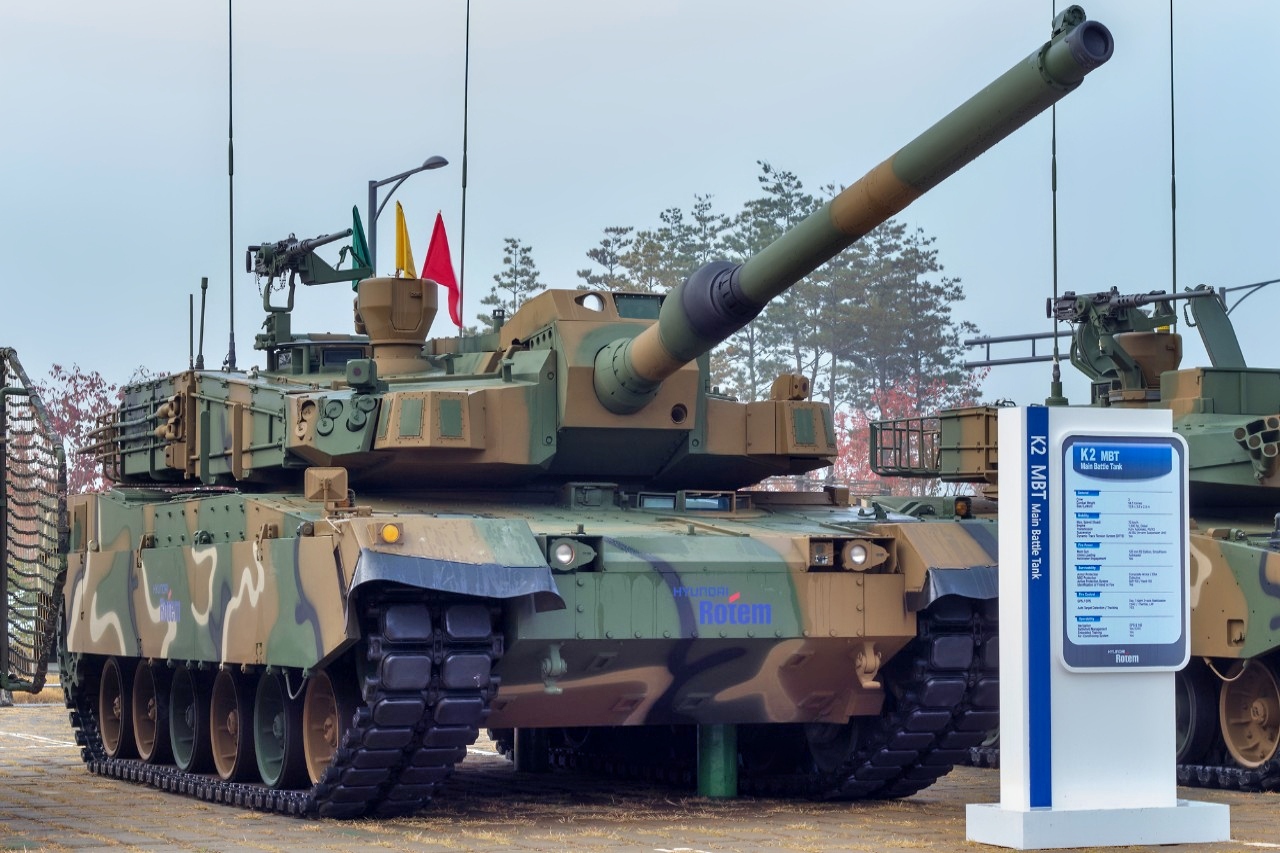
K2 Black Panther Tank from South Korea. Image Credit: Creative Commons.

K2 Black Panther. Image Credit: Creative Commons.
Maximizing Crew Safety
The crew configuration of the K3 is also changed for maximum safety. The tank is designed to operate with a three-person crew who are housed in an armored capsule located at the front of the hull, similarly to the T-14’s design.
This separation from the turret and ammunition compartment significantly improves crew survivability in the event of a direct hit. As automation advances, it is expected that the crew size could be reduced to just two, with driving and loading functions handled by AI systems.
Armor protection on the K3 is modular and multi-layered, combining ceramic, composite, and steel materials. This design allows for mission-specific customization and provides superior resistance to modern anti-tank weapons.
The tank will be equipped with a comprehensive suite of defensive systems, including a hard-kill Active Protection System (APS) capable of intercepting incoming projectiles, Directional Infrared Countermeasures (DIRCM) to disrupt heat-seeking missiles, and drone-jamming devices to counter UAV threats. A 360-degree virtual reality situational awareness system will provide the crew with real-time battlefield data through internal displays, enhancing decision-making and threat response.

K2 Black-Panther. Image Credit: Creative Commons.
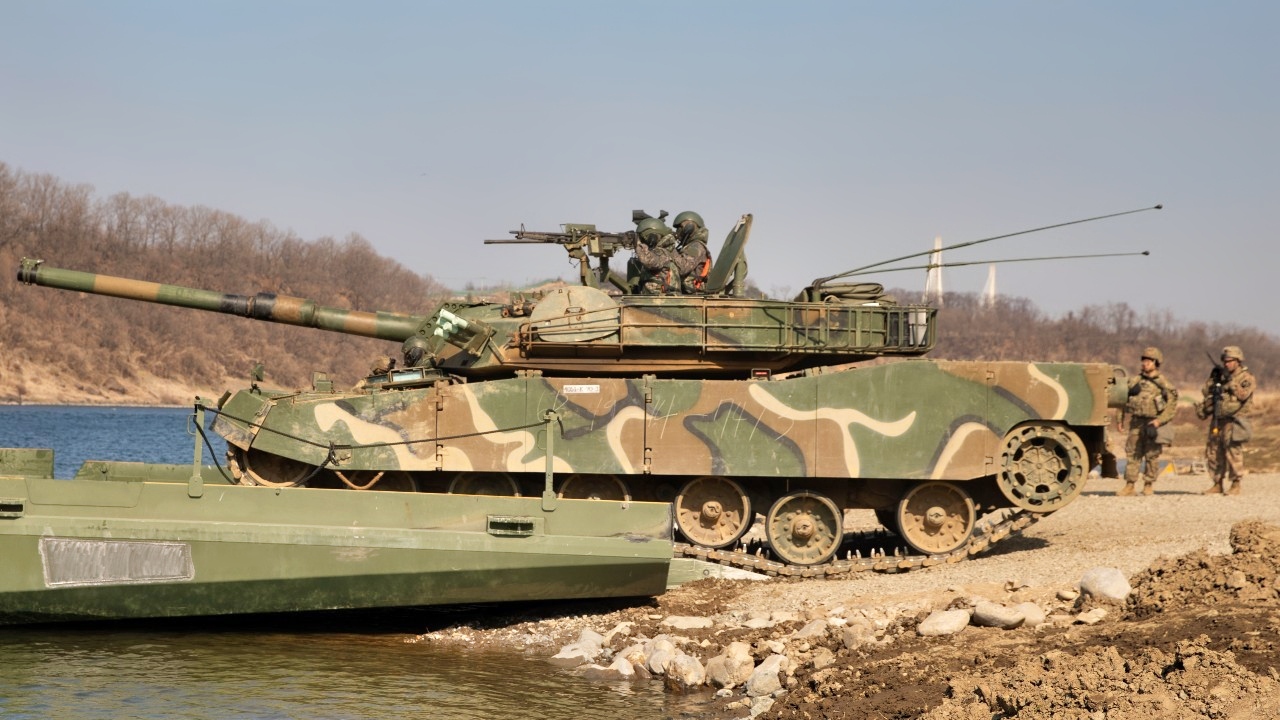
A tank crew operating a K2 Black Panther tank cross a newly constructed Improved Ribbon Bridge during a wet gap crossing training for Freedom Shield 24, March 14, 2024, in South Korea. An annual event, FS24, provides a rigorous environment to enhance readiness, interoperability, and response capabilities in realistic scenarios. (Texas Army National Guard photo by Spc. Joe Cantu, 100th Mobile Public Affairs Detachment)
The K3: A Stealth Tank
Stealth is also a critical component of the tank’s design. The tank incorporates radar-absorbing materials, low-profile geometry, and passive camouflage systems to reduce its radar and infrared signature.
These features are designed to enable the K3 to operate undetected in high-threat environments, giving it a tactical edge in both offensive and defensive operations (although I am personally skeptical of stealth systems on tanks).
Mobility is also a key focus, with the tank expected to reach speeds of up to 80 kilometers per hour thanks to its hybrid powertrain and active suspension systems. Autonomous driving modes will allow the K3 to navigate urban and off-road terrain with minimal human input, further increasing its operational flexibility.
K2 Black Panther Comparison
Compared to the K2 Black Panther, the K3 is a significant upgrade in nearly every domain. The K2 is equipped with a 120mm gun, diesel propulsion, and a manned turret, while the K3 features a 130mm gun, hybrid hydrogen propulsion, and an unmanned, AI-controlled turret.
The K3’s armor is more advanced and modular, and its defensive systems are more comprehensive, including hard-kill APS, DIRCM, and drone countermeasures. The K3 also offers superior stealth capabilities, faster mobility, and enhanced situational awareness through its VR system and drone integration.
Bottomline
Hyundai Rotem’s experience with international contracts, particularly its successful partnership with Poland for the K2, gives high hopes for its next-generation tank. With its factories already operating at full capacity, the K3 is expected to enter full-scale production within five years.
The tank is likely to attract global interest, especially from nations seeking next-generation armored platforms that strike a balance between combat effectiveness and environmental responsibility. Its hydrogen propulsion and AI systems could set new standards for MBTs worldwide, influencing future designs and procurement strategies.
That is, assuming anyone can afford it.
About the Author: Isaac Seitz
Isaac Seitz, a Defense Columnist, graduated from Patrick Henry College’s Strategic Intelligence and National Security program. He has also studied Russian at Middlebury Language Schools and has worked as an intelligence Analyst in the private sector.
More Military
Canada’s F-35 Mistake Still Stings
The F-14 Tomcat: You Bet the Navy Misses This Fighter
M2 Bradley: America’s Obsolete Mini-Tank?
YF-23 Black Widow II: The Best Stealth Fighter You Never Heard Of


