


After a nearly year-long deployment, the USS Gerald R. Ford (CVN-78), the newest and most advanced aircraft carrier in the U.S. Navy, could be out of action for as long as 14 months.
The carrier recently completed her long and grueling deployment, during which she suffered from faulty sewage systems, an onboard fire, and an intense combat deployment in Iran. The ship and her crew have been pushed to their limits, and extensive maintenance will likely be required before the carrier is back up to full operational standards.

The world’s largest aircraft carrier, USS Gerald R. Ford (CVN 78) (front) and the Arleigh Burke-class guided-missile destroyer USS Bainbridge (DDG 96) participate in an integrated phase training event, March 23, 2025. The Gerald R. Ford Carrier Strike Group is underway in the Atlantic Ocean completing integrated naval warfighting training. Composite Training Unit Exercise (COMPTUEX) is the Joint Force’s most complex integrated training event and prepares naval task forces for sustained high-end Joint and combined combat. Integrated naval training provides America’s civilian leaders and commanders highly-capable forces that deter adversaries, underpin American security and economic prosperity, and reassure Allies and partners.(U.S. Navy photo by Mass Communication Specialist 2nd Class Maxwell Orlosky)
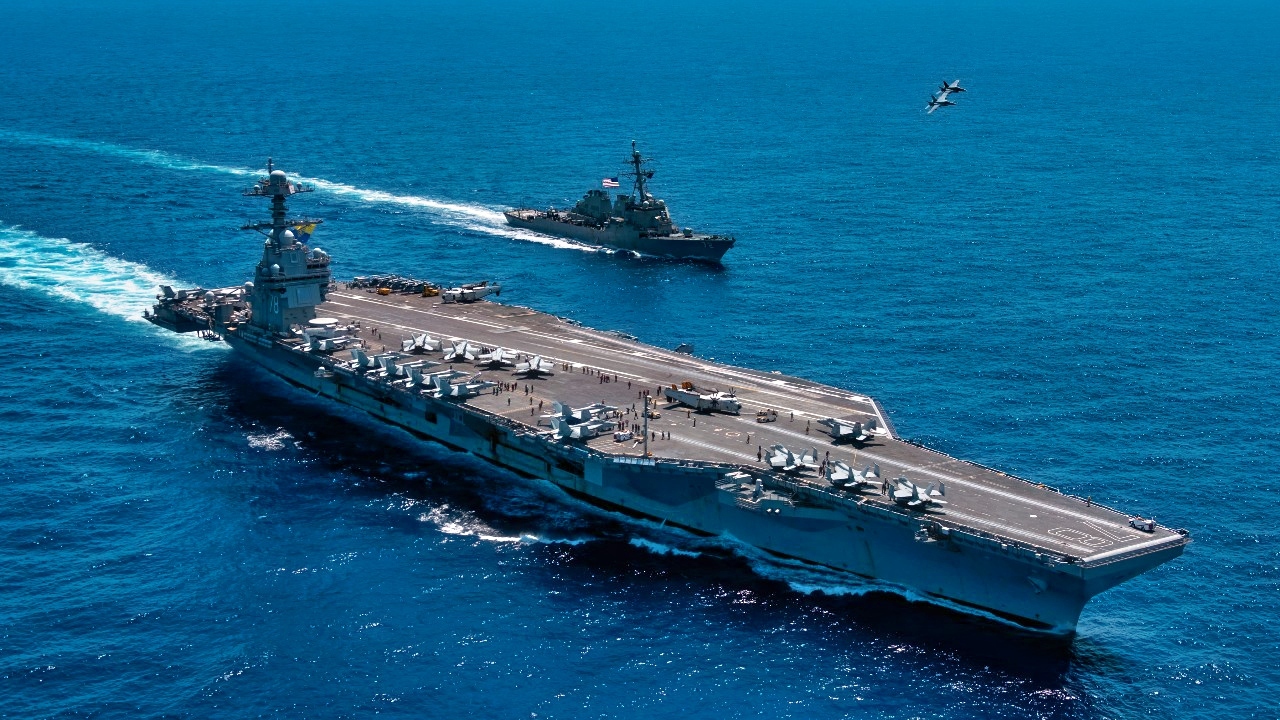
An F/A-18F Super Hornet, attached to the “Blacklions” of Strike Fighter Squadron (VFA) 213 and a F/A-18E Super Hornet, attached to the “Golden Warriors” of Strike Fighter Squadron (VFA) 87 fly over the world’s largest aircraft carrier, USS Gerald R. Ford (CVN 78), the Arleigh Burke-class guided-missile destroyer USS Mahan (DDG 72), April 11, 2025. The Gerald R. Ford Carrier Strike Group is underway in the Atlantic Ocean completing integrated naval warfighting training. Composite Training Unit Exercise (COMPTUEX) is the Joint Force’s most complex integrated training event and prepares naval task forces for sustained high-end Joint and combined combat. Integrated naval training provides America’s civilian leaders and commanders highly-capable forces that deter adversaries, underpin American security and economic prosperity, and reassure Allies and partners. (U.S. Navy photo by Mass Communication Specialist 2nd Class Maxwell Orlosky
USS Gerald R. Ford’s Extended Deployment
It should be noted that extended deployments for aircraft carriers are nothing new. The U.S. Navy operates a limited number of flattops around the world, and due to their high demand, the Navy typically keeps its carriers at sea for as long as physically possible.
What set Ford apart, however, was not only that her deployment kept getting extended, but also that the carrier experienced numerous maintenance issues and combat deployments during her time at sea. Her nearly year-long deployment began on June 24, 2025, when Ford left Norfolk, Virginia, to assist in the U.S. Naval buildup in the Middle East following the Twelve-Day War between Israel and Iran.
After a routine patrol in the North Atlantic, the carrier was redirected to the Caribbean to take part in operations against Venezuela, which resulted in the abduction of Venezuelan President Maduro. In February 2026, Ford was redeployed to the Middle East again.
By this time, the carrier had been at sea for nine months, and the crew was beginning to feel the strain of the long deployment. In March, Ford and her carrier strike group took part in Operation Epic Fury, where her air wing conducted airstrikes against Iranian targets. In May, the carrier returned to Norfolk after a 326-day-long deployment, one of the longest in recent history behind the USS Midway’s (CV-41) deployment of 332 days.
Plumbing Issues, Onboard Fires, and More
Ford’s deployment was anything but smooth. As the carrier made her way to the Mediterranean, media reports began to surface on issues involving its vacuum-based sewage system. Throughout the deployment, the system experienced frequent clogging and failures, occasionally resulting in severe sanitation problems. These malfunctions sometimes rendered large portions of the ship’s toilets unusable.
Granted, issues with vacuum-based sewage are not unique to Ford, but as America’s most advanced carrier and tensions with Iran heightened, Ford’s maintenance troubles did not inspire confidence.

Aviation Boatswain’s Mate (Equipment) 3rd Class Mark Ruiz, assigned to Air Department aboard the world’s largest aircraft carrier, USS Gerald R. Ford (CVN 78), prepares a Carrier Air Wing 8 F/A-18E Super Hornet attached to Strike Fighter Squadron 37 for launch on the flight deck, Aug. 1, 2025. Gerald R. Ford, a first-in-class aircraft carrier and deployed flagship of Carrier Strike Group Twelve, is on a scheduled deployment in the U.S. 6th Fleet area of operations to support the warfighting effectiveness, lethality and readiness of U.S. Naval Forces Europe-Africa, and defend U.S., Allied and partner interests in the region. (U.S. Navy photo by Mass Communication Specialist 2nd Class Mariano Lopez)
The biggest incident occurred on March 12, 2026, when a fire broke out in one of the ship’s primary laundry compartments. Although the fire was contained without damage to propulsion or core combat systems, it caused serious disruption aboard the ship. Smoke and fire spread through ventilation systems into adjacent compartments, damaging berthing spaces and forcing hundreds of sailors out of their living areas.
Nearly 200 crew members were treated for smoke inhalation, and at least a couple of sailors sustained non-life-threatening injuries. Approximately 100 sleeping berths were damaged or destroyed, and as many as 600 sailors were displaced. Consequently, Ford had to retreat to the Crete Naval Base in Souda Bay, Greece, for emergency repairs, where she received extra mattresses from the not-yet-commissioned John F. Kennedy.
All of these issues were compounded by the intense combat operations the carrier endured during Operation Epic Fury. The carrier had launched hundreds of combat sorties throughout March, all while coping with reduced living spaces and clogged toilets.
Regular peacetime patrols usually require 6 to twelve months of maintenance. However, after Ford’s intense deployment and the multiple issues along the way, her hull, crew, and onboard systems had been thoroughly fatigued. In May, the carrier was finally allowed to return home, where she was awarded a Presidential Unit Citation, one of the highest honors a military unit can receive.
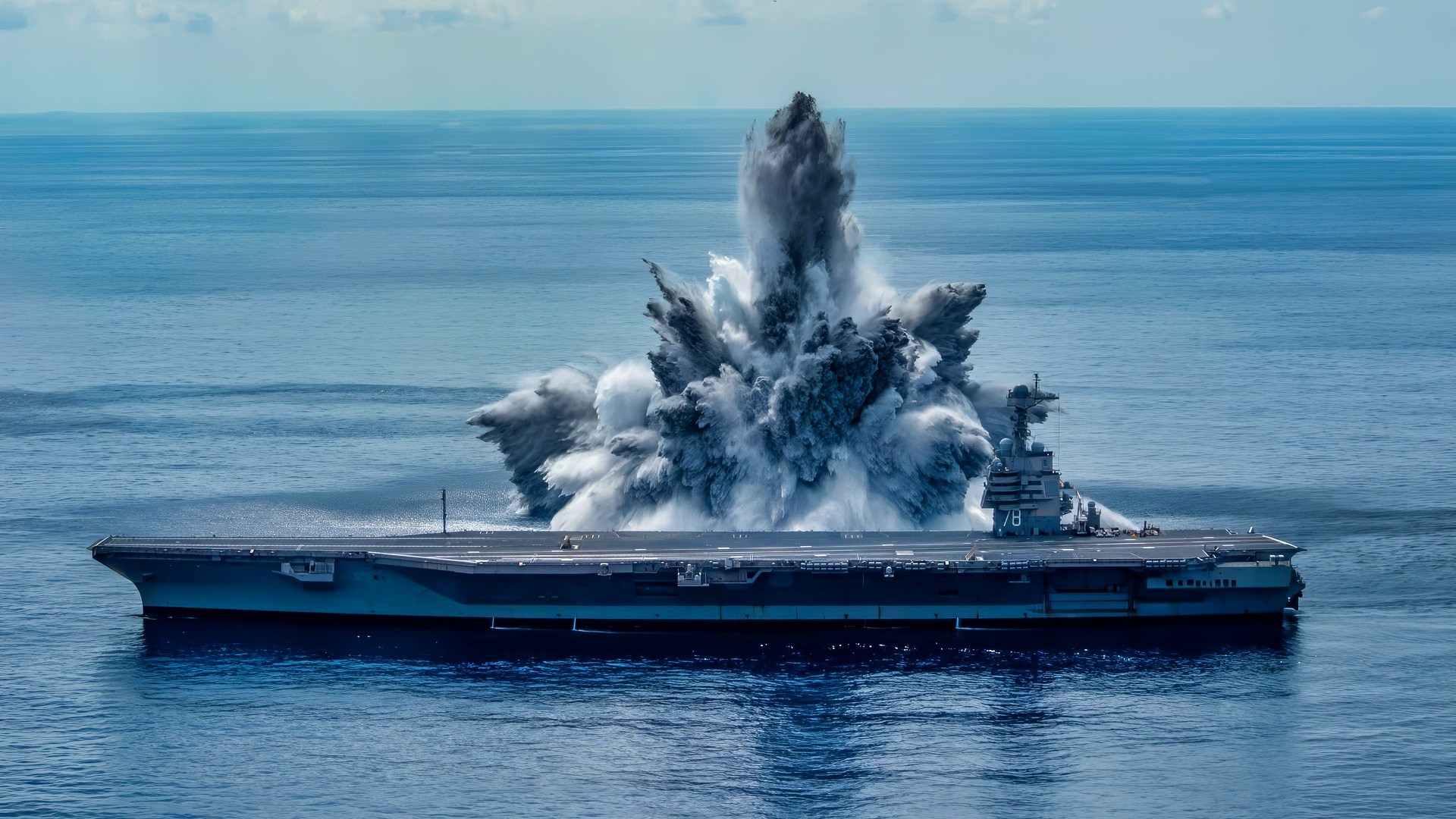
The aircraft carrier USS Gerald R. Ford (CVN 78) successfully completes the third and final scheduled explosive event of Full Ship Shock Trials while underway in the Atlantic Ocean, Aug. 8, 2021. The U.S. Navy conducts shock trials of new ship designs using live explosives to confirm that our warships can continue to meet demanding mission requirements under harsh conditions they might encounter in battle. (U.S. Navy photo by Mass Communication Specialist 3rd Class Novalee Manzella)
14 Months Out of Action?
It is difficult to say how long Ford will be out of action. Most carriers receive maintenance for around 6-12 months, but with carriers’ extra-long deployments and recent delays in maintenance and repair efforts, Ford will likely remain at port for a while longer.
Other analysts have suggested, and I am inclined to agree, that the carrier will likely remain at port for around 14 months.
There are several reasons why this is the case. First, Ford is a first-in-class vessel known for its technical complexity. Additionally, the mechanical difficulties and the extended deployment have placed greater strain on her systems, which will inevitably require more attention. This estimate could be completely wrong, but given the delays in the current refueling and complex overhauls, it makes sense to assume that Ford’s maintenance might take a while.
The temporary loss of Ford comes at an unfortunate time for the United States Navy. With tensions still high between Iran and Israel, and with the constant threat posed by China, carriers are in exceptionally high demand.
With four other carriers currently undergoing maintenance, the Navy is currently limited in the number of carriers it can deploy. As the most advanced carrier in the world, the Navy will likely do everything in its power to return Ford to operational status as quickly as possible, but after her nearly year-long deployment, this may be much easier said than done.
About the Author: Isaac Seitz
Isaac Seitz, a Defense Columnist, graduated from Patrick Henry College’s Strategic Intelligence and National Security program. He has also studied Russian at Middlebury Language Schools and has worked as an intelligence Analyst in the private sector.


Richard Barboza
June 1, 2026 at 11:32 pm
The toilet bowls are probably too small. If you have a weight fitness room inside the ship, it means that the men are eating well and also sticking up on protein shakes and vitamin b-12. All of those factors contribute to over-sized stools. Industrial sized toilet bowls are what’s needed.