

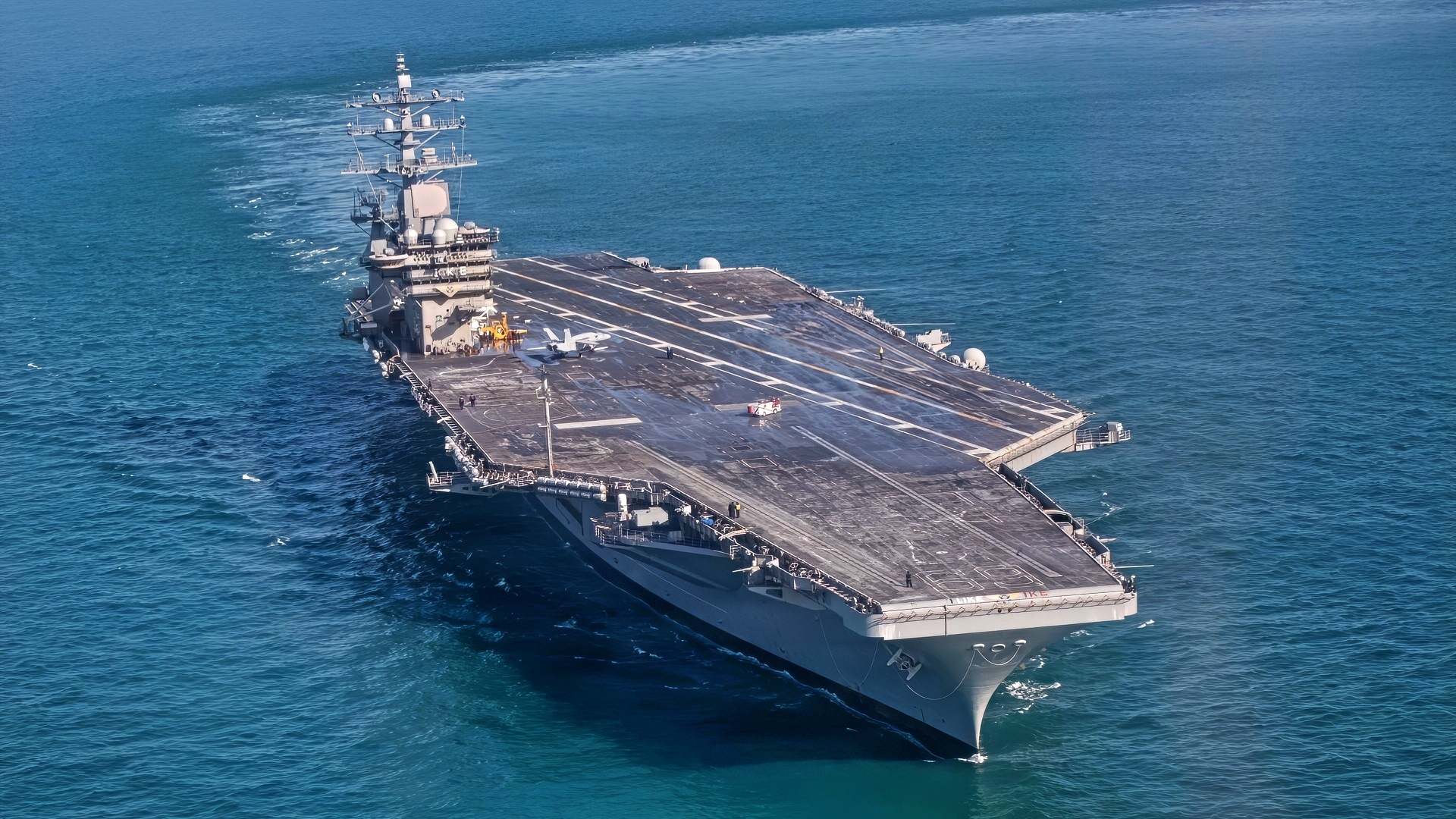
China Has Thousands Of Missiles Aimed At The Pacific. The War With Iran Was The Warm-Up Act: The recent war against Iran strained the United States military in ways that rattled defense planners, and Iran fired its missiles by the hundreds. China can fire them by the thousands. That difference in scale is the most important fact in any honest discussion of a Pacific war, because it converts a problem the United States managed against a regional power into one it cannot fully solve against Beijing.
The People’s Liberation Army has built the largest and most varied missile force on earth for a single purpose: to throw more incoming weapons at American and allied targets than any defensive system can stop.
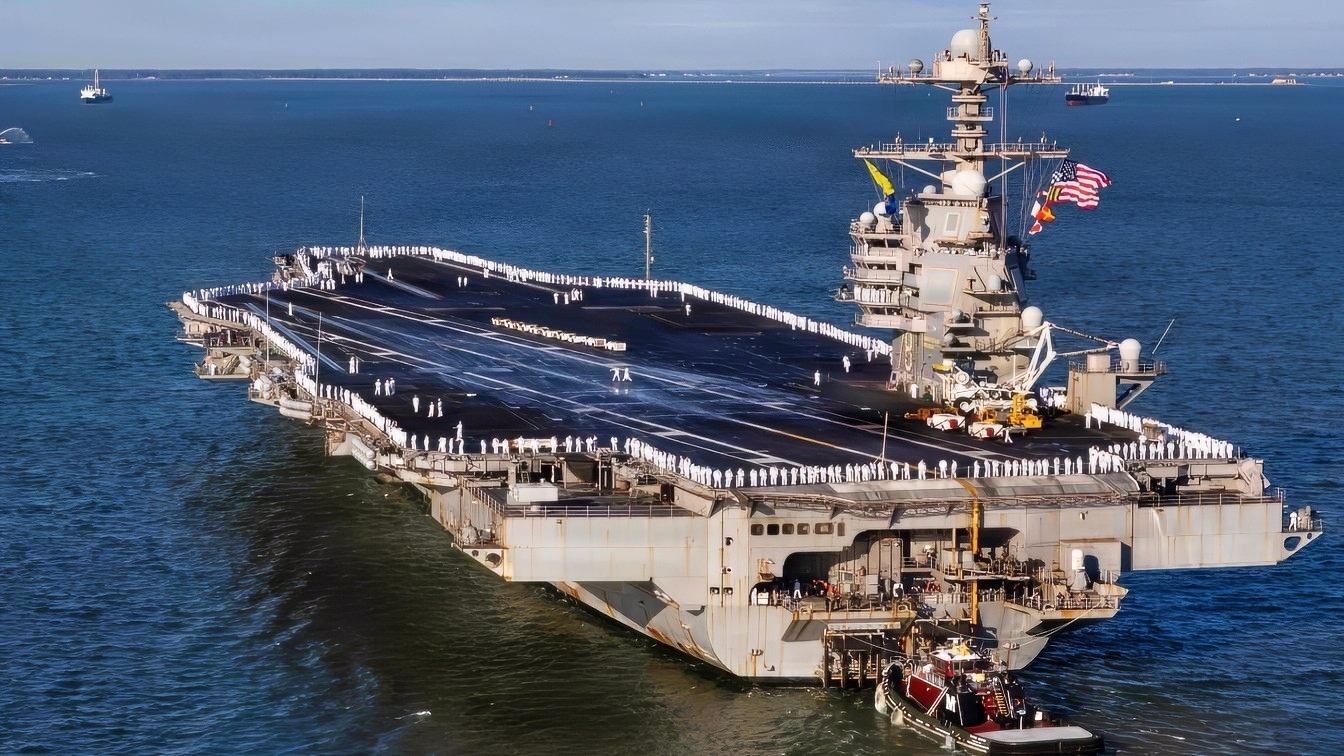
260516-N-FY193-1426 NORFOLK, Va. (May 16, 2026) USS Gerald R. Ford (CVN 78) returned to Naval Station Norfolk, May 16, 2026, following a historic 11-month deployment to U.S. 2nd, 4th, 5th, and 6th Fleets as part of the Gerald R. Ford Carrier Strike Group. Before returning to Norfolk after 326 days, the Gerald R. Ford crew conducted 23 replenishments-at-sea and sailed over 57,713 nautical miles. Embarked Carrier Air Wing 8 logged more than 5,760 flight hours and 12,200 flight launches. (U.S. Navy photo by Mass Communication Specialist 2nd Class Mike Shen)
China’s Missiles: The Numbers Are The Whole Story
The raw scale is the problem, because it is the part that most people underestimate.
China is assessed to field thousands of missile systems, the DF-26 among them, an arsenal built up without the constraints of the arms-control treaties that once limited such weapons, and one capable of launching massive salvos in the opening hours of a conflict.
Chinese military writing is explicit about the goal: to present American defenses with more missiles than they can possibly engage at once.
This is not an accident of procurement. It is a deliberate theory of victory.
The inventory backing that theory is deep and diverse. China is estimated to hold around 400 DF-26 missiles, the intermediate-range weapon nicknamed the “Guam killer,” and now fields five distinct types of anti-ship ballistic missiles: the DF-21D, the DF-26, the DF-17, the DF-27, and the ship-launched YJ-21.
Layered beneath those are large numbers of shorter-range ballistic missiles aimed at Taiwan and air- and sea-launched cruise missiles built to come in low against fixed targets.

Aircraft Carrier in Hard Turn. Image Credit: Creative Commons.
The PLA Rocket Force is judged to possess sufficient inventory depth to sustain saturation attacks against American airfields, ports, fuel depots, and command nodes across the Second Island Chain, with the DF-26’s 4,000-to-5,000-kilometer range placing Guam itself within the envelope.
The Hypersonic Layer Makes Defense Even Harder
If the ballistic and cruise tiers were the whole problem, defenders could at least plan against known flight paths. The hypersonic tier removes even that comfort. China is estimated to field up to 600 hypersonic missiles, weapons that travel above five times the speed of sound while maneuvering in flight, which makes them extraordinarily difficult to track and intercept. These are designed to work alongside cheaper weapons fired in bulk, the inexpensive missiles soaking up a defender’s interceptors while the advanced systems exploit the openings they create.
The DF-27 is the clearest signal of where this is heading. The Pentagon assesses that China has fielded an anti-ship system able to threaten vessels at distances surpassing its existing arsenal of cruise, supersonic, and hypersonic weapons, with a range that pushes the threat toward the American West Coast. A missile that can hold ships at risk across most of the Pacific, while maneuvering fast enough to slip past interceptors built for predictable arcs, is precisely the kind of weapon that turns an aircraft carrier’s defensive bubble into a gamble rather than a guarantee.
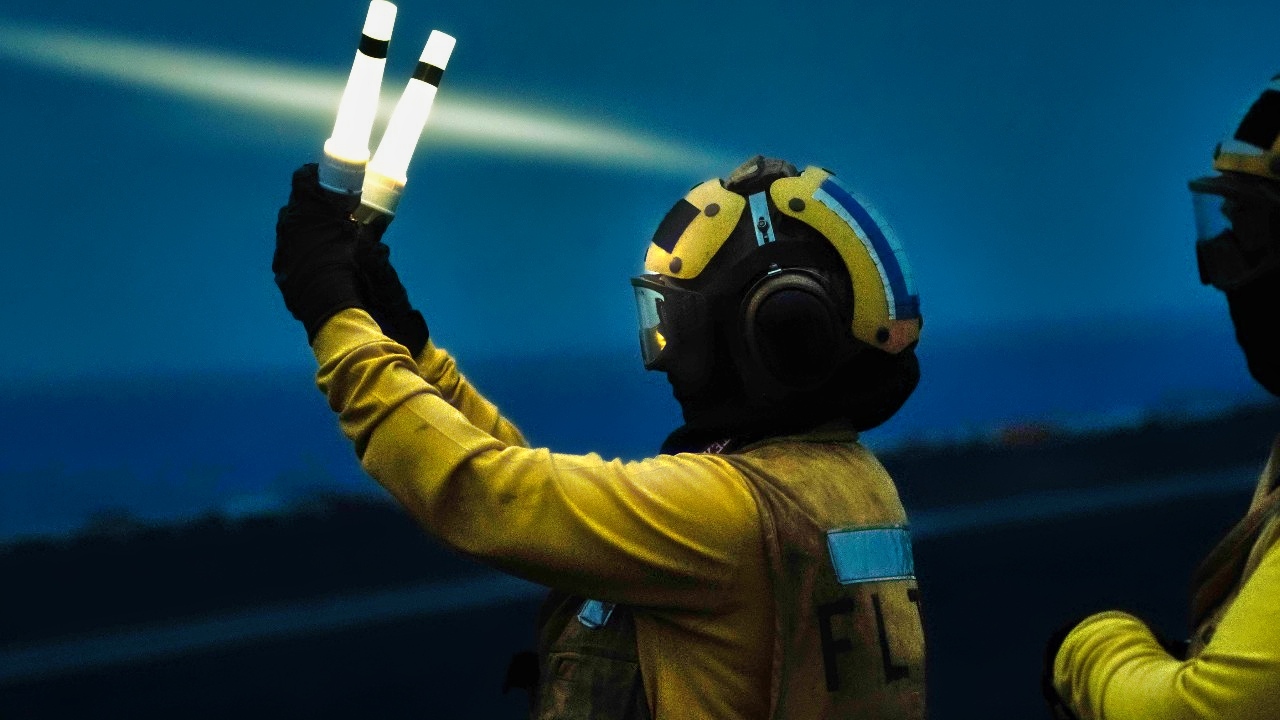
U.S. 5TH FLEET AREA OF OPERATIONS (Aug. 6, 2024) An Aviation Boatswain’s Mate (Handling) signals aircraft on the flight deck of the Nimitz-class aircraft carrier USS Theodore Roosevelt (CVN 71), Aug. 6. Theodore Roosevelt is deployed to the U.S. 5th Fleet area of operations to support maritime security and stability in the U.S. Central Command area of responsibility. (Official U.S. Navy photo)
Why the Math Cannot Close
The defeat mechanism is simpler than the technology. Chinese doctrine is to fire more missiles than a defender can engage, and that is exactly the capability Beijing has spent two decades building. I know this well; I have literally been studying it for close to two decades now.
Even a flawless interceptor accomplishes nothing once the launcher that fires it is empty, and every Aegis destroyer, every THAAD battery, every Patriot unit carries a finite magazine. When the attacker can launch more missiles than the defender has interceptors, the defender does not need to miss. He simply runs out.
This is where the war with Iran stops being a comparison and becomes a warning. That campaign drew down America’s stocks of high-end interceptors against an adversary firing a fraction of what China could field, and analysts concluded it had opened a window of vulnerability for a potential fight in the Western Pacific.
If a regional power firing in the hundreds could strain the magazine, an opponent firing in the thousands empties it in the opening salvos. The interceptor arithmetic that was merely uncomfortable against Tehran collapses entirely against Beijing, and no amount of marksmanship fixes a shortage of bullets.
What Defense Can and Cannot Do
None of this means the United States is helpless, and the honest version of the argument has to acknowledge as much.
Not every missile fired will hit, and the accuracy of long-range ballistic and hypersonic weapons against a carrier maneuvering at sea, dependent on a fragile chain of sensors and targeting data stretched across thousands of kilometers, remains far less certain than the launch numbers suggest.

Norfolk Naval Shipyard welcomed USS George H.W. Bush (CVN 77) for a Planned Incremental Availability Jan. 11. In addition to equipment maintenance, this availability will improve ship safety along with communications and combat system upgrades.
Washington is also investing heavily in the problem, pouring $1.9 billion into an integrated Aegis system on Guam built for 360-degree coverage against ballistic, cruise, and hypersonic threats arriving from every direction at once.
But better interceptors and smarter radars only raise the price of saturation; they do not make it impossible. The lesson defense planners are drawing is that survival in a Pacific war depends less on stopping every missile than on not presenting a target worth saturating in the first place. Dispersing aircraft across many airfields rather than packing them onto Guam, hardening fuel and ammunition stores, building decoys, keeping carriers mobile and unpredictable, and deepening allied magazines all change the arithmetic in ways that a single shield never can. The goal shifts from intercepting the whole salvo to absorbing it and fighting on.
That is the uncomfortable reality the Iran war pointed toward, and a fight with China would confirm it in full. The era in which American bases and carriers could assume they would be defended against whatever came at them is closing, replaced by one in which the side that can take a punch and keep operating holds the advantage.
About the Author: Harry J. Kazianis
Harry J. Kazianis (@Grecianformula) was the former Senior Director of National Security Affairs at the Center for the National Interest (CFTNI), a foreign policy think tank founded by Richard Nixon based in Washington, DC. Harry has over a decade of experience in think tanks and national security publishing. His ideas have been published in the NY Times, The Washington Post, The Wall Street Journal, CNN, and many other outlets worldwide. He has held positions at CSIS, the Heritage Foundation, the University of Nottingham, and several other institutions related to national security research and studies. He is the former Executive Editor of the National Interest and the Diplomat. He holds a Master’s degree focusing on international affairs from Harvard University.


