

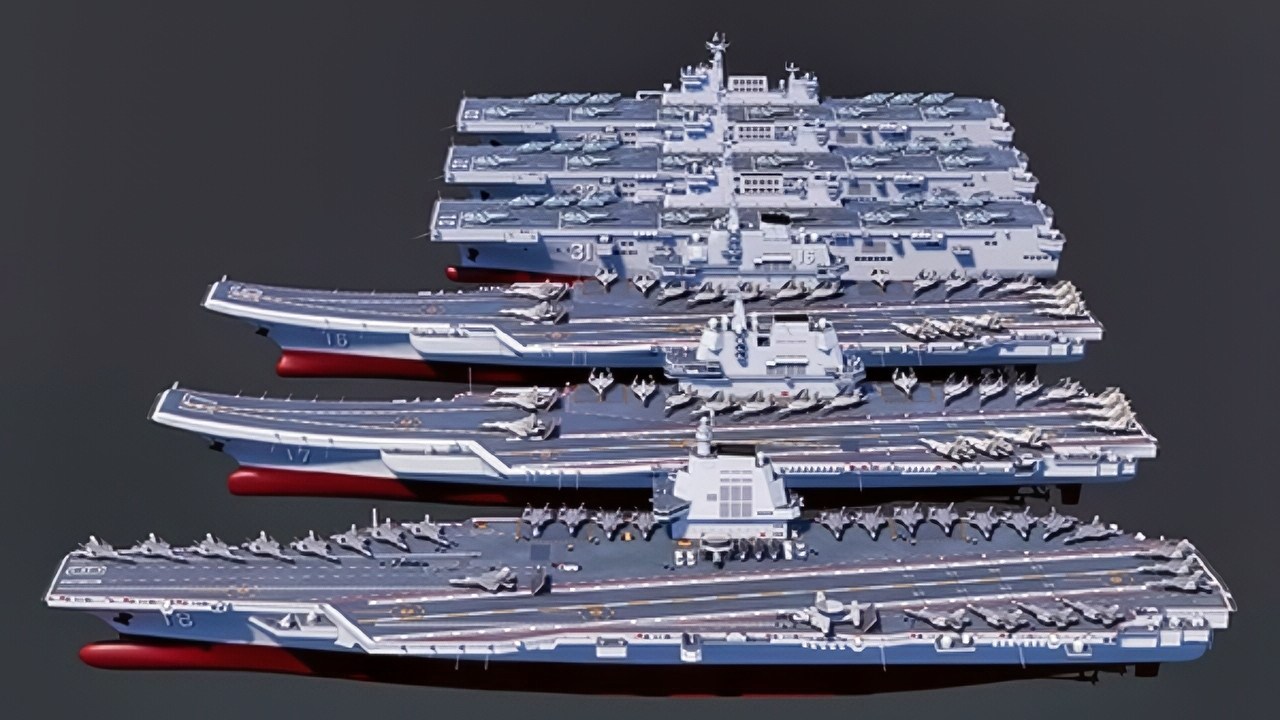
China’s Type 004 aircraft carrier is the fourth of China’s growing fleet of aircraft carriers. It’s also a representation of the Chinese People’s Liberation Army Navy (PLAN) evolving into a true maritime power. Whereas the previous carriers China developed were essentially experiments upon which the PLAN could learn how to conduct complex carrier operations, the Type 004 is a fully loaded combat system prepared to dominate the seas beyond China.
Construction on the Type 004 is underway at Dalian Shipyard, with prefabricated hull sections first appearing in early 2025 and becoming a recognizable carrier hull in less than a year. As of May 2026, the hull measured roughly 286 meters long and 46 meters wide, even before the bow and full flight deck were complete. That already makes it larger than any ordinary surface combatant and likely larger than China’s Type 003 Fujian carrier at a similar stage of development.
The Nuclear Question

China New Carrier Type 003 CCTV Screencap Photo.
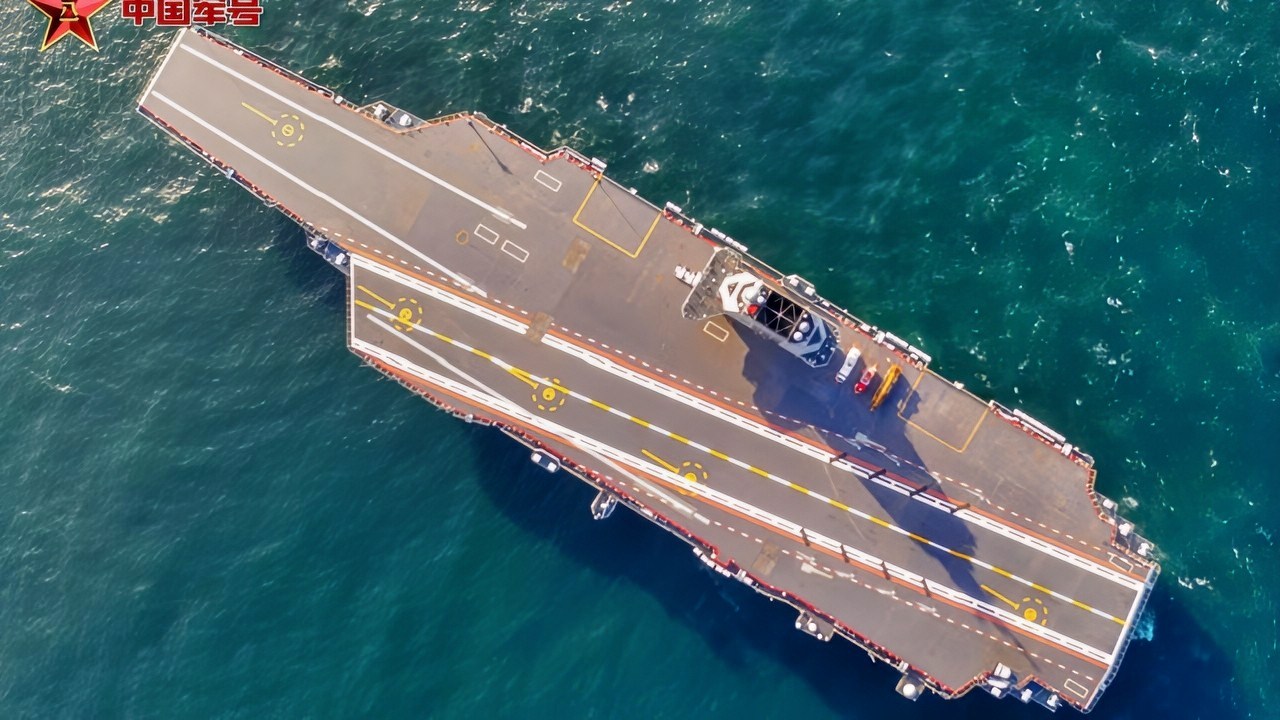
CV-18 Fujian aircraft carrier from China. Image Credit: Creative Commons.
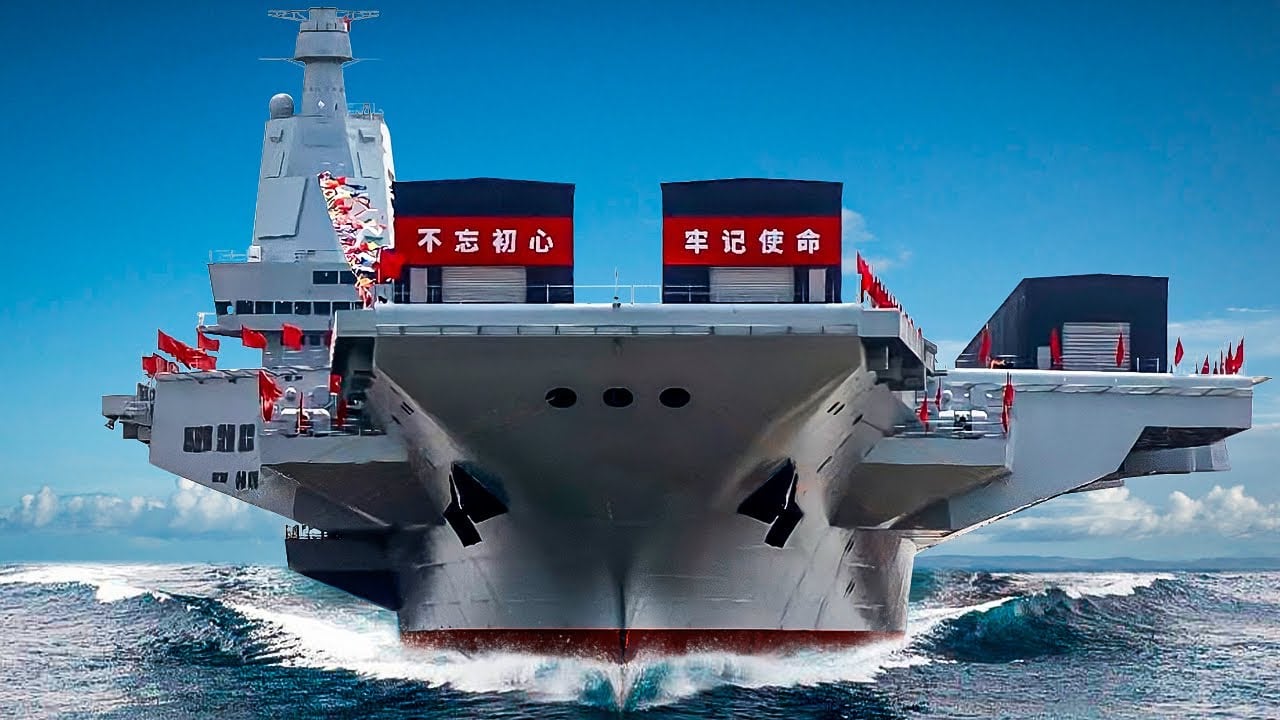
China Aircraft Carrier Creative Commons Image.
The nuclear question remains the big one. It remains unknown as to whether the Type 004 will be nuclear-powered. Some have claimed it would be. Others, such as the analysts at CSIS, say that’s unproven. CSIS assesses that nuclear propulsion on the Type 004 is likely, based mainly on two 15-meter-by-15-meter internal compartments visible in satellite imagery that resembled shielded reactor-containment spaces.
China’s previous carrier, the Type 003 Fujian, was conventionally powered and did not show similar openings at the same construction stage. CSIS also ties this to earlier evidence that China built a land-based naval reactor prototype linked to the 701st Research Institute, which is involved in Chinese carrier design.
If the Type 004 is nuclear-powered, then it signals a true evolutionary step in China’s rapidly growing carrier capabilities. After all, nuclear propulsion would give China a carrier capable of operating far beyond its near seas without the same dependence on fuel logistics. It would also generate far more electrical power for electromagnetic catapults, advanced radars, electronic warfare (EW), drones, and eventually directed-energy weapons. CSIS notes that nuclear power also frees internal volume for aircraft, fuel, munitions, and provisions.
Catapults, Elevators, and Sortie Generation
The question about the catapult is almost as important. China’s Type 003 already gave the PLAN electromagnetic launch capacity; that’s a key development for increased sortie rates. Type 004 is expected to continue that leap. It is plausible that the ship has four catapults rather than three. That would move China closer to the American Ford-class aircraft carrier.
A third aircraft elevator is also possible. That might sound like a minor detail, but it isn’t. Carrier combat power is really about how fast aircraft can be moved, armed, launched, recovered, repaired, and relaunched. A third elevator would help China close the operational gap with American carrier deck cycles.
The likely air wing is what turns this carrier from a prestige platform into a true combat system. A mature Type 004 would likely carry J-35 stealth fighters, J-15T strike fighters, KJ-600 airborne early warning aircraft, helicopters, and drones. The KJ-600 is especially important because earlier Chinese carriers lacked a true catapult-launched airborne early warning (AEW) aircraft comparable in role to the US E-2D Hawkeye.
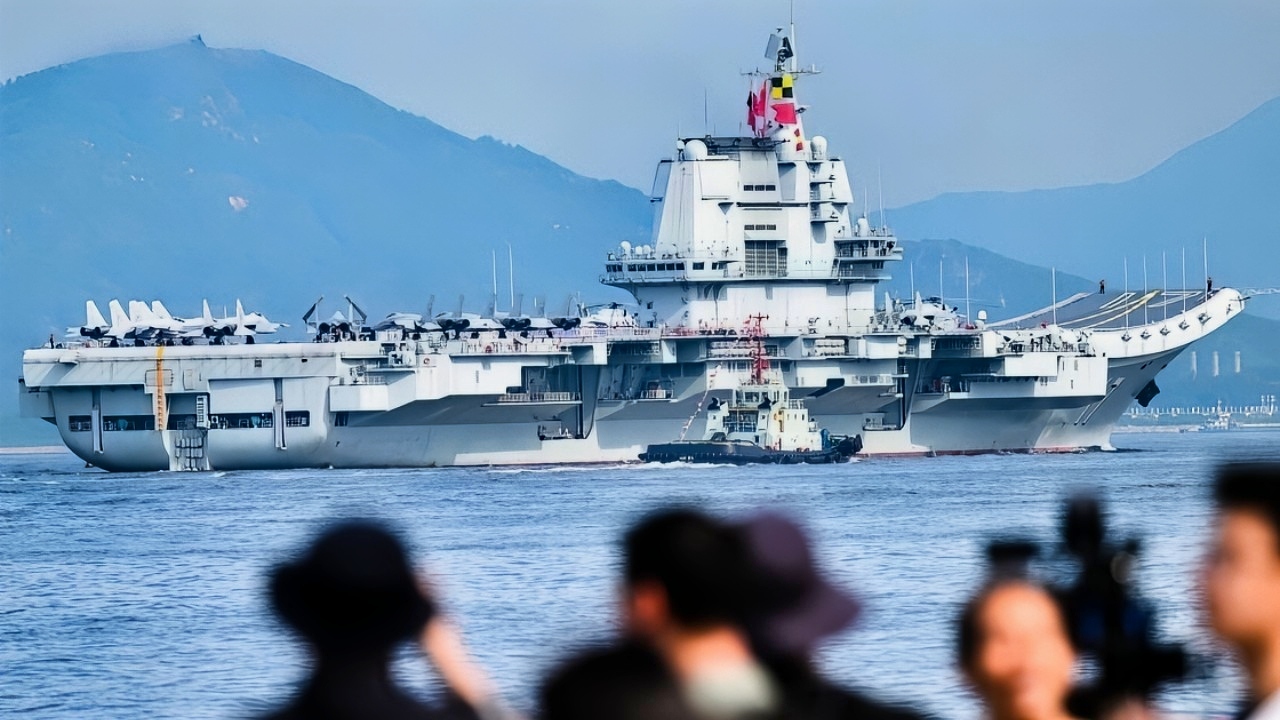
China Aircraft Carrier in Port. Image Credit: Chinese Navy.
Once China has stealth fighters, carrier-based AEW, and EMALS, it will have the components of a real blue-water carrier air wing.
Beyond the First Island Chain?
At first, it appeared as though China was simply interested in building carriers for what’s known as regional sea-denial. Indeed, that is likely what they will be used for initially. But Beijing is clearly calculating that the next phase of its naval development would be sustained blue-water power projection.
And the PLAN is building up its operational architecture in the Philippine Sea, the Indian Ocean, the Western Pacific, and eventually the Middle East sea lanes.
That makes sense, especially considering how integrated and expansive China’s global trading profile is. Remember your Julian Corbett: the flag follows trade. It also indicates that China anticipates having little issue controlling its near-abroad, notably the First Island Chain (the region extending from the Kamchatka Peninsula through Japan and Taiwan down to the Philippines and South China Sea).
Washington believes that the First Island Chain is merely contested, and that all it must do is refocus its efforts on denying the Chinese control of and access to the First Island Chain to end their global ambitions.
Beijing clearly assumes that the First Island Chain is theirs in all but name. China’s growing force posture indicates that Beijing assumes global power projection is at hand. Their Type 004 carrier, especially if it is nuclear-powered, indicates that they are planning for the moments after Beijing officially achieves dominion over the First Island Chain.
And Beijing thinks they’ll have that regional dominance soon.
A Compressed Learning Curve
Think about China’s overall rise and assess it through the particular lens of China’s aircraft carrier development. China went from retrofitting the aging Soviet-era hull of the Liaoning, a ski-jump carrier in 2012, to Fujian, a conventionally powered CATOBAR carrier, and now possibly a nuclear supercarrier in 2026. That’s quite the learning curve. The Americans took generations to build the institutional, industrial, and operational ecosystem that makes carrier aviation work.
China is trying to brute-force that process through shipbuilding capacity, state direction, and iterative design.
The Remaining Unknowns
Of course, blue water carrier operations in today’s era of advanced anti-access/area-denial (A2/AD) come with their own challenges. Conducting sea control in one’s near-abroad, under the defense of one’s own A2/AD network, is much easier than operating in an expeditionary capacity in one’s rival’s region that has similar A2/AD defenses.
And there are still several unknowns with the Type 004. We don’t know this vessel’s displacement. We do not know whether the reactor is mature (or even nuclear-powered). We don’t know the sort-generation rate. We do not know whether China can maintain nuclear carriers safely over decades (though, given the advanced nature of China’s society, that much can be assumed). We don’t know when the J-35 will be at sea. And we do not know whether the PLAN can execute complex carrier operations under combat stress.
America’s Challenge
The Type 004 is not yet China’s Ford-class killer. But it certainly may be China’s Ford-class threshold. If Beijing integrates nuclear propulsion, EMALS, stealth fighters, carrier-based AEW, drones, and a larger flight deck into a single platform, then the PLAN will have entered a new era. The question will no longer be whether China can build modern carriers.
The question will be whether America can build, maintain, crew, and deploy enough naval power to keep pace with China’s shipyard-driven surge.
I assess that the Type 004 will meet–and likely even surpass–Beijing’s expectations for the carrier.
Compare that to the many woes the US carrier forces have thus far endured, notably the much-ballyhooed Ford-class carrier. That spells a major problem for the US Navy’s force projection in the Indo-Pacific going forward. And it’s all because the US defense industrial base, its naval shipyards, and its broken defense acquisition program are broken.
About the Author: Brandon J. Weichert
Brandon J. Weichert is Senior National Security Editor. He also manages The Weichert Brief on Substack. Weichert hosts “National Security Talk” on Rumble, too. He is the author of four bestselling national security books, the most recent of which is A Disaster of Our Own Making: How the West Lost Ukraine (Encounter Books). Follow him via Twitter/X @WeTheBrandon.


pseudo
June 12, 2026 at 1:32 pm
“The Americans took generations to build the institutional, industrial, and operational ecosystem that makes carrier aviation work.” – Yeah, we spend years developing and testing, they steal it for free.