


The Ford-class represents a top-to-bottom redesign of the modern aircraft carrier. The A1B nuclear reactor delivers vastly more power than the A4W, electromagnetic catapults replace steam, and automation drops crew size by hundreds. Over a 50-year lifespan, the Ford-class is projected to save the Navy billions.
The USS Gerald R. Ford Is the Biggest and Most Expensive Aircraft Carrier Ever for a Reason
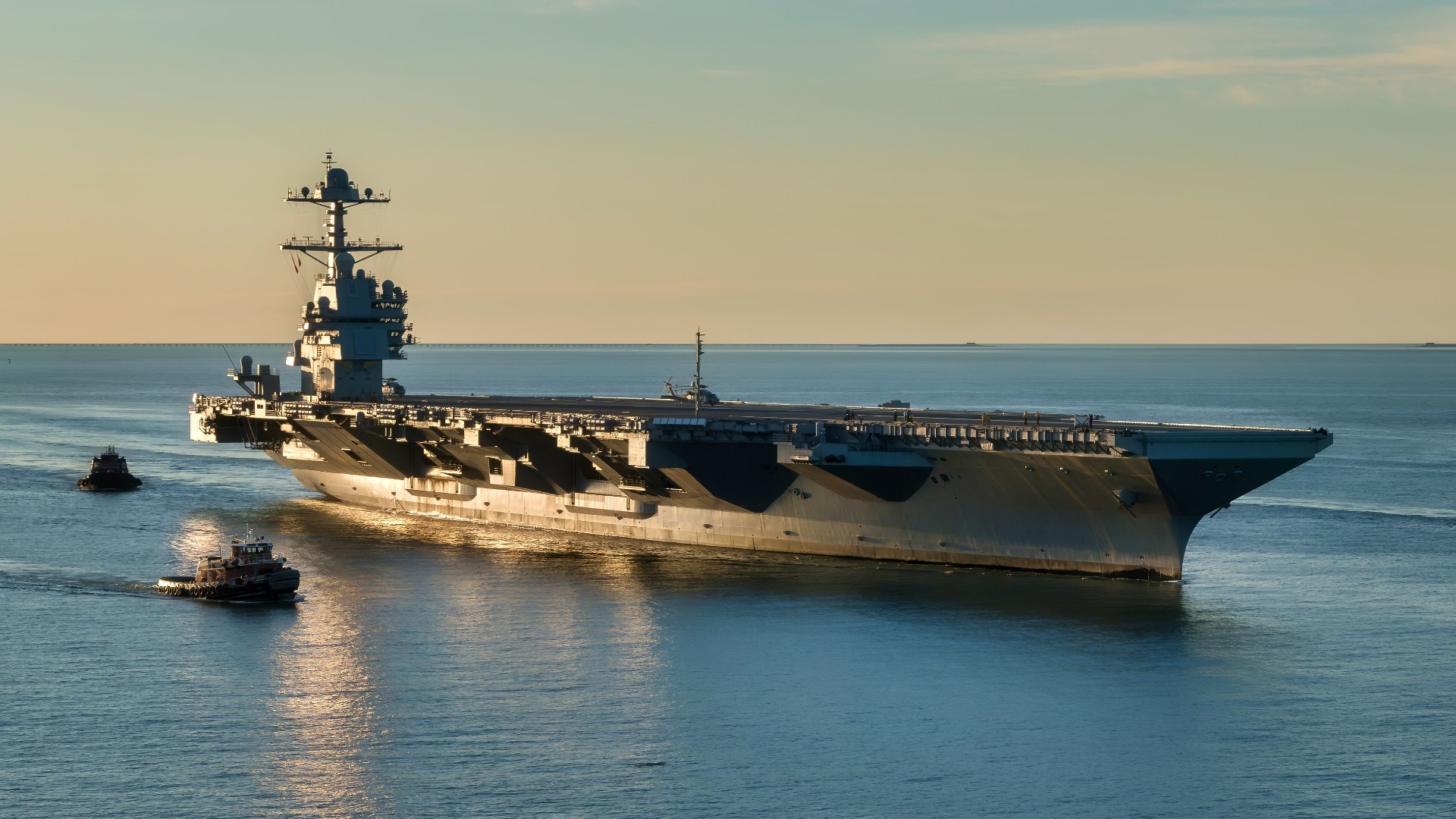
(April 14, 2017) The aircraft carrier Pre-Commissioning Unit (PCU) USS Gerald R. Ford (CVN 78) pulls into Naval Station Norfolk for the first time. The first-of-class ship – the first new U.S. aircraft carrier design in 40 years – spent several days conducting builder’s sea trails, a comprehensive test of many of the ship’s key systems and technologies. (U.S. Navy photo by Matt Hildreth courtesy of Huntington Ingalls Industries/Released)
Since the start of the ongoing Operation Epic Fury against Iran, the USS Gerald R. Ford (CVN-78) has, somewhat understandably, come under intense scrutiny for its many mishaps during its extended deployment.
Amid the media buzz about Ford limping away from the Middle East, many people have forgotten a simple fact: the Gerald R. Ford is currently the most advanced aircraft carrier in the world.
While her current deployment has stretched her to her absolute limits, and her crew’s morale has been significantly degraded, those are not the fault of the ship herself, but rather a result of the unfortunate circumstances that put her in that position.
The Most Sophisticated Carriers in the World
So, what exactly makes the Ford-class so advanced?
Although Ford-class carriers are roughly similar in size and displacement to their Nimitz-class predecessors, nearly every major system aboard them has been redesigned.
The Navy pursued this approach in response to concerns about the rising lifecycle costs of previous models and the limitations imposed by legacy systems that left little room for growth. With the advent of precision anti-ship missiles and technologically sophisticated adversaries, it became clear that future carriers would need far greater electrical capacity, automation, and flexibility than earlier designs could conveniently accommodate.
Like its predecessors, the Ford-class relies on nuclear energy for its power system. Previous U.S. carriers relied on A4W reactors, which were highly reliable but designed around mid-twentieth-century engineering constraints.

The world’s largest aircraft carrier, USS Gerald R. Ford (CVN 78), conducts flight operations in the North Sea, Aug. 23, 2025. Gerald R. Ford, a first-in-class aircraft carrier and deployed flagship of Carrier Strike Group Twelve, is on a scheduled deployment in the U.S. 6th Fleet area of operations to support the warfighting effectiveness, lethality, and readiness of U.S. Naval Forces Europe-Africa, and defend U.S., Allied and partner interests in the region. (U.S. Navy photo by Mass Communication Specialist 2nd Class Maxwell Orlosky)

Aviation Boatswain’s Mate (Equipment) 3rd Class Mark Ruiz, assigned to Air Department aboard the world’s largest aircraft carrier, USS Gerald R. Ford (CVN 78), prepares a Carrier Air Wing 8 F/A-18E Super Hornet attached to Strike Fighter Squadron 37 for launch on the flight deck, Aug. 1, 2025. Gerald R. Ford, a first-in-class aircraft carrier and deployed flagship of Carrier Strike Group Twelve, is on a scheduled deployment in the U.S. 6th Fleet area of operations to support the warfighting effectiveness, lethality and readiness of U.S. Naval Forces Europe-Africa, and defend U.S., Allied and partner interests in the region. (U.S. Navy photo by Mass Communication Specialist 2nd Class Mariano Lopez)
The Ford class introduces the A1B reactor, a system that produces substantially more electrical power while requiring fewer components and less maintenance. This increase in available power is one of the most important distinctions between the Ford and earlier carrier classes.
The Ford-class was designed with the hope that future systems would be integrated into the platform at a later date; this meant that the reactor had to be powerful enough to accommodate them.
Revolutionary Launch and Arresting Systems
The new and improved reactors also enable the Ford-class to operate the new electromagnetic launch systems (EMALS). For decades, carriers have relied on steam-powered catapult systems, which work well but are limited in the types of aircraft they can launch.
EMALS uses electromagnetic forces to accelerate aircraft down the flight deck, allowing launch energy to be precisely controlled. This precision reduces stress on aircraft structures, extends airframe life, and enables the launch of lighter platforms such as unmanned aerial vehicles. Unlike steam catapults, EMALS is fully software-controlled, making it more adaptable to future aircraft designs.
Closely associated with EMALS is the Advanced Arresting Gear system, which replaces the traditional hydraulic arresting equipment used since World War II. Instead of relying on fixed mechanical resistance, the new system uses energy-absorbing water turbines that dynamically adjust to the weight and speed of incoming aircraft. This greatly expands the range of aircraft that can be safely recovered aboard the carrier, from heavy strike fighters to lightweight UAVs. It also reduces stress on the landing gear and improves overall safety during recovery operations.
Together, EMALS and Advanced Arresting Gear modernize the entire launch-and-recovery cycle, making it more efficient and safer than anything installed on earlier carriers.
Increased Automation, Decreased Risk
One of the central goals of the Ford-class program was to reduce the long-term operating costs of aircraft carriers. A major contributor to those costs has historically been crew size, as Nimitz-class carriers typically operate with more than five thousand sailors when the air wing is embarked.
Through extensive automation, improved sensors, and integrated monitoring systems, Ford-class ships are designed to operate with several hundred fewer personnel. Automation enables continuous monitoring of machinery health, reducing the need for manual inspections and enabling predictive maintenance. Over the projected fifty-year lifespan of a carrier, these manpower reductions are expected to save billions of dollars while also easing recruiting and retention challenges that have plagued the Navy over the last several years.
Another major innovation lies below deck: the Advanced Weapons Elevator system. Earlier carriers relied on cable-driven elevators that were mechanically complex, slow, and constrained by vertical shafts that limited ship design flexibility.
The Ford class replaces these with electromagnetic elevators capable of carrying heavier loads at higher speeds while occupying less space.
These elevators can move weapons directly from magazines to flight deck staging areas with fewer handling steps, improving responsiveness while reducing manpower requirements.
Admittedly, the development of these systems was not the smoothest, and many kinks had to be smoothed out along the way, but the results speak for themselves.
The Best Aircraft Carriers in the Navy
The Ford class also introduces more modern command, control, and sensor architecture. Earlier carriers incorporated numerous standalone radar and combat systems, each requiring separate operators and separate maintenance.
Ford-class ships take a more integrated approach, combining multiple functions into a single centralized architecture, such as the Dual Band Radar.
This integration improves situational awareness, reduces operator workload, and allows information to be shared more rapidly across the ship and the broader carrier strike group. Improved internal networking ensures that command spaces, defensive systems, and the air wing operate as a cohesive whole rather than as discrete components.
Survivability is a critical concern for the new carriers, particularly as adversaries develop increasingly sophisticated anti-ship weapons. While no carrier is truly invulnerable, the Ford class incorporates several enhancements intended to improve resilience.
Such measures include structural improvements, better compartmentalization, and more advanced firefighting and damage-control systems, which all contribute to greater survivability.
Automation plays a role here as well, allowing damaged systems to be isolated or rerouted more quickly than on older ships.
About the Author: Isaac Seitz
Isaac Seitz, a Defense Columnist, graduated from Patrick Henry College’s Strategic Intelligence and National Security program. He has also studied Russian at Middlebury Language Schools and has worked as an intelligence Analyst in the private sector.


