

Iran Just Published 14 Points Of The Deal Donald Trump Called “Complete” — And They Describe Something Far Shakier: Less than a day after President Trump declared the war with Iran over and the agreement “complete,” Iranian state-affiliated media published what it says are the 14 points of the memorandum of understanding (MOU) — and the terms describe a far weaker, more conditional arrangement than the one Trump announced.
Honestly, if this is the deal Trump agreed to or even sort of somehow agreed to in some vague sense, it’s hard to see how it makes it to a Friday signing. Or, if this is somehow the deal Iran thinks it’s going to get and is leaking it for leverage, again, it might not make it to Friday.

A U.S. Air Force B-1B Lancer flies in the U.S. Central Command area of operations, Oct. 25, 2019. The bomber flew directly from its home station of Ellsworth Air Force Base, S.D., demonstrating the U.S. Air Force’s ability to rapidly deploy strategic bombers anywhere in the world. U.S. Strategic Command regularly tests and evaluates the readiness of strategic assets to ensure we are able to honor our security commitments. (U.S. Air Force photo by Master Sgt. Joshua L. DeMotts)
The semi-official Mehr News Agency’s version, which has not been independently verified and which neither government has officially confirmed, reopens the Strait of Hormuz in 30 days rather than immediately, seems to place the waterway under what looks like Iranian control, you believe Tehran’s recent statements, releases billions to Tehran before the hard talks begin, and rests on a Lebanon ceasefire that Israel is not bound to honor.
If Iran’s published version is the real one, the deal that calmed oil markets overnight is built on terms so shaky they could come apart the moment the two sides have to agree on what they signed.
Toll-Free Versus “Service Fees”: The Hormuz Contradiction
The clearest gap between the two governments is over the strait itself, and it is not a small one.
Trump told the New York Times the agreement ensures Hormuz will be “permanently toll-free,” and his Truth Social announcement ordered the “toll-free opening” of the waterway effective immediately.
Iran is now describing something different.
Iran will still be able to charge fees for commercial vessels to transit the Strait of Hormuz under the agreement reached with the U.S., a source quoted by Iran’s semi-official Fars news agency said Monday, contradicting U.S. officials’ characterization of the deal.
Here is a little more of what we know that is being reported: Per CNBS News, reporting back Fars News statements out of Tehran, Iran claims it would allow fee-free passage during the 60-day negotiation period initiated by the signing of the memorandum of understanding.
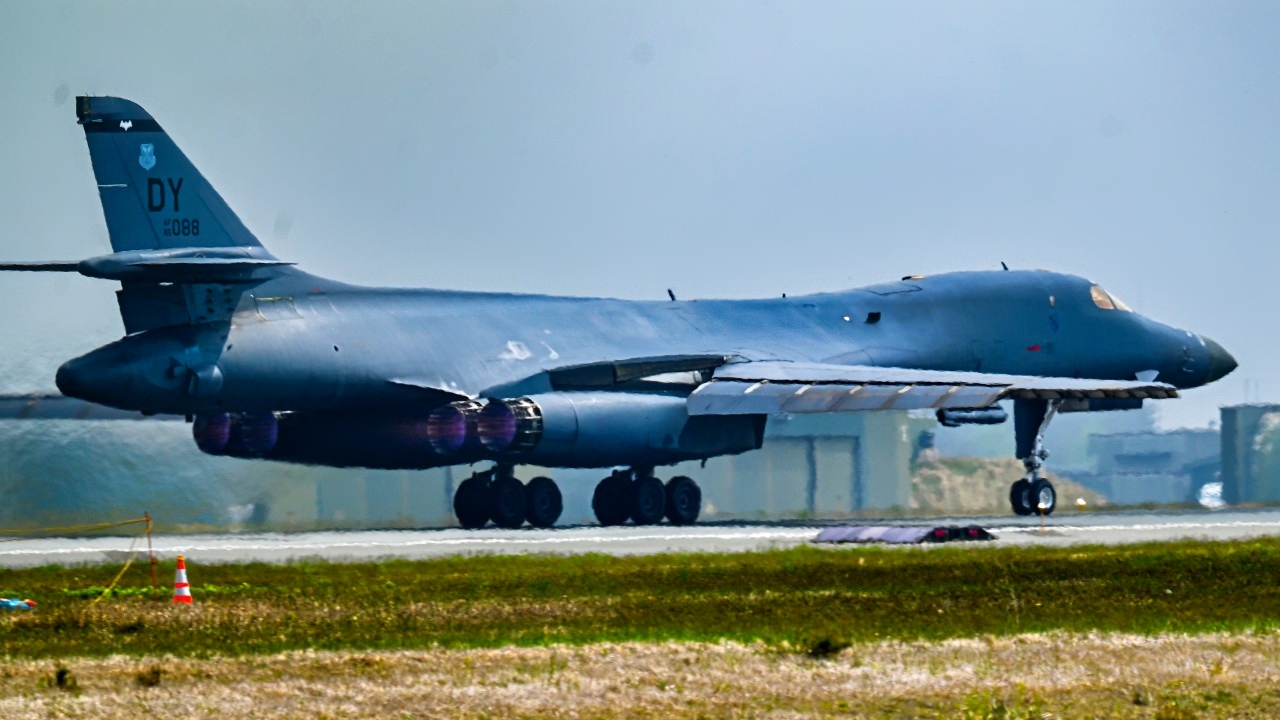
A B-1B Lancer prepares to return to Dyess Air Force Base, Texas, during Bomber Task Force 25-2 at Misawa Air Base, Japan, May 15, 2025. BTF missions provide opportunities to train and work with our allies and partners in joint and combined operations and exercises. (U.S. Air Force photo by Airman 1st Class Mattison Cole)
However, those transit charges could be applied after that period.
That’s bad news if true.
This is where it all gets sloppy. Trump said the strait reopens now and is free, then backtracked and said it would open this Friday; the Iranian draft says it reopens in 30 days, under “Iranian arrangements”, with now what looks like fees to be set by Tehran later.
Iran had not charged tolls before the war, which means the “toll-free” guarantee Trump is touting would, at best, restore what already existed while Iran asserts a new fee regime around it. But, at present, why would Iran give up its greatest point of leverage right now?
In the Iranian version of the MOU, the Strait of Hormuz is open under ‘Iranian arrangements’.
Yeah, that feels like a wink and nod to tolls or some sort of control.
Let’s hope that isn’t true. Or this whole thing is over before it even started.

A U.S. Air Force B-1B Lancer assigned to the 37th Bomb Squadron receives maintenance during Red Flag 24-3 at Nellis Air Force Base, Nev., July 24, 2024. Red Flag is an exercise that provides Airmen and Guardians with the opportunity to work alongside allied air forces in a realistic combat training environment. (U.S. Air Force Photo by Senior Airman Yendi Borjas)
Money First, Talks Later: The Sequencing Problem
The 14 points, as Mehr describes them, front-load Iran’s rewards.
The draft suspends sanctions on Iranian oil and petrochemical revenues and makes Iran’s financial resources fully accessible, with roughly $24 billion in frozen assets released during the 60-day negotiating window — before a final agreement is reached. Iran’s deputy foreign minister, Kazem Gharibabadi, has been explicit that Tehran will enter the next phase of talks only after verifying that Washington has delivered on ending the war, lifting the blockade, and releasing the funds. The structure places the concessions Iran wanted at the front and those the United States wanted at the end.
That sequencing is a problem because the back end is where the war’s actual cause sits, and the Iranian draft narrows it sharply. According to Mehr, the final negotiation would be limited to the fate of Iran’s enrichment activities, sanctions relief, and the reconstruction of Iran’s economy — and would leave out Iran’s missile program and its support for what Tehran calls resistance groups entirely.
Those two exclusions are precisely the items Israel and many in Washington have insisted any durable deal must address. A framework that pays Iran up front and then negotiates a final agreement with the missiles and the proxies removed from the table is one Iran can present at home as a victory, which is exactly how Tehran is presenting it.

Iran F-14 Tomcat Fighter. Image Credit: Creative Commons.
The Lebanon Clause Israel Never Signed
The draft’s most immediate fault line was exposed before the ink was even dry. The 14 points open with an immediate and permanent end to fighting on all fronts, including Lebanon — but Israel, which has been waging its own war against Hezbollah, is not a party to the memorandum and is not bound by it.
Yes, that’s right. Again, if true, this deal is already looking dead and buried.
Hours before the agreement was announced, Israeli forces struck Hezbollah in Beirut, and Iran has called Lebanon a red line. Trump himself said the strike should not have happened and publicly called Prime Minister Netanyahu a difficult person to deal with, a rare break with an ally that underscored how little control Washington has over the one front most likely to unravel the deal.
The contradiction is structural and unresolved. The United States is promising Iran a Lebanon ceasefire it cannot enforce, because the country doing the fighting there has not agreed to stop and answer to its own calculations. Iran has built that ceasefire into its published terms as a binding commitment.
The first Israeli strike on Hezbollah after Friday’s signing will test whether the entire memorandum survives contact with the war it claims to have ended.
A Real Pause On Paper, And A Deal That Does Not Yet Agree With Itself
The caveats matter, and they cut in Iran’s direction as much as Washington’s.
The 14 points come from Iranian state-affiliated media, citing a source close to Tehran’s negotiating team. The text has not been published or verified, and the United States has not confirmed its contents — Trump dismissed an earlier Iranian account of the terms as fabricated.
A US official has already rejected Iran’s characterization of the sequencing. The actual memorandum is not due to be public until after the signing ceremony set for Friday in Switzerland, which means the version shaping headlines this morning is Tehran’s, and Tehran has every incentive to describe a deal that looks like a win.
What is not in dispute is that the two governments are describing the same document in incompatible terms, and that the incompatibilities sit on the load-bearing points: when the strait reopens and on whose terms, whether Iran can charge for passage, when Iran gets paid, what the final talks cover, and whether the Lebanon ceasefire means anything while Israel keeps striking.
The core de-escalation is real and worth having — the shooting between the United States and Iran has stopped, and the blockade is lifting. But a deal whose two signatories cannot yet agree on its terms is not a settled peace. It is a ceasefire resting on a text that has to be read the same way by both sides, and, on this morning’s evidence, it is not being read the same way at all.
Friday will reveal which version was real. Until then, the safest assumption is that the hardest parts of this war are still ahead.
About the Author: Harry J. Kazianis
Harry J. Kazianis (@Grecianformula) was the former Senior Director of National Security Affairs at the Center for the National Interest (CFTNI), a foreign policy think tank founded by Richard Nixon based in Washington, DC. Harry has over a decade of experience in think tanks and national security publishing. His ideas have been published in the NY Times, The Washington Post, The Wall Street Journal, CNN, and many other outlets worldwide. He has held positions at CSIS, the Heritage Foundation, the University of Nottingham, and several other institutions related to national security research and studies. He is the former Executive Editor of the National Interest and the Diplomat. He holds a Master’s degree focusing on international affairs from Harvard University.


