

The ongoing military conflict with Ukraine has resulted in severe fuel shortages in Russia and Crimea, and frequent drone strikes have brought the Russian economy to the brink of collapse.
Some analysts and the Ukrainian Foreign Minister believe these drone attacks are forcing Russian President Putin to seek an end to the war before it’s too late.
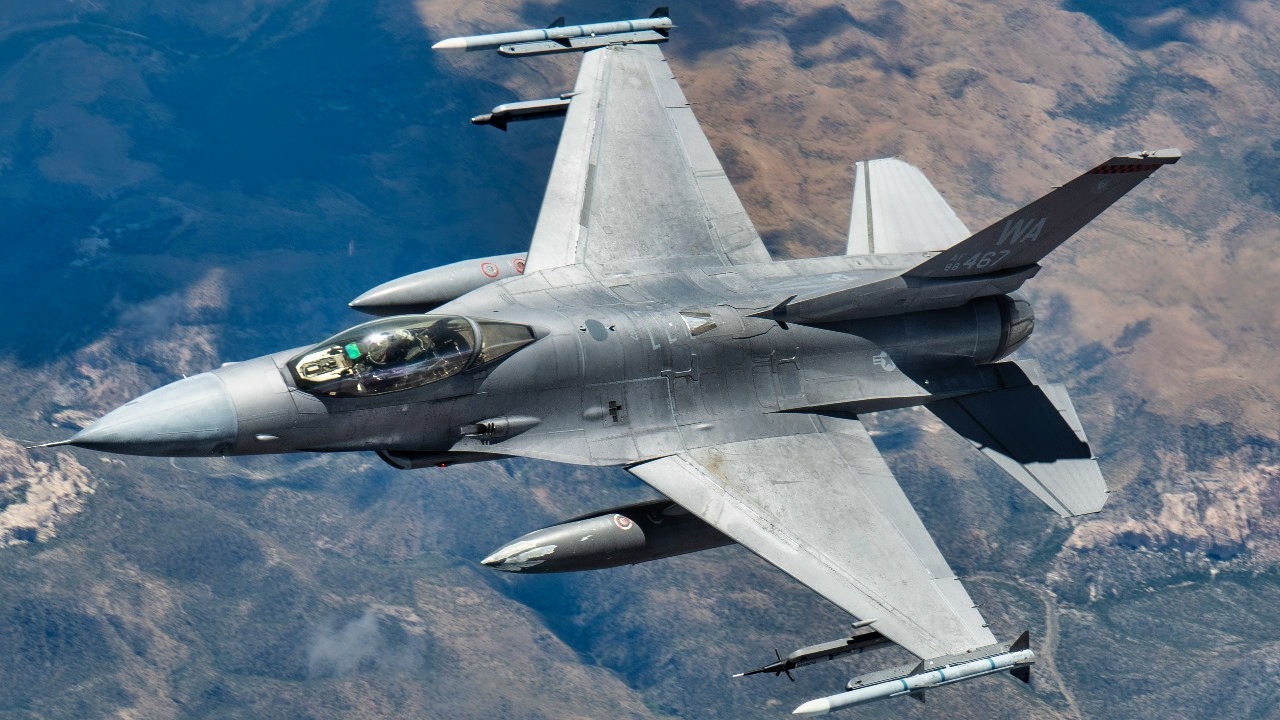
A U.S. Air Force F-16 Fighting Falcon assigned to the 16th Weapons Squadron flies over the Nevada Test and Training Range during a Weapons School Integration (WSINT) mission, June 9, 2025. WSINT is a graduate-level training event that combines multi-domain assets in large-force scenarios, enabling U.S. Air Force and joint service members to hone tactical expertise and integrate advanced capabilities in a dynamic threat environment. (U.S. Air Force photo by Staff Sgt. Jose Miguel T. Tamondong)
The Ukrainians are cutting the Russian supply line to the Crimean peninsula, as the Russians’ attempts at resupply are choked by drone attacks. This has led to Ukraine cutting off and isolating Crimea from Russia.
Ukraine’s Foreign Minister Sees NATO Membership In The Future
In an interview with PBS’ Simon Ostrovsky, Ukraine’s Foreign Minister Andriy Sybiha, to discuss the ongoing war, its relationship with the West and the United States, and if he believes that Putin will be forced to sue for peace.
Ostrosky asked about Ukraine’s relationship with the United States and President Trump, who has had a contentious relationship with President Zelenskyy. “
We have great cooperation with our American friends, and we are thankful for their efforts. Without the United States, it is not realistic to achieve tangible results in our peace efforts.”
“Our security and the security of the United States, the transatlantic security, they are indivisible. Everything is interlinked. And I think that a strong Ukraine is also a national interest of the United States.”
Ostrosky asked him point-blank whether NATO membership is in Ukraine’s future.
“Definitely,” Sybiha said. “Ukraine must and will become a member of the E.U. After the Hungarian elections, probably, we will eliminate the most difficult political obstacle.”

F-16 Fighting Falcons assigned to the 114th Fighter Wing sit ready on the ramp while conducting an elephant walk at Joe Foss Field, South Dakota, July 2, 2025. The 114th Fighter Wing conducted an elephant walk to demonstrate its ability to project fighter airpower. (U.S. Air National Guard photo by Master Sgt. Luke Olson)
“Prime Minister Viktor Orban’s defeat in last month’s election in Hungary cleared the last remaining barrier for Ukraine’s E.U. ascension negotiations.”
And about Russia and Putin being forced to try to end the war, Sybiha said, “We have proven that there are no safe places in Russia, and we can reach out to 2,000 kms.
“The most important thing now is to end this war. Ukraine wants to end this war. We have doable proposals. We are in the momentum to use our leverage to pressure Russia, not to ease sanctions, but, on the contrary, to increase pressure on Russia and to raise the price of further aggression personally for Putin.
“He must admit that he will never achieve his goals on the battlefield,” he added.
The Pressure On Putin Now To Seek A Peace Deal Is Rising
Ukrainian drone attacks are raising the cost of the war and pressuring Russian President Vladimir Putin, but they have not forced him to seek peace. Instead of pursuing negotiations, Putin’s administration has responded with escalated counterstrikes and shifts in domestic policy.
However, with the attacks on Russia growing in intensity and effectiveness, Russian citizens are feeling the effects of the war, with long lines at gas pumps as attacks have caused gas shortages. Airport travel has been significantly affected, and citizens are turning against the war, seeking peace.
Many Russian military analysts now consider the land bridge to Crimea to be nothing short of a “highway of death” for Russian logistics. In addition to the gas and oil attacks, Ukraine conducted coordinated strikes against the Osa air defense system, five coastal radar stations in Crimea, Russian command locations, UAV facilities, weapons shelters, and logistics vehicles across the peninsula.
Russia is losing ground and has too many troops in Ukraine
The war has turned in favor of Ukraine in recent months, in no small part due to Ukraine’s Special Operations Forces, who have unleashed devastating drone attacks on Russia, and even the capital in Moscow.
Since April, the Russians have lost more ground than they have taken, although for months, their gains have come at a glacial pace.
But even more importantly, Russia’s personnel losses, numbering about 1.4 million in total, and averaging between 30,000 and 35,000 a month, are now outpacing the military’s ability to replace them with new replacements.
This “mobilization gap” is severely impacting frontline operations and forcing the Kremlin to consider increasingly drastic measures to sustain its war effort.
The recruitment of voluntary contract soldiers for the Russian military dropped by about one-third this spring. High casualty rates, combined with economic strain from rising financial bonuses, are making it harder to attract fighters.
Because recruitment targets are falling significantly short of losses, frontline Russian units are badly understaffed.
Reports from media outlets have outlined how this mobilization deficit has forced the Russian military leadership to cannibalize elite units and weigh the political risks of enacting a new wave of mass mobilization, which the population opposes.
The Drone War Isn’t About Taking Ground, But Wearing Down Russia
The Ukrainian plan is vastly different from their failed, bloody 2023 offensive, where they tried to take back Crimea and cut off the Russian army inside Ukraine.
Ukrainian General Mykhailo Zabrodsky, who helped plan that 2023 offensive, said, “In 2023, it was about physical isolation and cutting off the land corridor to Crimea.
The intention of such a plan would have involved capturing a significant part of the territory and could have marked a turning point in the war.
“After the lack of success [in the counteroffensive]… the idea of isolating Crimea has returned again. Today, the number and quality of the Ukrainian armed forces’ strike drones allow the implementation of such a plan.”
This plan, in combination with Ukrainian maritime operations blockading Crimea from the Black Sea, is likely to cause “serious pain for the Russians”, he added.
Ukraine’s isolation of Crimea by conducting a “logistical lockdown” of Russian forces and attacking their ability to resupply their troops has resulted in seizing the initiative.
Frontline units are being stripped of air defenses as the Russians are moving them to protect Moscow and oil refineries.
The Russians may be more willing than ever to seek a true peace deal.
About the Author: Steve Balestrieri
Steve Balestrieri is a National Security Columnist. He served as a US Army Special Forces NCO and Warrant Officer. In addition to writing on defense, he covers the NFL for PatsFans.com and is a member of the Pro Football Writers of America (PFWA). His work was regularly featured in many military publications.


