


Warsaw, Poland – The city of Moscow has come under attack from Ukraine’s drone army for the third time in six days. Reports state that at least 60 drones were launched overnight from 21-22 June, which, among other disruptions, created temporary closures for the third time at all of the Russian capital city’s four major airports.
Ukraine Hits Moscow with Third Round of Attacks in Six Days
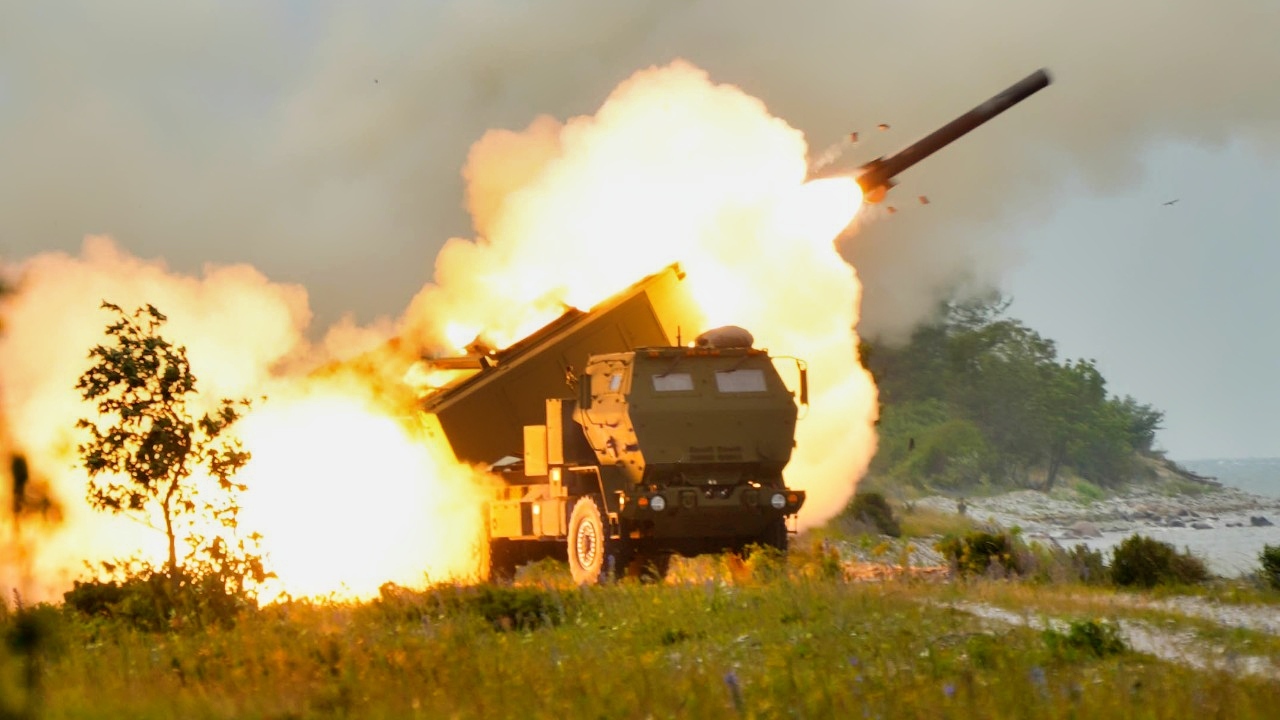
An Estonian Defense Forces M142 High Mobility Artillery Rocket System (HIMARS) fires a training rocket during a live-fire exercise in Undva, Estonia, July 11, 2025. U.S. Army elements from Bravo Battery, 1st Battalion, 14th Field Artillery Regiment, 75th Field Artillery Brigade, supporting Task Force Voit, assisted in the training process. The task force was originally formed in 2023 to support the Estonian Defense Forces in the creation of a HIMARS unit. Task Force Voit works closely with the Estonian Armed Forces, sharing critical defense strategies, training, and military readiness support. The presence of U.S. troops in the region serves as a cornerstone of NATO’s commitment to security in the Baltic region. The task force provides combat-credible forces to V Corps, America’s only forward-deployed corps in Europe. (U.S. Army photo by Staff Sgt. Rose Di Trolio)
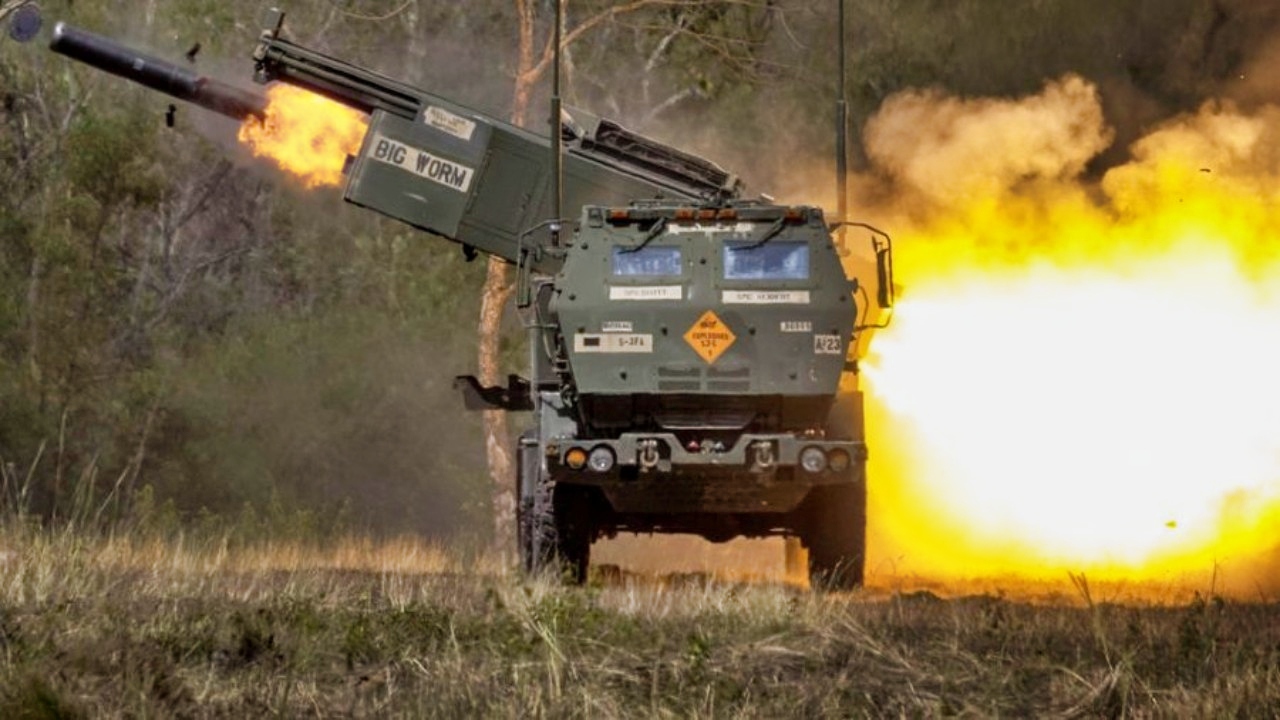
HIMARS. Image Credit: U.S. Government.
Beginning at 0400 Moscow time, the city’s mayor, Sergei Sobyanin, began posting regular updates claiming that a number of drones had been intercepted and downed before they could reach their targets. He also said at one point that 27 drones had been downed in the period of just one hour.
At about the same time, Russia’s Federal Air Transport Agency, Rosaviatsiya, announced that operations were being instituted at Moscow’s Domodedovo and Zhukovsky airports. Restrictions were also imposed at the best-known international airport in the Moscow area, Sheremetyevo. A total of 367 flights were canceled or delayed.
Sobyanin later said stated that a total of 32 drones had been targeted against the city, but those numbers do not make sense given that he claimed that 27 of them had been shot down – that would mean that only five of the strike drones actually made it to their targets.
This seems an unlikely and too low a number, given that videos posted on Russian social media sites and Telegram channels showed drones flying over Moscow, with explosions in the background.
Failing Air Defenses for Moscow
Generating an even greater mystery was Sobyanin revising the numbers upward by later stating that “air defense forces shot down 84 UAVs during the raid on Moscow alone. There was no damage or casualties.”
But analysts at the Institute for the Study of War in Washington, DC, have stated the obvious: Ukraine’s ability to hit Moscow repeatedly and at will is exposing serious weaknesses in Russia’s air defenses.
After the Ukrainian attacks, Russian military bloggers began criticizing more caustically than ever the censorship that has been imposed on any reporting about these attacks, as well as the Russian government’s inability to protect the civilian population from these attacks.
What more than one commentator is saying today is that the air defenses are not just inadequate. They appear unable to carry out the most elementary tasks associated with this category of military operations, leaving open the question of whether these batteries are manned by adequately experienced personnel or properly maintained.
One of those is RAND Corporation analyst Michael Bohnert, who has been covering the conflict in almost granular detail. Images of Russia’s air defense failures “keep pouring in,” he writes on his X account. “There is something fundamentally wrong with Russian air defense,” he concludes. It is more than Ukraine just using what are proving to be overwhelming numbers, “good route planning, and long-term preparations.”
Are The Russians Even Prepared for These Attacks?
He points out what appear to be numerous shortcomings that are almost inexplicable given how long the war has been going on.
One of those is how high the Ukrainian drones and missiles flew without being intercepted – at altitudes where they should have been easy to intercept.
“Many were flying what appeared to be between 100 and 300 feet. At this altitude radar visibility should have been in the dozens of miles, even in a city with buildings. This leads to my first observation, many of the Russian fire units appear to be unready for the incoming drones,” he writes.
“Many of the shots are only after the drone has passed. Either the operators are untrained (highly likely), the command and control is poor (I have yet to hear radios in the background of fire teams shot videos), or there is next to no early warning,” he continues.
Poor procedures and execution are not the only shortcomings. Substandard personnel also appear to be the root of many of the problems, he comments.
“It is very hard to separate poor training from poor equipment.” An image he included with his posting has become one of the more circulated of the 18 June attacks on Moscow. It shows one of the Russian air defense personnel shooting a man-portable air defense missile (MANPAD) at one of the incoming Ukrainian drones.
“The missile immediately veers off somewhere else. It could be operator error either with poor shot selection or general procedures. It could be faulty systems providing poor feedback. It could be older systems that can’t handle saturation well,” he writes.
To learn more details of how and why these air defense units keep failing he observes that if we all wait for the next big attack the world is likely to find out. “We probably won’t have to wait long,” he concludes.
About the Author: Reuben F. Johnson
Reuben F. Johnson has thirty-six years of experience analyzing and reporting on foreign weapons systems, defense technologies, and international arms export policy. Johnson is the Director of Research at the Casimir Pulaski Foundation. He is also a survivor of the Russian invasion of Ukraine in February 2022. He worked for years in the American defense industry as a foreign technology analyst and later as a consultant for the U.S. Department of Defense, the Departments of the Navy and Air Force, and the governments of the United Kingdom and Australia. In 2022-2023, he won two awards in a row for his defense reporting. He holds a bachelor’s degree from DePauw University and a master’s degree from Miami University in Ohio, specializing in Soviet and Russian studies. He lives in Warsaw.


Glowboys
June 22, 2026 at 6:45 pm
a small nuke will fly by the end of july.
europe has really been fighting this war vicariously thru ukraine and putin knows this. they’ve been supplying weapons and support all throughout. putin knows this.
at very least he’s going to go for blood now, they both for the most part been leaving civillian stuff alone, ukraine, the petty tyrant just nixed that. it’s going to get ugly fast.
JOSEY WALES
June 22, 2026 at 8:39 pm
WOW YOU MEAN TO TELL US THAT MOSCOW HAS FINALLY BEEN SURROUNDED BY THE UKRANIAN ARMY GROUP A???? IS ARMY GROUP B STILL ADVANCING ON STALINGRAD, ER, LENINGRAD???
zcks
June 22, 2026 at 10:47 pm
If Ukraine keeps purposely attacking civilian targets like this I don’t see the Russians continuing to hold back.