
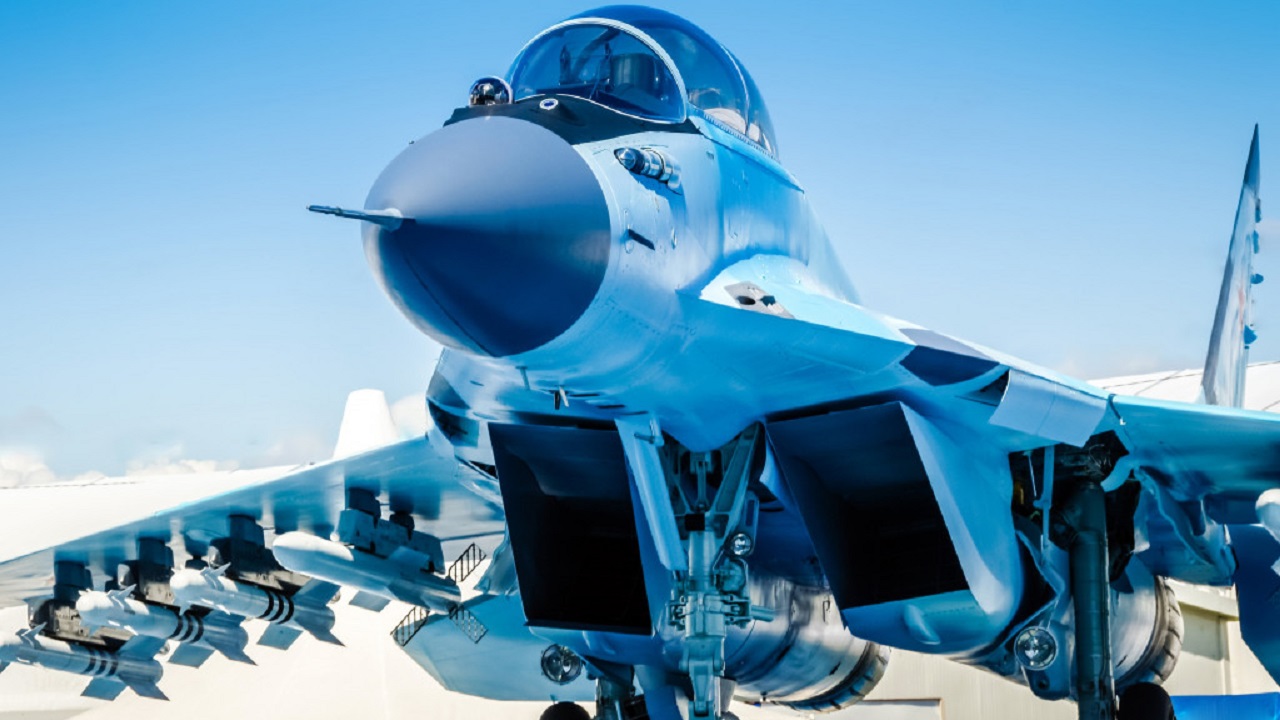
In 2025, a Russian fighter aircraft that was purchased only in small numbers returned to the headlines when reports indicated that Russian officials were seeking ways to revive production amid the ongoing war in Ukraine.
The MiG-35, despite its lack of export success, was being considered to give Russian forces an edge in Ukraine, but the news revealed an uncomfortable reality for Moscow.
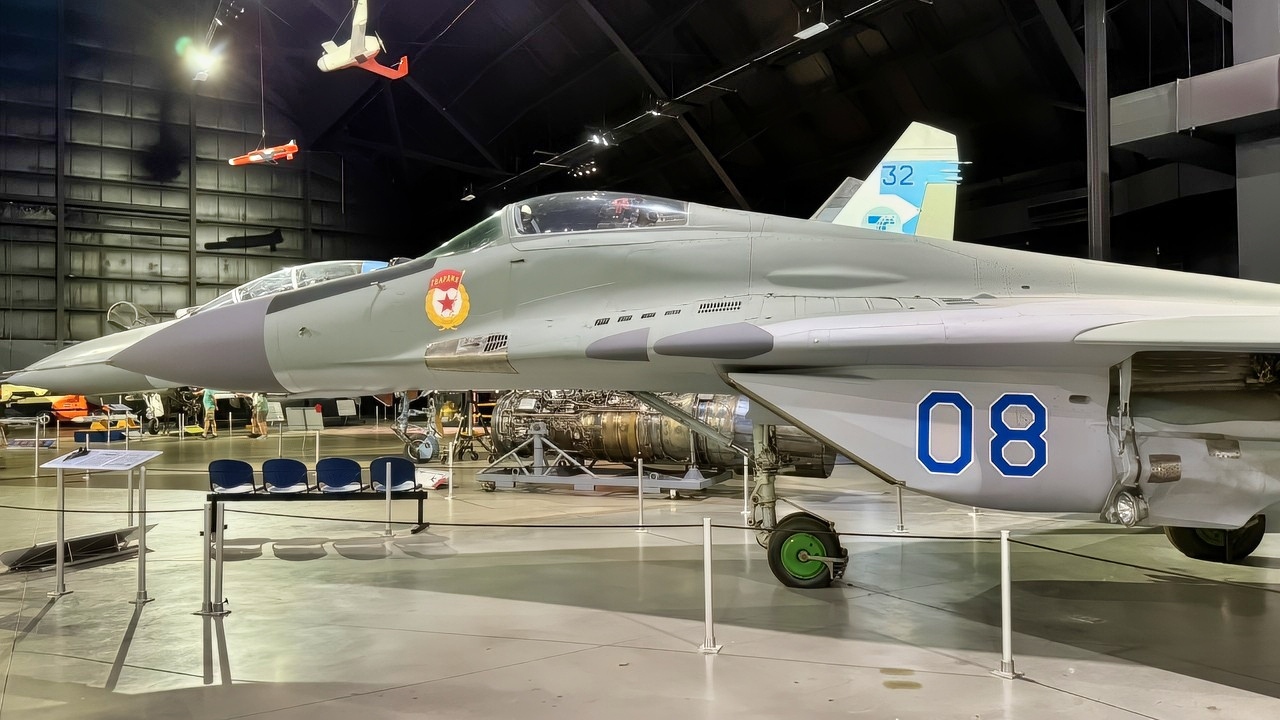
Real MiG-29 at USAF Museum in Dayton. Image Credit: National Security Journal.
It was clear that, after years of fighting in Ukraine, the conflict was becoming so resource-intensive that Moscow desperately needed a low-cost multirole fighter aircraft to help turn around its fortunes.
A Relatively New Aircraft
The MiG-35 can trace its origins back to the MiG-29, one of the most famous and successful fourth-generation fighters ever produced by the Soviet Union.
Developed during the Cold War to counter aircraft such as the F-15 and F-16, the MiG-29 had a reputation as an agile fighter with strong dogfighting capabilities.
It was also a huge export success. But when the Soviet Union collapsed, the MiG design bureau struggled financially while its rival, Sukhoi, began to gain influence within the Russian aerospace industry.

MiG-29 Flares. Image Credit: Creative Commons.
To remain relevant, MiG began developing newer, more advanced versions of the MiG-29, which eventually evolved into the MiG-35.
It was not an entirely new aircraft. The MiG-35 is probably best understood as the ultimate evolution of the MiG-29 family.
It does look different, with a redesigned airframe – but it’s still based on the same design.
It features new avionics and improved sensors, modern cockpit displays, and substantially upgraded combat capabilities.
The aircraft was officially unveiled to the international market in 2017, and the first production aircraft entered Russian service in 2019.
What Makes the MiG-35 Different?
The MiG-35 is not a fifth-generation fighter, despite the substantial upgrades.
Russia instead classifies the aircraft as a “4++” generation fighter, meaning it incorporates many of the technologies associated with fifth-generation aircraft while missing one critical defining feature: stealth.
The fighter is powered by two RD-33MK turbofan engines and can reach speeds of approximately Mach 2.25.
It has a combat radius exceeding 600 miles and can carry a wide range of air-to-air and air-to-ground weapons on nine external hardpoints.
And one of its most important overall improvements is its avionics suite. The aircraft has a modern glass cockpit and digital flight control systems, as well as upgraded electronic warfare equipment.
Those upgrades mean the MiG-35 is capable of conducting air-superiority missions, ground-attack operations, precision strikes, and reconnaissance.
It provides many of the capabilities of a heavy Russian fighter but operates at a much lower cost.
Why the MiG-35 Never Became A Success
Even with its impressive specifications, the MiG-35 never achieved much success. It certainly wasn’t the success Moscow had hoped for, and the biggest problem was timing.
By the time the aircraft had reached maturity, Russia had already invested heavily in the Su-30SM and Su-35.
Both aircraft offered better range, heavier payloads, and generally stronger performance.
It meant that the Russian Aerospace Forces showed less enthusiasm for purchasing large numbers of MiG-35s – and so, it didn’t.
Export opportunities also didn’t seem to materialize.
Countries that traditionally purchased Russian fighters began opting for Western and Chinese aircraft, while others chose upgraded versions of their existing fleet.
In recent years, Russia has also seen a general decline in fighter exports, further complicating efforts to market the MiG-35 abroad.
Throw in the matter of sanctions, and it should come as no surprise that Russia finds itself struggling to make and sell fighters overseas.
The aircraft, therefore, found itself in a difficult position.
It was certainly more advanced than legacy MiG-29 variants, but it didn’t have the prestige or the performance advantages of Russia’s top fighters – and with limited export interest, there was no reason for the MiG-35 to see any real success.
Cost Considerations
One of the best arguments for the MiG-35 was cost.
The fighter jet was designed to be cheaper to acquire and operate than heavier Russian fighters while offering much of the same performance and capabilities.
In theory, it should have been an attractive option for both Russia and foreign customers seeking a capable fighter at a lower price.
In practice, though, that advantage didn’t prove significant enough to outweigh the superior payload and range of other aircraft. And plans to revive the MiG-35 never materialized, either.
Despite the speculation, Moscow never followed through with any publicly announced procurement plan.
There was no major production run announced, no substantial new orders were revealed, and the aircraft remained overshadowed by both the Su-35 and Su-57 programs.
Despite all of its advanced avionics and its potential as a low-cost fighter, the MiG-35 struggled to find a place within Russia’s modern air force. It was a promising fighter that seemed to arrive at the wrong time.
About the Author: Jack Buckby
Jack Buckby is a British researcher and analyst specializing in defense and national security, based in New York. His work focuses on military capability, procurement, and strategic competition, producing and editing analysis for policy and defense audiences. He brings extensive editorial experience, with a career output spanning over 1,000 articles at 19FortyFive and National Security Journal, and has previously authored books and papers on extremism and deradicalization.


