
Ukraine Warns Russia May Be Preparing Northern Offensive: Amid Ukraine’s hugely successful long-range strike campaign, Kyiv is now warning that a new Russian offensive could be on the way – this time, from the north. And the goal this time would not be to capture Kyiv, but to stretch Ukrainian defenses to their limits.
Commander-in-Chief Oleksandr Syrskyi said in an interview that was broadcast on Tuesday that he believes Moscow may be preparing a new military offensive from Russia’s Bryansk region into Ukraine’s Chernihiv region, opening up a new axis of attack designed to force Kyiv to expend valuable reserves. In effect, Russia would force Kyiv to use interceptors and put its air defense systems into high gear, right as it batters Russian oil infrastructure. The new warning comes as Ukrainian authorities also assess that Russian troops are showing signs of exhaustion and that the long-range campaign against Russian targets is having the intended effect.
Why Ukraine Thinks Russia Could Attack from the North

U.S. Soldiers assigned to the 2nd Armored Brigade Combat Team, 1st Cavalry Division supporting the 4th Infantry Division maneuver an M1A2 Abrams tank and M2 Bradley Fighting Vehicle past a simulated opposing force’s Leopard 2A6 tank during exercise Arrow 23 in Niinisalo, Finland, May 5, 2023. Exercise Arrow is an annual, multinational exercise involving armed forces from the U.S., U.K., Latvia, Lithuania and Estonia, who train with the Finnish Defense Forces in high-intensity, force-on-force engagements and live-fire exercises to increase military readiness and promote interoperability among partner nations. (U.S. Army National Guard photo by Sgt. John Schoebel)
Speaking in an interview with Ukrainian broadcaster TSN, Syrskyi said multiple intelligence sources point toward the possibility of new offenses along Ukraine’s northern border.
“The most likely scenario, and this is confirmed by several data sources, is possible offensive action in the north from the territory of Russia, from the Bryansk region,” he said. “This is a realistic option, of course, and we are preparing for it.”
Syrskyi insisted that the objective of the new campaign would differ significantly from the failed attempt to seize Kyiv during the opening weeks of the war in February, 2022. Rather than sending forces directly toward the capital, Russian forces are expected to attempt to capture territory in the Chernihiv region while forcing Kyiv to redeploy units from other sectors of the front.
An operation like this, he said, would amount to “stretching” the front and depriving Ukraine of its reserves.
The assessment follows warnings by Ukrainian President Volodymyr Zelenskyy in May that Ukrainian intelligence suggested Russia was preparing for multiple scenarios for expanding the war through Ukraine’s northern borders. Kyiv, at the time, announced it would reinforce defenses around the Chernihiv-Kyiv corridor as a result.

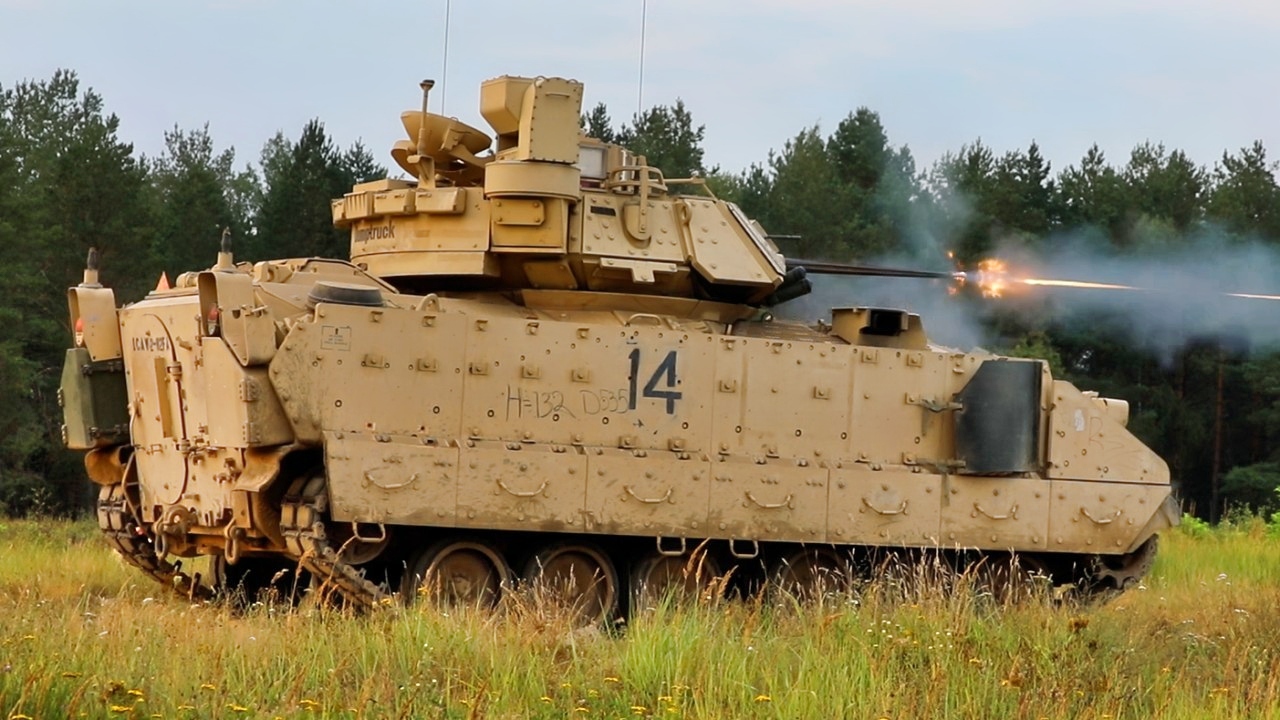
The Bradley Fighting Vehicle cuts loose several rounds from the 25mm main gun on the orchard Combat Training Center Range.
Soldiers completed training this week of the Bradley Commanders Course with the 204th Regional Training Institute, (RTI), of the Idaho Army National Guard on Gowen Field. The course is designed to train active duty, reserve and national guard officers and non-commissioned officers in combat critical M3 Bradley Fighting Vehicle Commander Skills. Field exercises were conducted on the newest Range 10, the Digital Air Ground Integrated Range (DAGIR), on the Orchard Combat Training Center grounds.
What Happened to Belarus
The recent exchanges of hostile words between Minsk and Kyiv may not lead to the conflict some have suggested it would.
While Belarusian leader Alexander Lukashenko warned Kyiv to stop issuing threats, he also warned that his response to any such action would “change” the nature of the war. According to Syrskyi, Kyiv assesses that another invasion launched from Belarusian territory is now less likely than it was before.
Belarus was crucial for the Russian assault on Kyiv in 2022. The country served as a staging ground for Russia’s assault, allowing its forces to cross its territory during the invasion’s opening phase. However, Syrskyi believed that the political calculation in Minsk had changed since then.
“In view of recent events, I don’t think the Belarusian leadership would opt to use their own territory and give it to the aggressor to use as a staging area for an offensive operation,” he said. “At the same time, of course, we are taking this possibility into account as well.”
His comments follow weeks of diplomatic pressure between Kyiv and Minsk, which started when Zelenskyy warned Lukashenko to remove Russian military communications systems from its northern border.
The relay stations were said to be assisting Russian drone attacks – and when Kyiv gave Minsk one week to remove them, they were reportedly switched off or moved before Kyiv could launch an assault.
Russia’s Offensive is Starting to Slow
During the same interview, Syrskyi described how Russia’s momentum on the front lines is weakening. He described how the intensity of fighting along the front has been falling steadily in recent weeks as Russia reallocates resources to defend its vast territory from ongoing long-range Ukrainian strikes. According to the commander-in-chief, the slowdown is also a product of exhaustion among Russian forces after months of sustained operations across Eastern Ukraine that are delivering diminishing returns.
The problem for the Russian army is huge: according to recent reports, the average lifespan of a Russian soldier sent to the front line has fallen to just 20 minutes.
Syrskyi described how Moscow continues to launch assaults across multiple sectors of the front; Ukraine believes that units are facing mounting logistical challenges, in part caused by problems at home – including the destruction of critical military hubs in Crimea and elsewhere. Ukrainian forces continue to strike oil refineries, fuel depots, communications centers, and military infrastructure that support soldiers on the front line – and every new strike places more pressure on the front.
The 40-Day Campaign
Talk of a renewed Russian offensive from the north comes only days after the Ukrainian president announced he had approved a 40-day campaign of long-range strikes designed to raise the cost of Russia sustaining the war.
In a statement, Zelenskyy said that it is his intention to “press for an end to the war” and bring Putin to the negotiating table by striking critical infrastructure that supports the war effort both logistically and economically.
About the Author: Jack Buckby
Jack Buckby is a British researcher and analyst specializing in defense and national security, based in New York. His work focuses on military capability, procurement, and strategic competition, producing and editing analysis for policy and defense audiences. He brings extensive editorial experience, with a career output spanning over 1,000 articles at 19FortyFive and National Security Journal, and has previously authored books and papers on extremism and deradicalization.


Alex FITCH
July 1, 2026 at 2:17 pm
Thanks for the nice pictures, having NOTHING to do with the article. I’m one of the few Americans who have not memorized the Ukraine map.
You might think about that for your next article .