

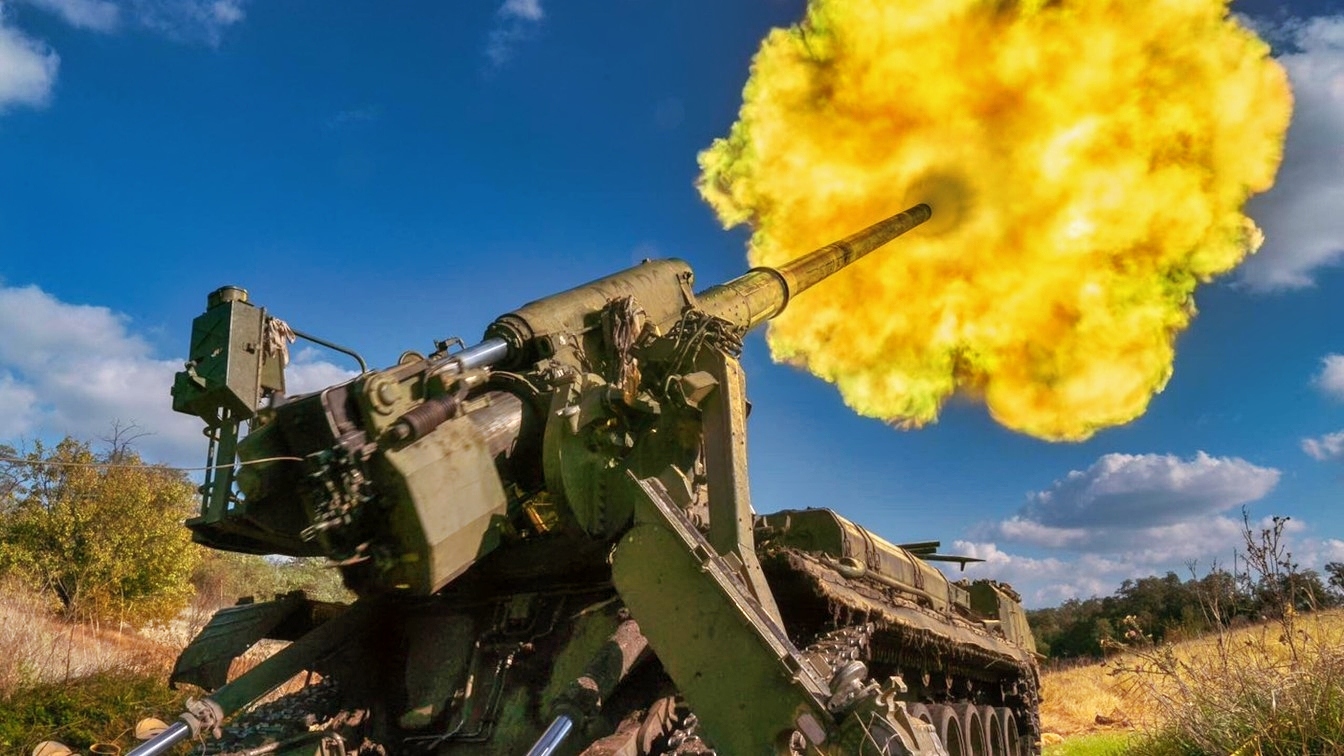
Both Russia and Ukraine are increasingly relying on tactical glide bombs as traditional artillery becomes more vulnerable to drones. The shift reflects the ongoing revolution in warfare, where persistent ISR drones, electronic warfare, and precision strike have made massed artillery difficult to use. Presently, Russia leads in both the inventory and operational experience of glide bombs. But Ukraine has begun fielding its own domestically produced glide bomb, too, suggesting that both sides see the weapon as central to the campaign’s future.
Battlefield Problems
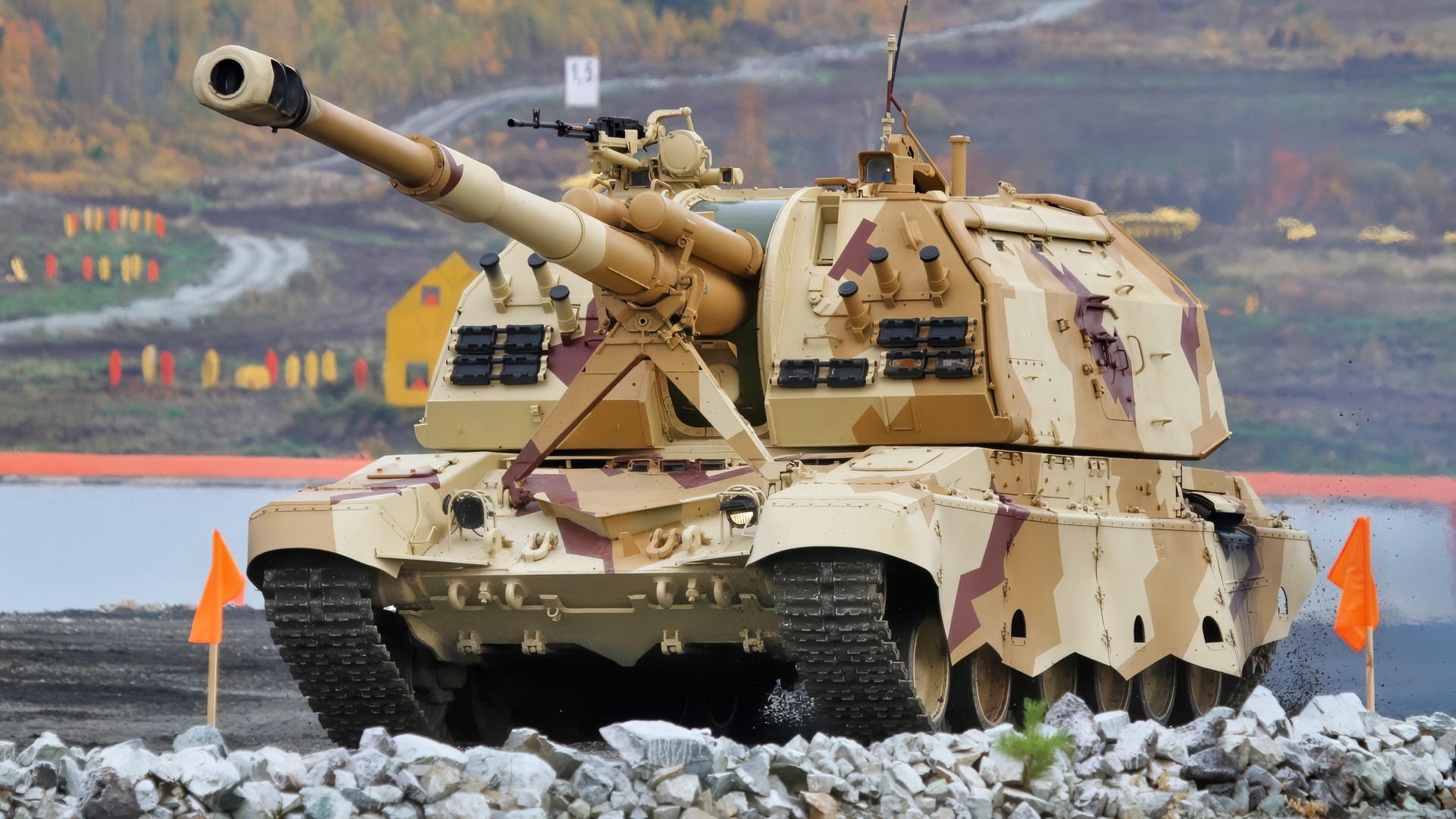
Russian Artillery. Image Credit: Creative Commons.
Both Ukraine’s and Russia’s forces depend on delivering indirect fire before infantry advances. Traditionally, this role belonged to artillery. But drones have fundamentally changed that equation.
Constant UAV surveillance means artillery pieces are often detected almost immediately after firing. Counterbattery strikes, FPV drones, and loitering munitions then make it difficult to survive repeated firing missions. This limits the ability to sustain artillery fire rates.
Both sides have suffered heavy artillery losses, and now many of the surviving guns are pushed farther back from the front. The longer distances naturally reduce the effectiveness of shorter-range systems, leaving mortars and FPV drones to fill the gap as best they can.
But these offer smaller warheads, are weather dependent, and are vulnerable to electronic warfare. They also have a limited destructive effect compared to sustained artillery fire. Militaries still require heavy explosive effects to support maneuvers. Both sides needed a solution. Enter the glide bomb.
From a gun that shot at trees to an $18 billion boondoggle, these are the 5 worst and most disastrous weapon systems in U.S. Army history. Image Credit: U.S. Army.
Introducing the Glide Bomb
Taking a conventional unguided bomb and adding folding wings, a guidance package, control surfaces, and INS/GPS navigation, you get yourself a glide bomb, which is released by aircraft dozens of kilometers from its intended target.
The wings deploy, and the bomb glides to its objective while the launch aircraft remains outside the enemy air-defense envelope. Compared with drones, glide bombs can deliver hundreds of kilograms of explosives rather than a few kilograms.
And compared to artillery, glide bombs offer a much longer reach. And compared to cruise missiles, glide bombs are dramatically cheaper.
Basically, glide bombs are cheap, smart-guided bombs that offer precision heavy firepower.
Russian Adoption
Russia has adopted glide bombs quickly. With a massive Cold War stockpile of FAB bombs, Russia simply added UMPK guidance kits rather than building entirely new weapons. Several variants are compatible with Russian aircraft such as the Su-34, Su-35, and Su-30.
Russia has continued to improve its systems throughout the war. Early versions were vulnerable to Ukrainian GPS jamming, but later versions featured Kometa anti-jam satellite navigation, greater reliance on inertial navigation, and increased glide range.
The reported range of original variants was about 60–80 kilometers, but newer variants offer a 95-kilometer range, allowing aircraft to remain farther from Ukrainian SAMs. Russia has reportedly launched over 1,800 glide bombs during the first week of June alone, using them against troop concentrations, logistics nodes, UAV command posts, bridges, and defensive positions. Indeed, glide bombs are increasingly replacing artillery as the preferred heavy tactical strike weapon.
Ukrainian Reaction
Ukraine has responded to the Russian adoption of the glide bomb. Initially dependent on Western systems such as the JDAM-ER, French AASM Hammer, and Rusty Dagger, Ukraine had limited inventories and was fully reliant on foreign deliveries. Now, seeing the value of the concept, Ukraine is developing a domestic alternative, the “Equalizer,” or Vyrivniuvach.
The Equalizer is a 250-kilogram-class weapon developed under Brave1. Featuring an indigenous wing kit and guidance package, the Equalizer was reportedly first used in combat in June 2026. This gives Ukraine a sovereign production capability rather than forcing it to rely entirely on imported glide bombs.
Glide bombs are well suited for replacing artillery’s explosive effect. But unlike artillery, glide bombs require surviving combat aircraft and sufficient air superiority to reach release points. That means countries without functioning air forces cannot employ glide bombs the way Ukraine and Russia have been able to. But so far, that hasn’t been a problem for either side in the present conflict.
The Russo-Ukrainian War continues to reshape modern warfare.
Persistent drones have made traditional artillery increasingly exposed. But rather than abandon massed fires, both militaries are adapting, converting inexpensive gravity bombs into precision stand-off weapons.
About the Author: Harrison Kass
Harrison Kass is a writer and attorney focused on national security, technology, and political culture. His work has appeared in Tablet, City Journal, The Hill, The Spectator, and The Cipher Brief. He holds a JD from the University of Oregon and a master’s in Global & Joint Program Studies from NYU. More at harrisonkass.com.


Swamplaw Yankee
July 1, 2026 at 4:04 pm
LOL, Buddy? What about the big guy move into the Muslim GULF miasma?
The much promoted IDF Merklava tank devils could advance safely right into Bayt-e Rahbari GHQ without a single loss.
With loyal wingmen UAV controlled from each IDF super tank, the imagery conveyed to IDF planes safe + way back over Haifa, these precision glided bombs would have reduced every possible obstacle to the Israeli tank army to a swift regime change.
No need to launch a single super expensive Tomahawk or Patriot paid for by US taxpayers.
All the other tank armies control loyal wingman UAV’s, glided bombs, why were the super duper IDF Merklava tanks saved from showing their true field abilities to the elite at the Bayt-e Rahbari HQ?