


The New York Times reported that Iran and Oman are moving forward with plans to collect transit fees from ships transiting the Strait of Hormuz, despite public objections from the United States, according to an Iranian official and four diplomats who are involved.
If enacted, the plans would represent a significant change from Oman’s previous stance on charging fees to transit the strategic waterway.
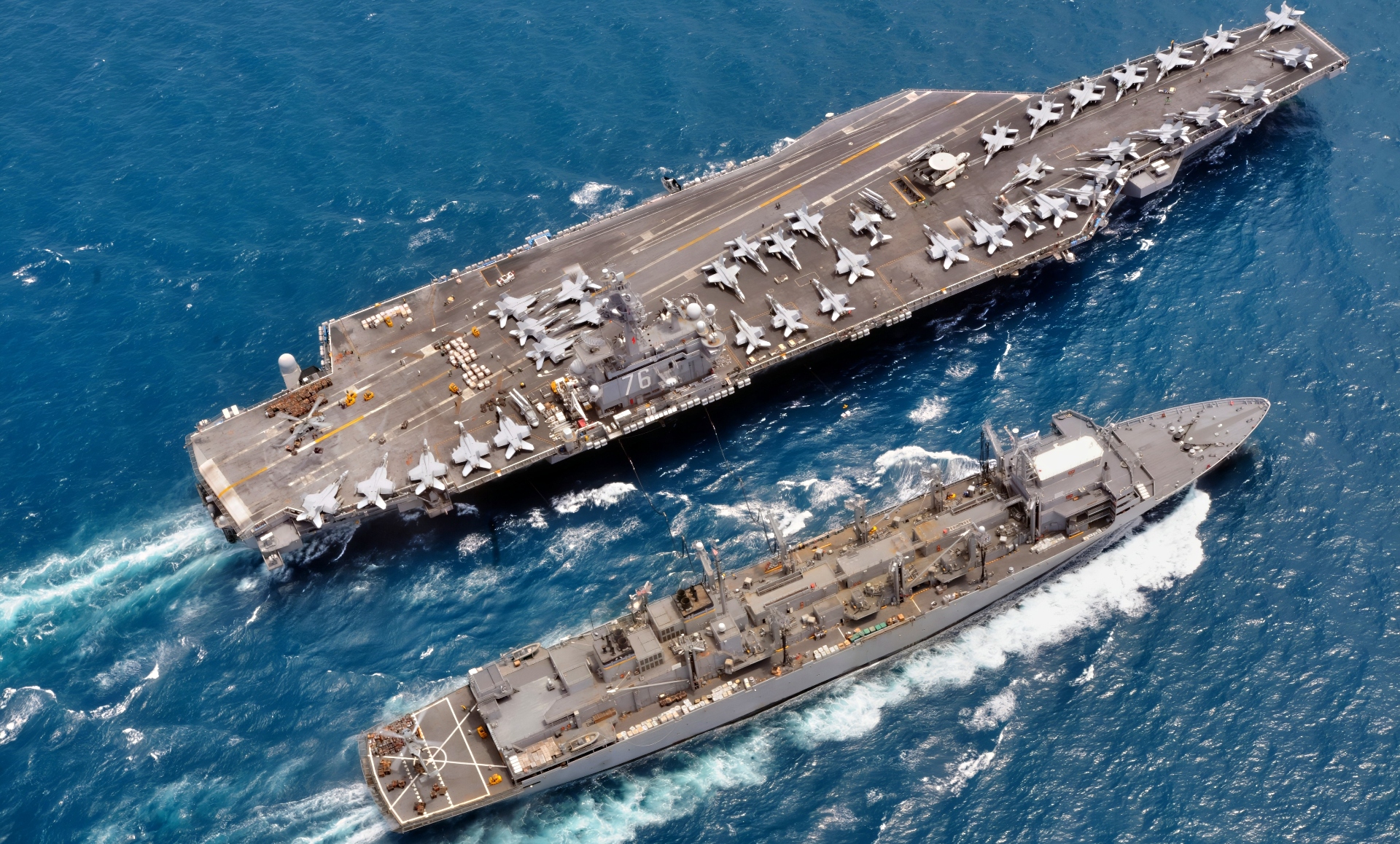
(August 15, 2008) With SH-60 helicopters moving pallets of supplies both USS Ronald Reagan (CVN 76) and USNS Bridge (T-AOE 10) work together during a replenishment at sea or RAS. With Reagan’s six galleys and approximately 4,100 Sailors it takes a lot of produce to feed that many folks and the Nimitz-class aircraft carrier got what it needed from USNS Bridge to do so.
The Ronald Reagan Carrier Strike Group is on a routine deployment in the 7th Fleet area of responsibility. Operating in the Western Pacific and Indian Ocean, the U.S. 7th Fleet is the largest of the forward-deployed U.S. fleets covering 52 million square miles, with approximately 50 ships, 120 aircraft and 20,000 Sailors and Marines assigned at any given time.
U.S. Navy photo by Senior Chief Mass Communication Specialist (SW/NAC) Spike Call
Before the conflict, the Strait of Hormuz was an international shipping route between Iran and Oman, through which vessels sailed freely, carrying oil and gas from the Persian Gulf to the rest of the world.
During the fighting, Iran effectively blocked the waterway, an important chokepoint for global trade, sending energy prices skyrocketing.
Since then, Iranian officials have repeatedly declared their intentions to monetize the strait. However, the exact nature of these charges remains a point of intense diplomatic negotiation and international disagreement.
Oman’s Proposal Is a Voluntary Service Fee
Omani officials propose a voluntary service-fee model to fund maritime safety, environmental protection, and emergency services, rather than a mandatory toll.
Oman’s proposal is modeled on the Straits of Malacca and Singapore agreements, an Asian waterway where a private Japanese foundation collects voluntary contributions for safe navigation, the regional diplomat said.
The fees in the Strait of Hormuz would be voluntary, according to Oman’s proposal. Oman’s Foreign Minister, Badr al-Busaidi, has rejected transit fees as illegal but has distinguished between “transit fees” and fees for services provided by countries along the strait.
The Iranian Deputy Foreign Minister, Kazem Gharibabadi, however, insists that the payments would be obligatory and has threatened to impose tolls unilaterally if Oman does not reach a joint agreement with Iran.
The United States has repeatedly said commercial navigation through the Strait of Hormuz should remain free. President Donald Trump has called the idea of charging ships “unacceptable.” The president threatened Oman with military action if it “did not behave like everyone else.”

(July 11, 2014) – The aircraft carrier USS Ronald Reagan (CVN 76) is underway during Rim of the Pacific (RIMPAC) 2014. Twenty-two nations, more than 40 ships and submarines, more than 200 aircraft and 25,000 personnel are participating in RIMPAC exercise from June 26 to Aug. 1, in and around the Hawaiian Islands. The world’s largest international maritime exercise, RIMPAC provides a unique training opportunity that helps participants foster and sustain the cooperative relationships that are critical to ensuring the safety of sea lanes and security on the world’s oceans. RIMPAC 2014 is the 24th exercise in the series that began in 1971. (U.S. Navy photo by Mass Communication Specialist 2nd Class Jacob Estes/Released)
US Secretary of State Marco Rubio also rejected the proposal during a visit to Bahrain last week, saying the United States would oppose any system that requires ships to make payments, regardless of whether they are called fees, tolls, or voluntary donations.
“We need to get back to what the straits looked like before this conflict,” Rubio said.
Treasury Secretary Scott Bessent also warned that the U.S. would aggressively penalize and sanction any actors facilitating a toll scheme.
Anyone cooperating with the Persian Gulf Strait Authority or paying these tolls will face severe sanctions risks, as the funds ultimately benefit the Islamic Revolutionary Guard Corps (IRGC).
“The Iranian military’s latest attempt to extort global maritime trade is proof that Economic Fury has left the regime desperate for cash,” said SecretaryBessent.
“Through Economic Fury, the United States has imposed a financial stranglehold on the world’s leading state sponsor of terrorism. Treasury has deprived the Iranian regime of revenue for its weapons programs, terrorist proxies, and nuclear ambitions.
“Under President Trump’s leadership, we will remain relentless in our pursuit to constrict the network of vessels, intermediaries, and buyers through which Iran exports both its oil and malevolence.”
Oman’s current proposal completely contradicts what Muscat said a few months ago.
Oman Guaranteed No Fees For Ships Transiting The Strait
Oman’s Transport Minister, H.E. Eng. Saeed bin Hamoud bin Saeed Al Maawali confirmed back in April that the Sultanate has signed agreements guaranteeing that no fees will be imposed on ships passing through the Strait of Hormuz.
“Oman’s position is clear regarding the strait – it has signed all relevant international maritime transport agreements, and fees cannot be imposed under these agreements,” he said.
The minister made the statement amid discussions about maritime charges, emphasizing Oman’s commitment to maintaining free and safe navigation through the strategic waterway.
And on June 30, in an interview with Monte Carlo International Radio, Omani Foreign Minister Sayyid Badr said that Oman rejects imposing fees on ships passing through the Strait of Hormuz, characterizing it as “internationally prohibited.”
Badr stressed that the Sultanate of Oman seeks to ensure that navigation through the Strait of Hormuz remains safe, secure, and free for all countries, including Iran, given the waterway’s importance to the global oil transshipment to the world economy.
Will Iran’s Leverage Pay Off?
The Iranians see the Strait of Hormuz as leverage against the rest of the world, something they won’t relinquish.
Mehdi Mohammadi, a senior adviser to General Mohammad Bagher Ghalibaf, Iran’s lead negotiator with the United States, said on his social media page that terminology did not matter to Iran “whether you call it tolls, service fees for security or naval passage.”
“There is no free service anywhere in the world,” he said.
Arsenio Domínguez, secretary general of the International Maritime Organization, which regulates global shipping, has said that tolls or any system that interferes with the principle of freedom of navigation through international waterways would not be in accordance with international law.
However, he too said he’d support a voluntary fee, similar to the existing arrangement in the Straits of Malacca and Singapore.
“It’s learning from something that already exists, that is being tested,” he said, adding that the aim is to find practical solutions to the crisis triggered by regional conflict, and that he intends to present various options to IMO member states “to see what is viable.”
About the Author: Steve Balestrieri
Steve Balestrieri is a National Security Columnist. He served as a US Army Special Forces NCO and Warrant Officer. In addition to writing on defense, he covers the NFL for PatsFans.com and is a member of the Pro Football Writers of America (PFWA). His work was regularly featured in many military publications.


Dr. Hujjatullah M.H.B. Sahib
July 1, 2026 at 3:55 pm
Kudos to the author for this revealing write-up, that some voluntary fee was harvested by an extra-regional power from ships transiting the Malacca and Singapore straits is indeed news to me.No wonder Trump briefly entertained the idea of even co-harvesting a Hormuz toll, even as an extra-regional power itself, if Iran was amenable to the suggestion. Regardless as to how this issue pans out in the near future, one thing is clear that current Hormuz crises has taken on multiple controversies implicating Oman,the USA and even the IMO, not to mention all the most impacted Persian Gulf parties. It is obvious that International Law, if not also multi-polar-based global governance also,cries out for a legal resolution, one that can iron out the emerging controversies by making recourse to upholding the relevant principles CONSISTENTLY!