
The fragile memorandum of understanding (MOU) cease-fire deal between the United States and Iran is on the verge of coming undone after Iran struck a commercial cargo ship passing near Omani waters, and the U.S. responded with strikes on Iranian military targets. The exchange began on Thursday when Singapore-flagged commercial cargo ship Ever Lovely was hit by a one-way attack drone while transiting close to the Omani side of the Strait of Hormuz.
At least four one-way attack drones were reportedly launched at the ship, with one striking the upper deck of the vessel, causing damage. No injuries were reported.
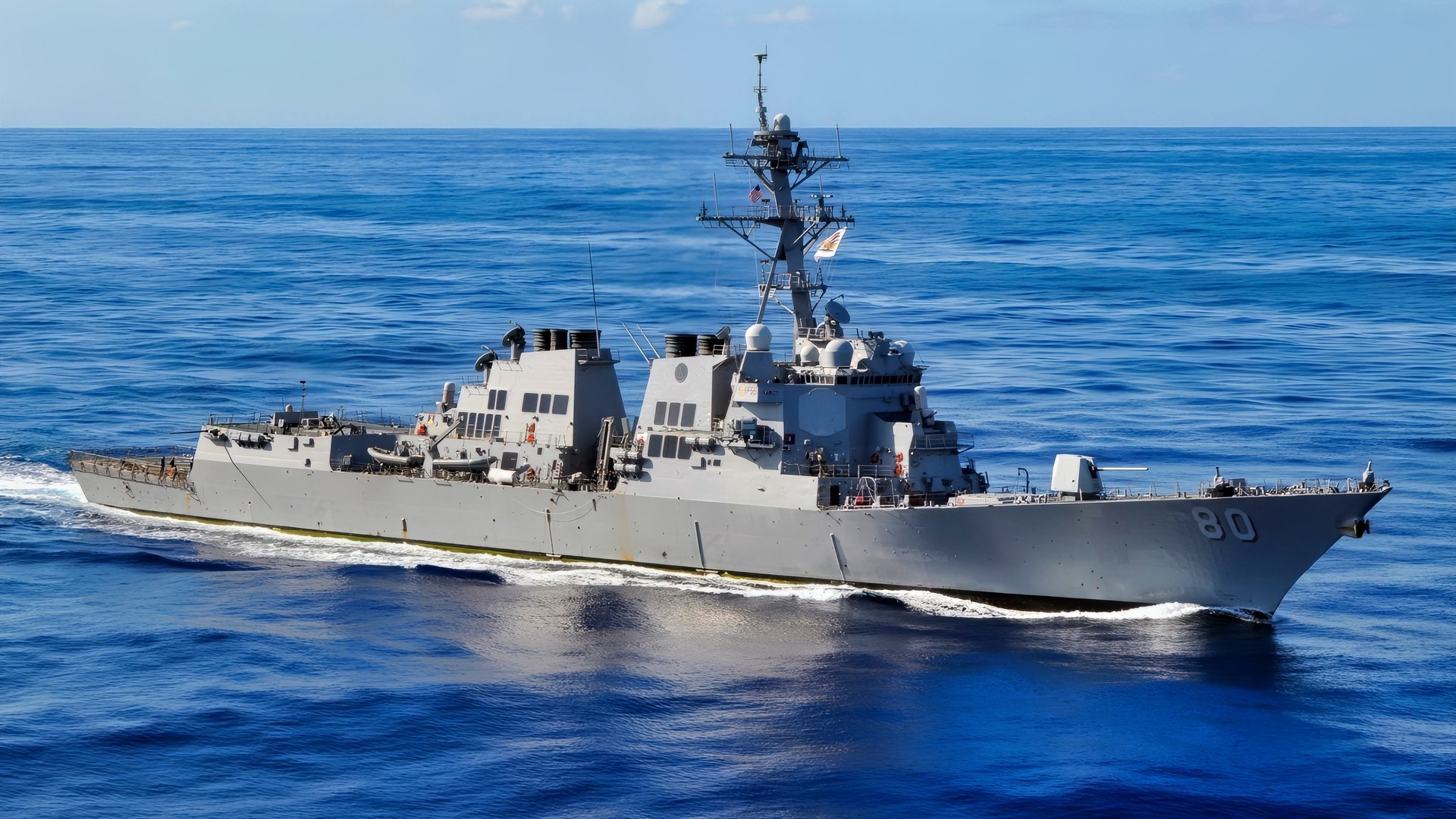
ATLANTIC OCEAN (Sept. 06, 2008) – The guided-missile destroyer USS Roosevelt (DDG 80) steams through the Atlantic Ocean. Roosevelt is deployed as part of the Iwo Jima Expeditionary Strike Group (ESG) in support of maritime security operations in the Navy’s 5th and 6th fleet areas of responsibility. The Iwo Jima ESG is made up of Roosevelt, homeported at Mayport, Fla.; the amphibious assault ship USS Iwo Jima (LHD 7); the amphibious dock landing ship USS San Antonio (LPD 17); the amphibious transport dock ship USS Carter Hall (LSD 50); the guided-missile cruiser USS Vella Gulf (CG 72); the guided-missile destroyer USS Ramage (DDG 61); all homeported at Norfolk, Va.; and the fast attack submarine USS Hartford (SSN 768), homeported at Groton, Conn. U.S. Navy photo by Mass Communication Specialist 2nd Class Jason R. Zalasky (Released)
President Donald Trump called the attack a “foolish violation” of the MOU and said that the ship “took a little beating” but remained operational.
The incident surprised commercial shipping companies and analysts who believed that the MOU had established a safe passage route for commercial ships.
It also followed the announcement of a United Nations-backed safe route through the Strait of Hormuz intended to evacuate more than 11,000 stranded civilian seafarers.
The latest strikes only add to the confusion, creating yet more uncertainty for commercial shipping firms and insurers.
Why Iran Lashed Out
The Iranian naval drone strike occurred after the Islamic Revolutionary Guard Corps issued a threat stating that any ships attempting to pass through the Strait without Iranian permission or outside Tehran-approved routes would be responsible for the consequences. Tehran was responding to news of a United Nations-backed route that was established to support the evacuation of vessels stranded in the Persian Gulf since the outbreak of the Iran War.
“The only authorized route for passage through the Strait of Hormuz is the route announced by the Islamic Republic of Iran,” the IRGC said in a statement on Thursday.
For Iran, the alternate shipping route posed a problem. If ships passed along the route on the Omani side of the Strait of Hormuz, it proved that passage through the Strait of Hormuz was possible without risking strikes from the Iranians. It undermined a critical point of leverage for Tehran as it attempts to hash out a peace deal with Washington that preserves its claims to the waterway.
U.S. Strikes Iranian Targets
On Friday, U.S. Central Command said that American forces struck Iranian drone and missile storage facilities and coastal radar sites in response to the drone strike.
In a statement, CENTCOM described the Iranian attack as “unwarranted aggression” against commercial shipping vessels and argued Iran’s ongoing behavior in the strait “undermined freedom of navigation as commerce increasingly flows through the vital international trade corridor.”
For the United States, the retaliatory strikes were necessary to prove that Iran cannot launch new attacks with impunity – but it is a double-edged sword.
Every new strike, including U.S. military activity in the region, creates yet more uncertainty for shipping companies and insurers seeking to restore the flow of oil from the region.
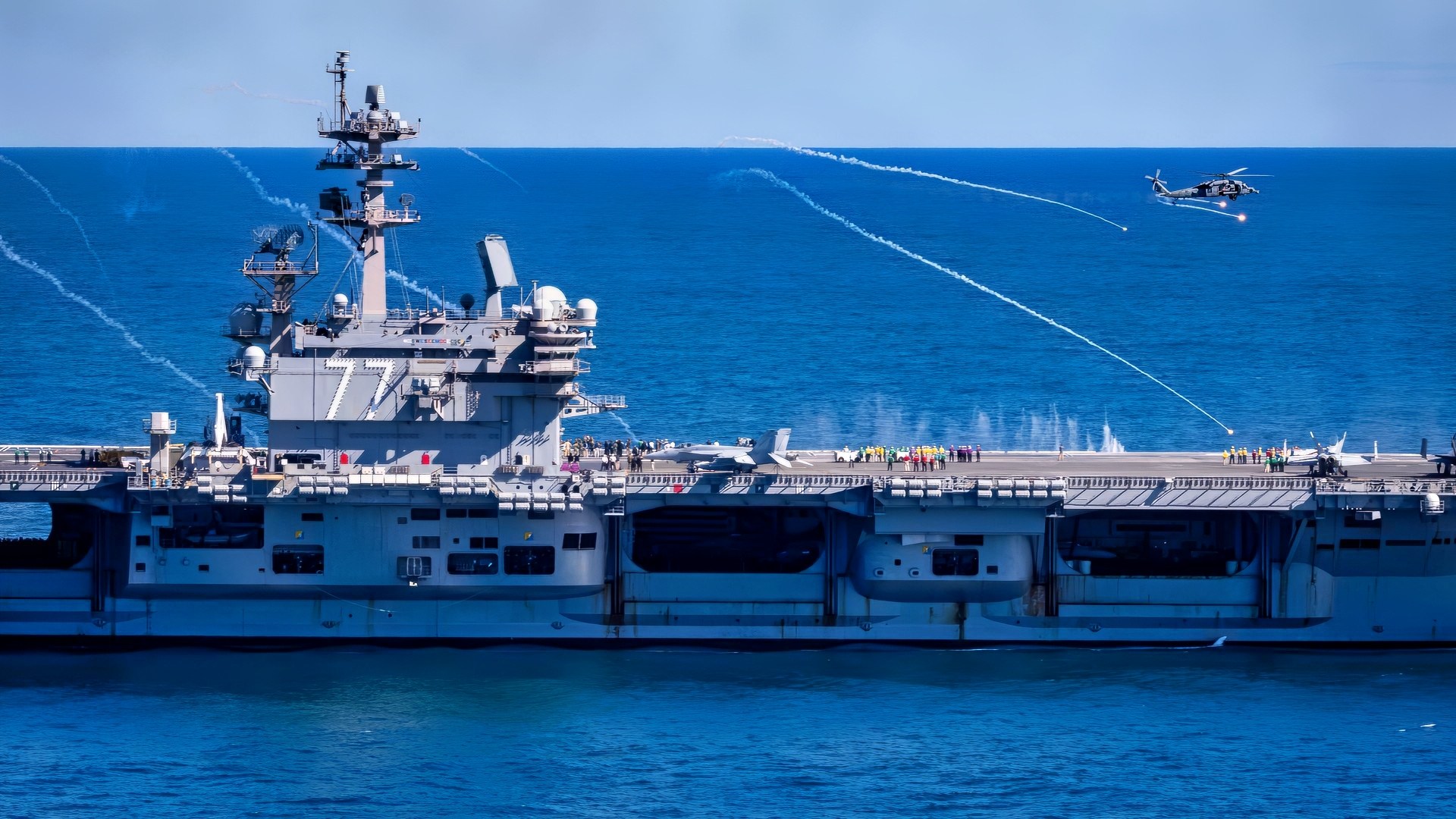
(Oct. 5, 2025) An MH-60S Sea Hawk attached to the “Dusty Dogs” of the Helicopter Sea Combat Squadron (HSC) 7 fires flares above the Nimitz-class aircraft carrier USS George H.W. Bush (CVN 77) in support of the Titans at Sea Presidential Review. The Titans of the Sea Presidential Review is one of many events taking place throughout the country to showcase maritime capabilities as part of the U.S Navy’s 250th birthday. America is a maritime nation. For 250 years, America’s Warfighting Navy has sailed the globe in defense of freedom. (U.S. Navy photo by Mass Communication Specialist 2nd Class Mitchell Mason)
On June 26, Vice President J.D. Vance responded to the recent exchanges of fire, warning that the U.S. would respond to any Iranian escalation.
“Iran signed a ceasefire agreement. We have honored it. If they have disagreements about how the MOU is being applied, they can pick up the phone. But violence will be met with violence,” Vance said.
Shipping Recovery Is Under Threat
The recent escalation threatens to reverse a fairly modest – but positive – recovery in traffic through the Strait of Hormuz.
The world understands the value of this waterway, which once moved one-fifth of global oil and liquefied natural gas shipments. Before the latest round of attacks, shipping traffic had begun to trend upward after Washington and Tehran signed a preliminary agreement to lay the groundwork for a future peace deal.
Traffic through the Strait of Hormuz increased to 78 ships on June 24 – the highest weekly total since the war began in late February.
The figures are far lower than the roughly 130 ships that would transit daily before the conflict, but are a sign that confidence is slowly returning after traffic through the strait plummeted by as much as 95% during the early days of the war.
But that progress is now once again in doubt. After the Ver Lovely was struck, the IMO was forced to halt its evacuation efforts, with only a fraction of the stranded ships having successfully passed according to plan. IMO Secretary General Arsenio Dominguez said that just 115 vessels carrying about 2,500 crew members have been evacuated since Tuesday, with almost 10,000 more civilian seafarers still waiting to pass.
Speaking to the New York Times, Michelle Wiese Bockmann, an analyst from Windward, said that “shipping is literally caught in the crossfire as the U.S. and Iran battle for control of Hormuz Strait.”
“This does little to restore confidence that security and safety can be guaranteed to get stranded ships out.”
About the Author: Jack Buckby
Jack Buckby is a British researcher and analyst specializing in defense and national security, based in New York. His work focuses on military capability, procurement, and strategic competition, producing and editing analysis for policy and defense audiences. He brings extensive editorial experience, with a career output spanning over 1,000 articles at 19FortyFive and National Security Journal, and has previously authored books and papers on extremism and deradicalization.


