

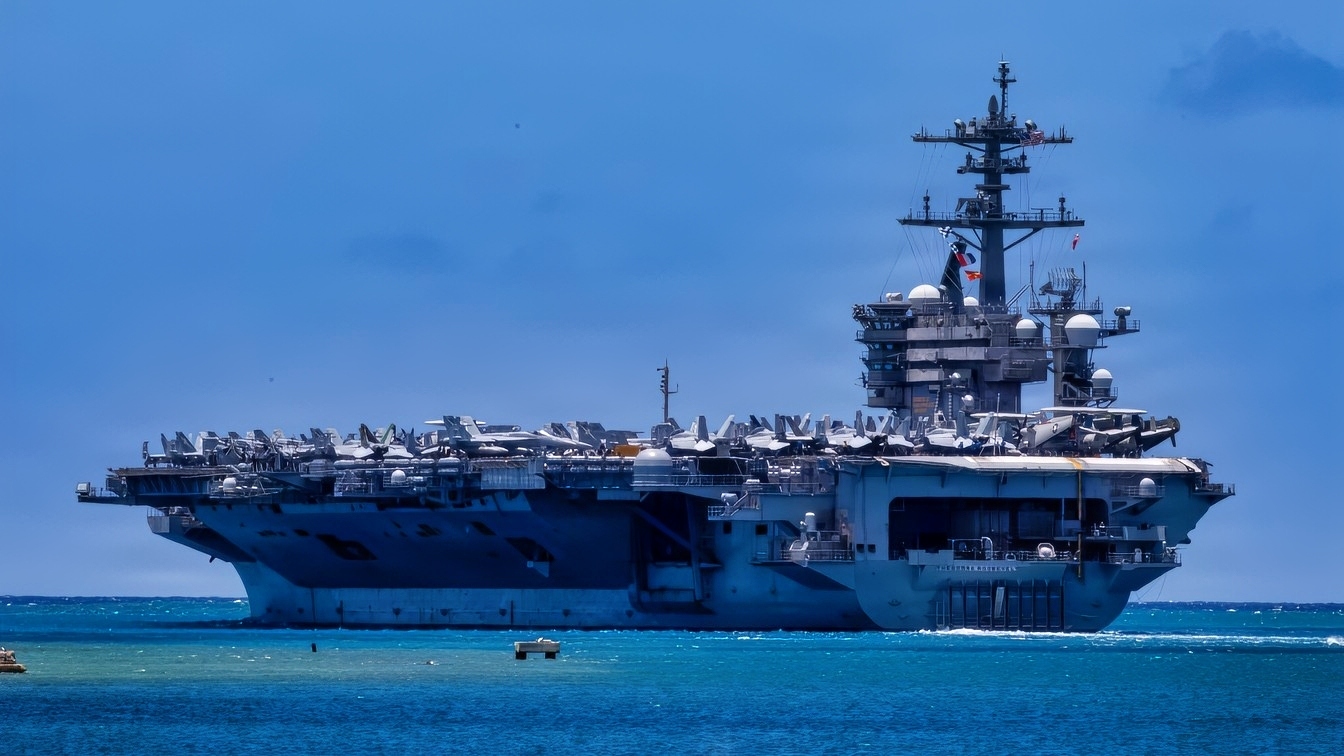
Summary and Key Points: With the Strait of Hormuz effectively closed since late February 2026, the Gulf’s oil and gas producers are pouring billions into pipelines and corridors designed to route their exports entirely around Iran. Saudi Arabia is leaning on its Red Sea pipeline and weighing a major expansion, Iraq is trying to revive a long-dead line across Syria, and Qatar is hunting for any way to move its gas overland. The effort is real, and it is slowly eroding Iran’s single greatest strategic lever. But it is not an escape. Pipelines cannot come close to matching the strait’s volume, and the new routes inherit the very Iranian threat they are meant to avoid.
Can We Go Around the Strait of Hormuz? How To Blunt Iran’s Geographic Advantage

Aviation Boatswain’s Mate (Equipment) 3rd Class Mark Ruiz, assigned to Air Department aboard the world’s largest aircraft carrier, USS Gerald R. Ford (CVN 78), prepares a Carrier Air Wing 8 F/A-18E Super Hornet attached to Strike Fighter Squadron 37 for launch on the flight deck, Aug. 1, 2025. Gerald R. Ford, a first-in-class aircraft carrier and deployed flagship of Carrier Strike Group Twelve, is on a scheduled deployment in the U.S. 6th Fleet area of operations to support the warfighting effectiveness, lethality and readiness of U.S. Naval Forces Europe-Africa, and defend U.S., Allied and partner interests in the region. (U.S. Navy photo by Mass Communication Specialist 2nd Class Mariano Lopez)
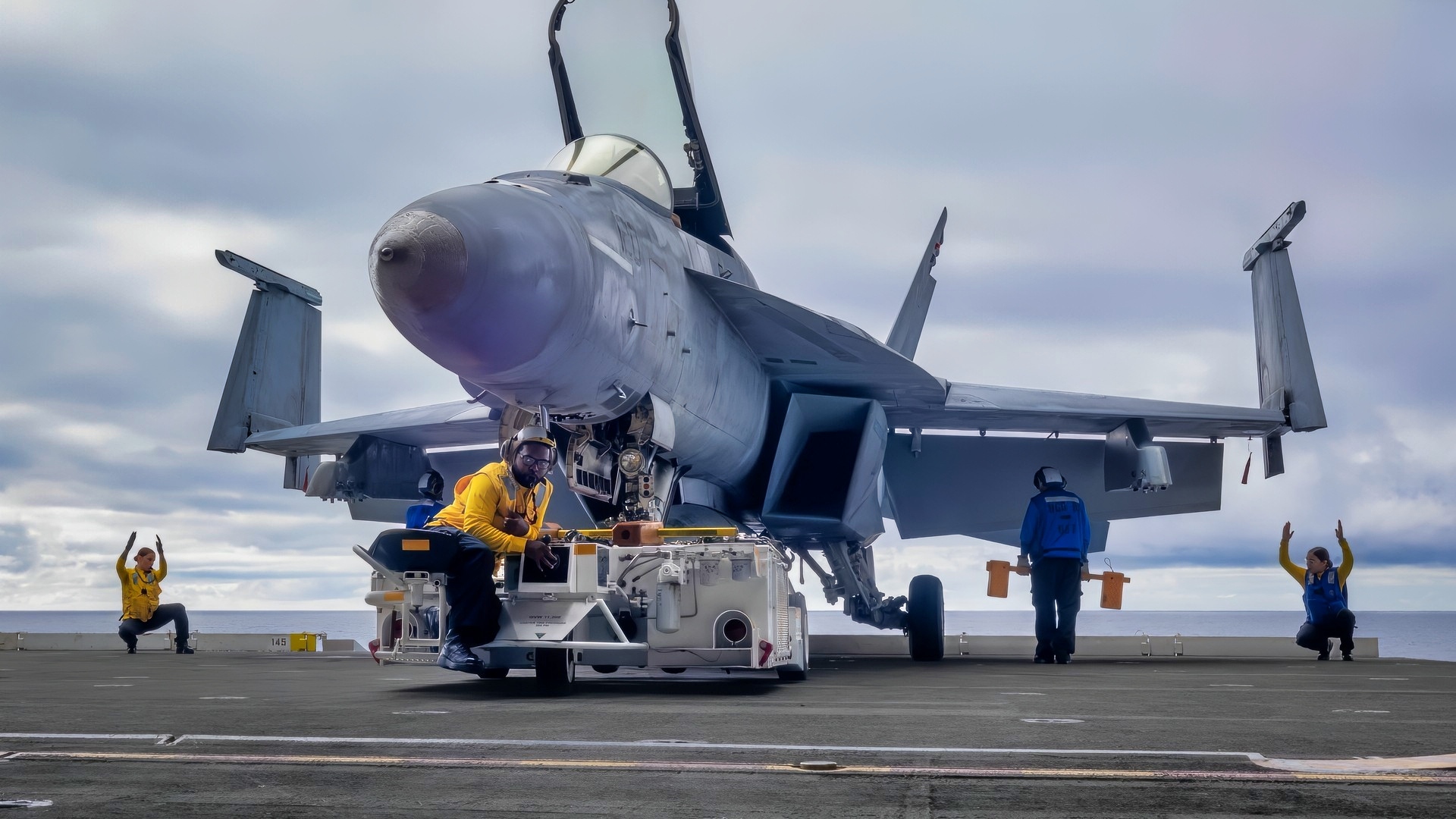
ATLANTIC OCEAN (Aug. 13, 2025) Sailors transport an F/A-18E Super Hornet attached to the “Gladiators” of Strike Fighter Squadron (VFA) 106 onto an aircraft elevator aboard the Nimitz-class aircraft carrier USS George H.W. Bush (CVN 77). George H.W. Bush is underway conducting carrier qualifications and routine operations in the Atlantic Ocean. (U.S. Navy photo by Mass Communication Specialist Seaman Apprentice Kayleigh Tucker)
For decades, Iran’s ultimate trump card was geography. Roughly a fifth of the world’s oil and a similar share of its liquefied natural gas sailed out of the Persian Gulf through a single channel that Iran overlooks along its entire northern coast: the Strait of Hormuz. As of July 11, 2026, that channel has been effectively shut for more than four months (yes, there has been some traffic that has moved through, albeit it is a tiny trickle), closed since late February when Iran, now at war with the United States and Israel, warned it would target any vessel attempting to pass.
Throughput that once ran near 20 million barrels of oil a day has collapsed to a fraction of that, in what the International Energy Agency has called the most severe oil supply shock in history.
And it has triggered exactly the response Iran should fear most: a scramble by its neighbors to ensure they never depend on the Strait of Hormuz again.
Saudi Arabia’s Red Sea Escape Hatch
The Gulf’s most important workaround already exists, and it runs the width of Saudi Arabia.
The East-West Pipeline, known as Petroline, carries crude from the oil-rich Eastern Province across the peninsula to the Red Sea port of Yanbu, entirely clear of the strait. Built during the 1980s Iran-Iraq war for precisely this contingency, it has become the kingdom’s lifeline: Riyadh is now loading up to 77 percent of its crude exports at Yanbu, running the roughly five-to-seven-million-barrel-a-day line near its limits.
The more consequential development is what comes next. State giant Saudi Aramco is reportedly weighing a multi-billion-dollar expansion of Petroline, potentially adding up to two million barrels a day of capacity toward Yanbu, along with new Red Sea export terminals and a parallel line for refined products. Because these are decisions Saudi Arabia can make within its own borders, analysts consider this the most achievable of all the bypass schemes, deliverable within a few years rather than a decade. It is the backbone of any serious effort to route the Gulf’s oil away from Iran.
Iraq’s Long Road West
Iraq is both the most desperate to escape Hormuz and the least able to.
Its southern fields around Basra, which produce the bulk of its exportable crude, are effectively Hormuz-locked, with no meaningful inland pipeline connection, and their near-total shutdown has left storage tanks overflowing. So Baghdad is reaching out in every direction at once. It has moved to more than triple flows through the northern Kirkuk-Ceyhan pipeline to Turkey, from around 220,000 to 770,000 barrels a day, and it is planning a new line to link Basra westward toward outlets in Turkey, Jordan, and Syria.
The most intriguing option runs through Syria. An old pipeline from Iraq’s Kirkuk fields to the Syrian Mediterranean terminal at Banias, completed in 1952 and shut since 1982 amid Iraqi-Syrian antagonism, is now being eyed for rehabilitation following the 2024 collapse of the Assad regime. It has been folded into a far more ambitious vision, the revived Türkiye-Syria “Four Seas” project, a proposed web of pipelines and rail corridors that Turkish and Syrian officials discussed in April and that US envoy Thomas Barrack has publicly promoted as a Hormuz alternative. On paper, it would give Gulf and Iraqi energy a path to the Mediterranean that never touches the strait.
Qatar’s Gas Trap
If Saudi Arabia shows the promise of bypass, Iraq shows the difficulty, and Qatar shows the limit. Doha is among the most exposed producers in the region because its exports are not oil but liquefied natural gas, which is far harder to reroute. It cannot simply be pumped down a repurposed crude line; moving it overland requires complex, expensive refrigerated infrastructure. The vast majority of Qatar’s LNG, like the UAE’s, has always transited Hormuz, and there is no pipeline or route in existence that could carry even a fraction of the lost volumes.
Qatar is nonetheless studying options, including routing transport lines across Saudi Arabia toward the Red Sea and a revived 2009 proposal for a Türkiye-Qatar gas pipeline running up through the Arabian Peninsula. But these remain distant concepts, and Qatar’s predicament is the clearest evidence that the Gulf cannot simply pipe its way out of Iran’s shadow.
Why Iran’s Leverage Erodes but Does Not Collapse
Add together every operational and proposed route, and the arithmetic is sobering.
The meaningful bypass systems, at full capacity, might move on the order of 10 million barrels a day, and the realistically available spare capacity is far less, against the roughly 20 million barrels Hormuz once carried. On the gas side, the shortfall is close to absolute. Even the most optimistic buildout leaves a large volume of Gulf energy with nowhere to go.
More importantly, the alternatives do not remove the Iranian threat so much as relocate it. Iran has already struck Saudi Arabia’s East-West pipeline during this war, cutting throughput by an estimated 700,000 barrels a day, and hit the UAE’s Fujairah terminal with drones. As one King’s College London analysis dryly noted, new terminals at Yanbu or Fujairah are no harder to reach with a drone than the old ones, and truly replicating Hormuz in pipelines would cost hundreds of billions of dollars and a decade of construction. And if Iraq comes to export through Syria while Qatar pipes gas across Arabia, then Syria and Iraq, both chronically unstable, simply become the new chokepoints, exposed to the same sabotage and pressure.
The honest verdict, then, lands between Iran’s fears and its hopes. The war has done real and lasting damage to Tehran’s most powerful lever, because the billions now flowing into permanent bypass infrastructure will not be unspent when the fighting ends. As Oxford Economics’ lead emerging-markets economist put it, with the investments accelerating, “Iran, and its main strategic leverage, weakens.”
But weakening is not collapse. For years to come, Iran will retain the ability to disrupt a strait that no combination of pipelines can fully replace, and to threaten the alternatives besides. The Gulf is learning to live with less of Hormuz. It has not learned to live without it.
About the Author: Harry J. Kazianis
Harry J. Kazianis (@Grecianformula) was the former Senior Director of National Security Affairs at the Center for the National Interest (CFTNI), a foreign policy think tank founded by Richard Nixon based in Washington, DC. Harry has over a decade of experience in think tanks and national security publishing. His ideas have been published in the NY Times, The Washington Post, The Wall Street Journal, CNN, and many other outlets worldwide. He has held positions at CSIS, the Heritage Foundation, the University of Nottingham, and several other institutions related to national security research and studies. He is the former Executive Editor of the National Interest and the Diplomat. He holds a Master’s degree focusing on international affairs from Harvard University.


