


Big. That is the most useful single word for the aircraft the world calls the J-36, and it is the only descriptor that rests on something anyone has seen rather than inferred. Stealth is an assumption from its shape. Sixth-generation is a label with no agreed-upon definition. Fighter may not even be the right category. But size can be measured from photographs, and the J-36 is enormous.
The aviation analyst Bill Sweetman, writing before the aircraft had been officially acknowledged at all, put it at roughly 23 meters long with a 19-meter wingspan and about 200 square meters of wing area, which makes it the largest combat aircraft China has ever built and, by his reckoning, the second largest anywhere in 35 years. Estimates of its maximum takeoff weight cluster around 50 tonnes. An F-35 at maximum takeoff weight is a little over 30. Its main internal weapons bay alone is estimated at about 7.6 meters, roughly 25 feet, with additional side bays for smaller munitions. An AMRAAM, the standard American air-to-air missile, is about 3.7 meters long.

J-36 Fighter. Image Credit: Screenshot from X.
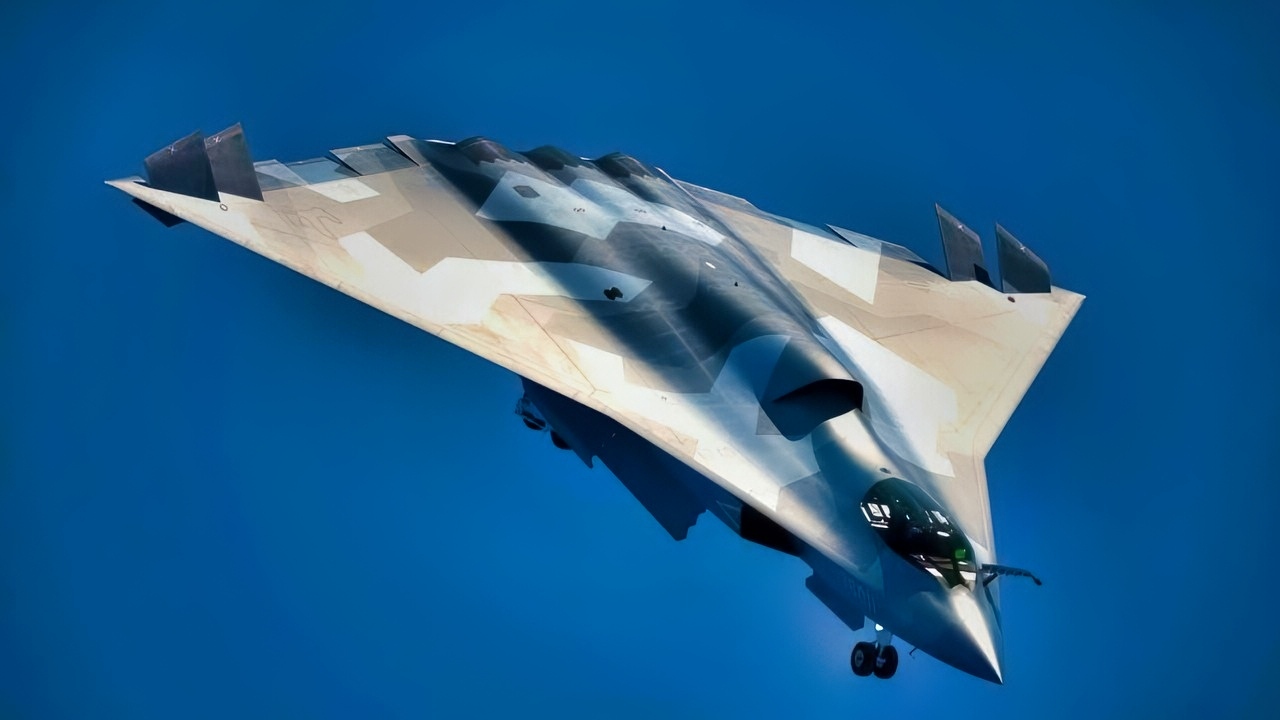
J-36 Fighter Artist Rendition from X Screenshot
Everything else worth saying about this aircraft descends from those numbers.
What Is Confirmed
The list is short. A large tailless aircraft was filmed by civilians over Chengdu on 26 December 2024 and is attributed to Chengdu Aircraft Corporation. It has a diamond-shaped double-delta wing, no vertical stabilizers, and no canards.
It has three engines, two in the fuselage and a third fed by a dorsal intake, a configuration no fighter in service anywhere has ever used. At least three prototypes have flown, and the later airframes differ noticeably from the first, including thrust-vectoring nozzles that supply the pitch authority the missing tailplanes would otherwise provide.
On 28 June 2026, after eighteen months of grainy enthusiast photography, the People’s Liberation Army acknowledged the aircraft exists. It did so in about one second of footage buried at the end of a four-minute promotional video about a transport plane, in which a pilot mentions refueling “Little Six” and a tailless shape crosses the window. That is the entirety of the official record.
What the Size Probably Means
Here, the analysis becomes inference, and it should be labeled as such.
A very large airframe with three engines and enormous internal volume is optimized for fuel and payload rather than for turning fights. Justin Bronk of the Royal United Services Institute has written that the J-36 will probably have an extremely impressive range on internal fuel and a huge internal weapons bay, and that the requirement it appears to satisfy is offensive counter-air sweeps across the enormous distances of the Indo-Pacific.
That is the strategic argument in one sentence. The Pacific is mostly water; American airpower there depends on tankers and airborne early-warning aircraft orbiting predictably, and those aircraft are slow, large, and unarmed. An aircraft that can fly a very long way carrying very long-range missiles does not need to beat an F-35 in a dogfight. It needs to shoot the tanker that the F-35 was going to meet.
Chinese sources have made harder claims. A report in the Chinese magazine Shipborne Weapon, reported by the South China Morning Post, asserted the J-36 could enforce an airspace blockade for up to two hours at a combat radius of nearly 1,000 kilometers. Treat that as a claim from a state-adjacent publication rather than a specification.
What Nobody Knows
Start with the name. “J-36” is not a Chinese designation. It is a label Western analysts assigned, derived from a serial number seen on the airframe. Beijing has never announced the aircraft’s name.
After that, what powers it, and whether three engines represent a clever solution or a workaround for engines that still trail American and European thrust. What its radar and sensors can do. What it carries. What its real combat radius is. Whether it is a fighter, a fighter-bomber, or a flying command node for drones. Whether it becomes an operational aircraft or an expensive technology demonstrator, a fate that has overtaken ambitious programs before, including China’s own long-delayed H-20 bomber.
Both Washington and Beijing speak loosely of sixth-generation aircraft entering service in the early 2030s. Nobody outside the program knows whether the J-36 will be among them.
Which is why the one word matters. In a subject saturated with confident claims about a machine nobody outside China has examined, size is the fact that survives every round of skepticism, and it is the fact that should concern American planners most. Not because the J-36 is invincible, but because building something that large, that strange, and that fast says something about Chinese aerospace that no leaked photograph needs to confirm.
About the Author: Harry J. Kazianis
Harry J. Kazianis (@Grecianformula) was the former Senior Director of National Security Affairs at the Center for the National Interest (CFTNI), a foreign policy think tank founded by Richard Nixon based in Washington, DC. Harry has over a decade of experience in think tanks and national security publishing. His ideas have been published in the NY Times, The Washington Post, The Wall Street Journal, CNN, and many other outlets worldwide. He has held positions at CSIS, the Heritage Foundation, the University of Nottingham, and several other institutions related to national security research and studies. He is the former Executive Editor of the National Interest and the Diplomat. He holds a Master’s degree focusing on international affairs from Harvard University.


