

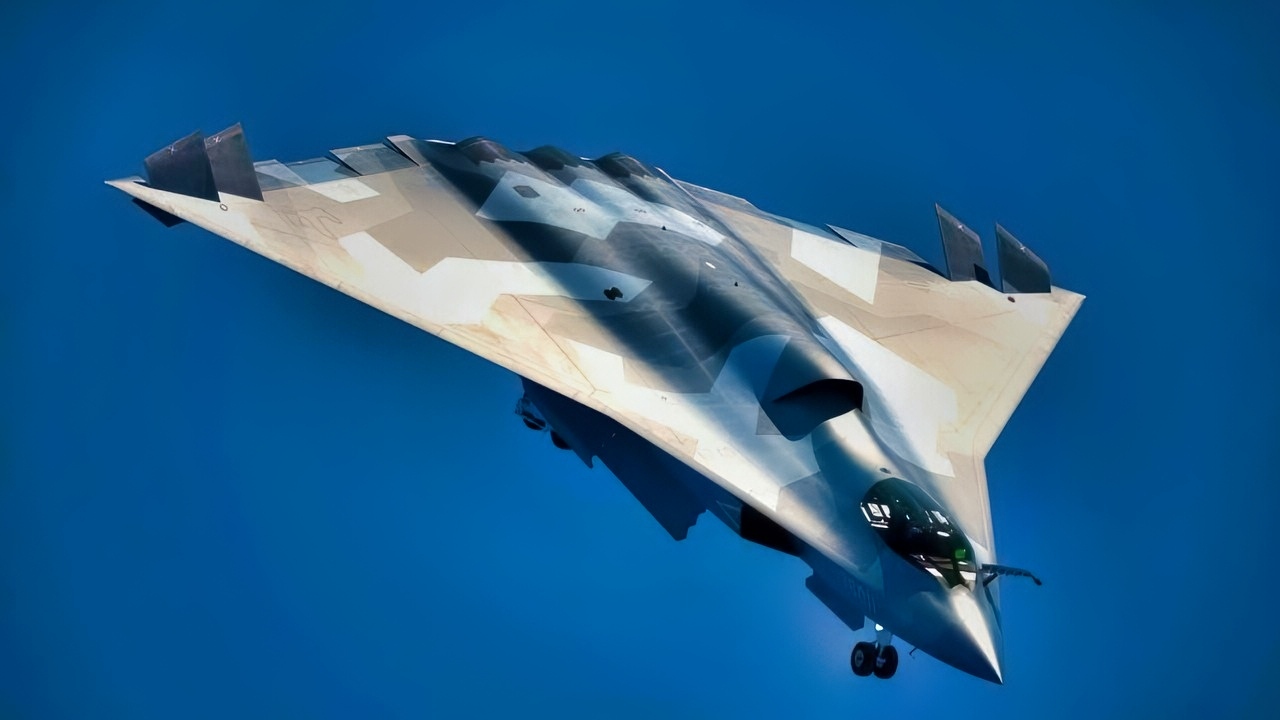
Key Points and Summary – China’s J-36 is the strangest and most ambitious fighter prototype Beijing has shown yet: a tailless, flying-wing, triple-engine design aimed squarely at sixth-generation air combat.
-First spotted in 2024 and now seen in multiple iterations, the “Ginkgo Leaf” appears optimized for long-range stealth strikes, with a trijet layout, large internal bays, and a side-by-side cockpit that hints at a deep-strike or command-and-control role.

J-36 Fighter. Image Credit: Screenshot from X.
-With projected ranges out to 3,000 kilometers, the J-36 could fit directly into China’s anti-access strategy against U.S. bases and bombers. But shifting prototypes and extreme complexity suggest full-rate production is still many years away.
China’s Bizarre J-36 Fighter Could Change Everything in the Pacific
The J-36 is one of the most mysterious aircraft in development by China’s Chengdu Aircraft Corporation. First spotted in 2024, the vehicle stunned Western observers with its highly unconventional design and triple-engine layout.
The aircraft has been spotted a number of times since then, allowing experts to more accurately estimate its specs and capabilities. The J-36 is likely still in development and a long way away from operational deployment, but its evolution in a short time period is still impressive.
Development Timeline
The J-36 is part of China’s sixth-generation fighter program, intended to rival the U.S. Next Generation Air Dominance and Europe’s Future Combat Air System and Tempest projects.
Its development reflects Beijing’s determination to dominate future aerial warfare through stealth, artificial intelligence integration, and advanced propulsion technologies.
Work on the program began years ago. Between 2018 and 2019, Chengdu reportedly submitted eight proposals for sixth-generation fighter designs, four of which underwent wind tunnel testing.
By 2021, satellite imagery and leaks revealed tailless prototypes at Chengdu facilities, and U.S. Air Force officials acknowledged China’s progress toward sixth-generation characteristics, including stealth and system-of-systems integration.

J-36 Fighter from X Screenshot. Image Credit: X Screenshot.
The aircraft made its first public flight in December 2024. There was no announcement of this flight, nor any official acknowledgment of it. The aircraft was filmed by public bystanders, however, and in the following months, it was spotted numerous other times, allowing Western analysts to view the J-36 from different angles. Its triple-engine layout drew notice—it is extremely unconventional for a modern aircraft.
Just when experts thought they understood the aircraft, a new prototype was spotted.
This new aircraft featured divertless supersonic inlets, redesigned landing gear, and what appear to be flat thrust-vectoring nozzles.
The latest iteration again confused onlookers in the West, but it did confirm a vital piece of information: The J-36 is not complete, although the redesigns suggest that development on the aircraft is coming along smoothly.
The J-36’s Unusual Design
The J-36’s design breaks from convention. Its tailless flying-wing configuration eliminates vertical stabilizers, reducing radar cross-section from all angles and enhancing stealth beyond fifth-generation fighters such as the F-22 and J-20.
The design is aerodynamically unstable and likely requires advanced fly-by-wire controls. The diamond-double-delta wing provides high lift and internal volume for fuel and weapons. It seems optimized for supercruise and long-range missions, and the aircraft has earned the nickname “Ginkgo Leaf” for its distinctive shape.
Perhaps the most striking feature is the trijet propulsion system. The J-36 uses three engines, two ventral and one dorsal, fed by caret-style side intakes and a dorsal supersonic inlet. As of right now, the engine layout is entirely unknown, though some speculate it may use WS-15 or WS-19 turbofans.
The three-engine configuration would offer redundancy, a high thrust-to-weight ratio, and extended range, with estimates suggesting a combat radius of up to 3,000 kilometers.
The second prototype introduced two-dimensional thrust-vectoring nozzles, similar to those on the F-22, improving agility at high angles of attack and in post-stall maneuvers.
Optimized for Stealth and Long-Range Missions
The J-36 seems designed for broadband stealth, evading radar across multiple frequency bands. Diverterless supersonic intakes reduce radar and infrared signatures, while low-observable exhausts minimize heat signature through advanced cooling systems.
The aircraft possesses three weapons bays—one large, paired with two smaller ones on the side—which allows it to carry missiles and bombs without external pylons, preserving its stealth profile.

J-36 Fighter from China. Image Credit: Creative Commons.
The cockpit and avionics are largely unknown. The J-36 features a side-by-side two-seat cockpit, an unusual choice for fighters but ideal for long-range missions. Many analysts suspect the aircraft may be a strike bomber, based on its size and cockpit layout.
Its sensors and radar are unknown, but if the J-36 is truly a sixth-generation aircraft, then it can be expected to field the latest and most advanced radars, sensor fusion capabilities, and Electronic Warfare systems.
What We Know About the Aircraft
The specs of the aircraft are also still unknown, but analysts suggest a length of approximately 22.5 meters, a wingspan of 24 meters, and a wing area of about 248 square meters. Maximum takeoff weight could reach 55 tons.
The aircraft is expected to achieve speeds beyond Mach 2.5, with a range between 2,000 and 3,000 kilometers. Armament will likely include PL-15 and PL-17 air-to-air missiles, and a variety of air-to-surface missiles and precision guided bombs.
The J-36 could redefine China’s anti-access/area denial strategy in the Indo-Pacific.

J-36 Fighter X Screenshot Image.

China J-36 Fighter Takeoff. Image Credit: X Screenshot.
Its range and stealth make it ideal for denying U.S. forces access to forward bases such as Guam, countering platforms such as the B-21 Raider bomber, and serving as a deterrent in Taiwan contingencies.
However, the aircraft is still in the prototype stage, and major design changes between iterations indicate ongoing experimentation.
Cost and complexity will ultimately dictate its production life, with estimates placing unit cost between $150 million and $200 million, similar to Western sixth-generation fighters.
Full-scale production is likely years away, possibly in the 2030s.
About the Author: Isaac Seitz
Isaac Seitz, a Defense Columnist, graduated from Patrick Henry College’s Strategic Intelligence and National Security program. He has also studied Russian at Middlebury Language Schools and has worked as an intelligence Analyst in the private sector.


