


China’s emerging 6th-generation stealth aircraft, designated J-36, has now appeared in public photography twice. The first set of images surfaced on Chinese social media in December 2024. A second appearance in 2025 captured the aircraft from multiple angles. What the photos reveal is a configuration unprecedented in combat aviation history: three engines, a diamond-shaped wing, and no vertical tails. The blended wing-body fuselage combines stealth bomber elements with fighter-style inlets. A forward data probe visible on recent images suggests the aircraft is still in experimental flight testing, not yet approaching production.
The J-36 Has a Diamond Wing, No Tail, and 3 Engines — A Configuration Never Seen on Any Fighter or Bomber

China J-36 Fighter Takeoff. Image Credit: X Screenshot.

J-36 Fighter X Screenshot Image.
Despite incessant media hype and rampant speculation, very little is known about China’s emerging 6th-generation stealthy fighter-bomber, the J-36, beyond its seemingly unprecedented configuration.
The platform has a stealthy design.
China may be breaking new ground with a hybrid, smooth, blended-wing-body fighter-bomber stealth airplane with three engines and a seemingly large internal weapons bay.
Should it be able to penetrate air defenses and operate successfully over enemy airspace using a new generation of stealth technologies and advanced sensors, the J-36 could pose new threats.
However, a larger, stealthy fuselage with three engines, such as the J-35, may prove much less stealthy than smaller, sleeker platforms such as contenders from the United States, including the F-35, F-22, or the still-in-development 6th-gen F-47.
Also, the J-36’s three engines are very likely to generate a stronger heat signature, more difficult to alter or suppress, meaning that the new People’s Liberation Army Air Force (PLAAF) airplane may prove more vulnerable to enemy air defenses.
However, so little is known about the J-36 that the reportedly 6th-gen aircraft could ultimately wind up as an overly ambitious failure.
2nd Appearance of J-36
The second public appearance of China’s mysterious J-36 stealth aircraft also raised new questions about the extent of its technologies, its intended mission scope, and its actual ability to rival advanced US 5th- and 6th-generation aircraft.
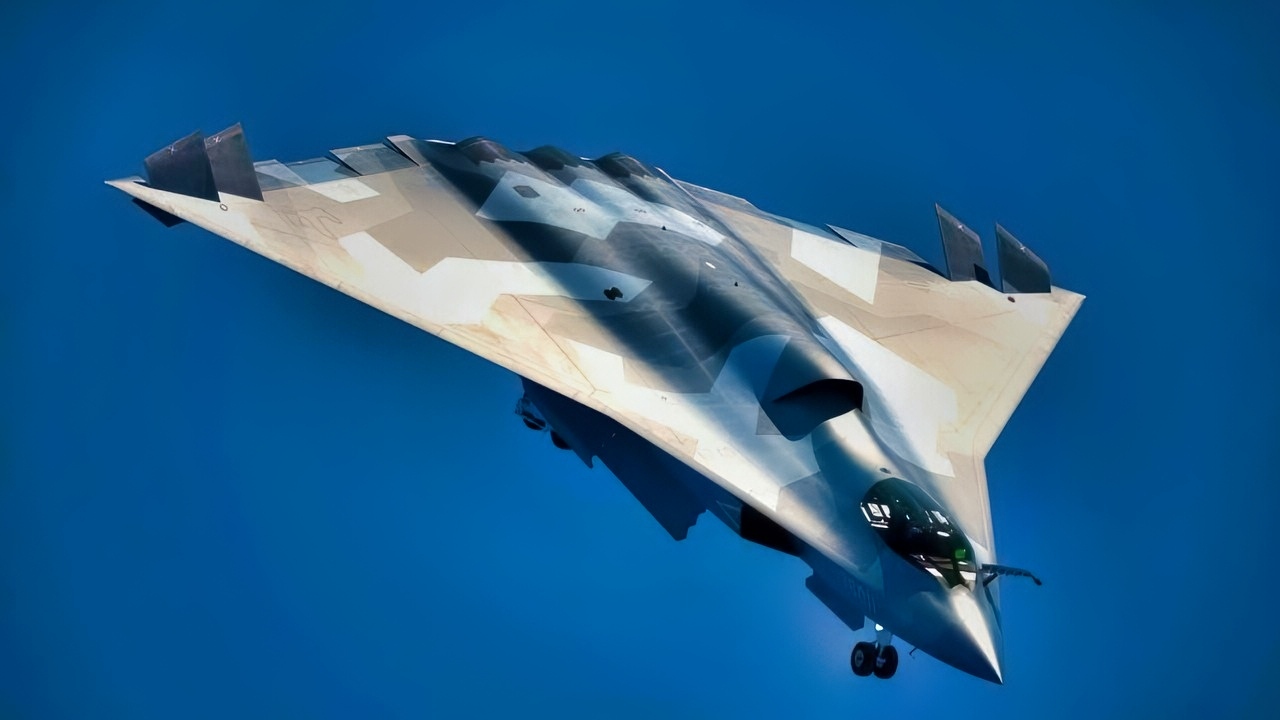
J-36 Fighter Artist Rendition from X Screenshot

J-36 Fighter. Image Credit: Screenshot from X.

J-36. Image Credit: Creative Commons.
After first appearing on social media in December, 2024, an occasion that generated no shortage of speculation and ad hoc analysis, the People’s Liberation Army Air Force J-36 has been captured a second time, this time from several different angles.
The aircraft may be breaking new ground and introducing unprecedented stealth configurations, as its fuselage resembles elements of both a stealth bomber and a stealth fighter.
Some analysts believe it could be a deliberate hybrid blending of the horizontal blended wing-body design, fundamental to high-altitude bombers, with a maneuverable, high-speed, low-altitude fighter jet.
The aircraft’s shape appears to incorporate elements of both, raising questions about whether it represents a technical breakthrough or is instead an ineffective, overly ambitious effort to do too many things with a single aircraft.
Fighter-Bomber combination
Could it be possible to engineer a “tactical stealth bomber” able to both carry large amounts of ordnance and perform fighter-jet-like air combat maneuvers? If so, it suggests the PLA has made new aerodynamic breakthroughs. Yet, the appearance of these potential attributes may be an overly ambitious effort to blend too many unique characteristics into a single aircraft.
The diamond-shaped wing, however, does not appear to incorporate any tails, fins, or vertical structures, a clear effort to reduce the aircraft’s radar signature. Similar to industry renderings of US Air Force 6th-generation designs, the J-36 suggests that both US and Chinese engineers may have found ways to maneuver and vector without needing tails and vertical structures typically used to manage airflow and enable high-speed maneuvers.
Available views of the fuselage show a large, smooth, flat tactical bomber with fighter-jet-like inlets beneath the wings. High altitude ultra-stealth bombers typically blend the inlet in the structure of the fuselage above the wing in a smooth-rounded configuration.
The absence of hard edges or protrusions reduces the ability of “electromagnetic pings” to bounce off a structure and deliver an accurate radar return signal. Such is the case with the US B-2 and B-21, as they are built to appear like a “bird” to enemy radar.
Stealth Configuration
The J-36, however, combines this kind of design with fighter-jet-like attributes, such as an angled, pointed nose for optimal speed and rectangular inlets beneath the wings, similar to those on the F-35 and F-22.
While this might enhance fighter-like capabilities, it can reduce stealth effectiveness to some extent by increasing the radar signature. Stealth properties are, of course, also heavily influenced by heat signature, and it’s not immediately clear which thermal management methods might be incorporated into the J-36.
Perhaps the most significant element of the J-36 pertains to its apparent three-engine structure, which could reduce stealth but potentially introduce new dimensions of speed, power, and aerial agility.
The third engine might represent an effort to bring F-22-like aerial maneuverability to a larger, heavier, bomber-like platform.
While a third engine might increase speed and offer vectoring capabilities for a larger, bomber-esque platform, it would likely challenge efforts to reduce heat emissions and could decrease stealth. Three engines would increase speed, however, and that is a survivability-enhancing attribute.
J-36 Concepts of Operation
All of these variables raise questions about the intended Concepts of Operation for the fighter, because the J-36 could connect fighter-jet-like speed with bomber-like payload carriage.
Available images of the J-36 show a large internal weapons bay, which raises the possibility of a low-altitude tactical bomber able to carry a large B-2-like ordnance payload. This profile allows an aircraft to operate with longer dwell time and the ability to drop a larger number of weapons on target in a single mission.
The larger body also means the aircraft could fly longer missions by carrying more fuel than a standard fighter.
Does the J-36 strike an optimal blend of attributes capable of introducing unprecedented air-attack possibilities?
This seems possible, yet there are still too many unknowns.
For example, what kinds of sensing, mission systems, or fire-control technologies does the J-36 have?
Can it operate with F-35-like long-range high-fidelity sensors such that it can destroy enemy targets at standoff distances where it is not detected?

PHILIPPINE SEA (Dec. 11, 2023) An F-35C Lightning II, assigned to the “War Hawks” of Strike Fighter Squadron (VFA) 97, recovers aboard Nimitz-class aircraft carrier USS Carl Vinson (CVN 70). Vinson, the flagship of Carrier Strike Group ONE, is deployed to the U.S. 7th Fleet area of operations in support of a free and open Indo-Pacific. (U.S. Navy photo by Mass Communication Specialist 2nd Class Benjamin Ringers)
What kinds of computing, fire-control, and weapons interfaces does the aircraft incorporate?
Does it really achieve a new degree of stealth multi-role versatility?
The PLA itself might not yet have the answers to all of this, as the aircraft may only be in a demonstrator or experimental phase, not yet ready for production.
There is evidence to support this, according to an interesting essay from the Aviationist, which noted a forward data probe on the aircraft, a feature typically used during the initial testing and assessment phases of new platforms to collect data for further analysis.
About the Author: Kris Osborn, Warrior Maven President
Kris Osborn is the President of Warrior Maven – Center for Military Modernization. Osborn previously served at the Pentagon as a highly qualified expert in the Office of the Assistant Secretary of the Army—Acquisition, Logistics & Technology. Osborn has also worked as an anchor and on-air military specialist at national TV networks. He has appeared as a guest military expert on Fox News, MSNBC, The Military Channel, and The History Channel. He also has a Masters Degree in Comparative Literature from Columbia University.


