


One of Russia’s most valuable military aircraft (so valuable, Moscow has kept it out of most of the Ukraine War) may have crashed outside Moscow on July 23. These claims, emanating in the Ukrainian press, remain unverified.
If true, though, this loss would represent a black eye for the Russian Aerospace Forces because the Sukhoi Su-57 “Felon” remains Russia’s only operational fifth-generation stealth warplane. What’s more, the aircraft has relatively small numbers and is difficult to replace.

Su-57 Felon Fighter Russian Ministry of Defense Photo
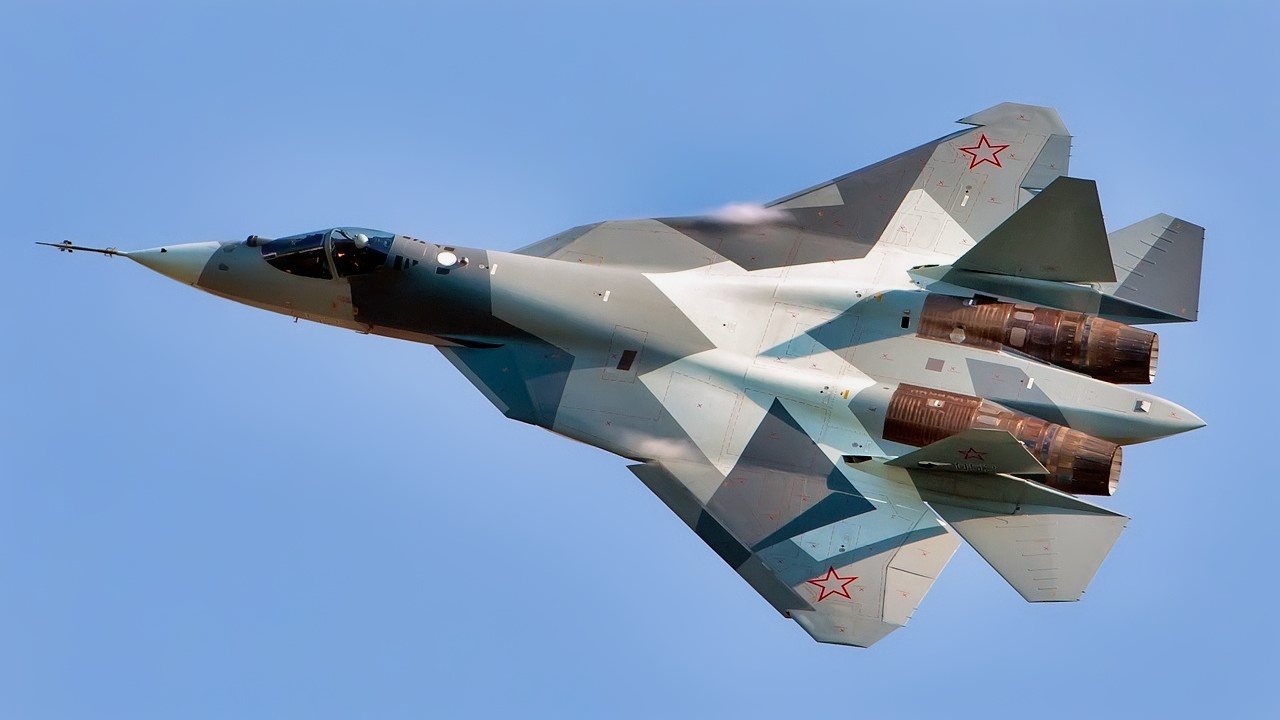
Russia PAK-FA or Su-57 Felon. Image Credit: Creative Commons.
As with so much of the reportage over the Ukraine War, the initial reports are dreadfully incomplete. Indeed, some are even contradictory.
What most experts assess is that some Russian warplane did crash outside Moscow while on a training mission. What they cannot confirm, however, is that it was the Su-57.
What Do We Know?
Anyway, multiple independent media reports show that a Russian military aircraft crashed during a training flight in Moscow Oblast, near Zvenigorod, west of Moscow.
Russian state media acknowledged that a military aircraft did crash, and the pilot ejected safely.
Russian authorities have opened an investigation into the matter.
Meanwhile, multiple witness videos circulating online show a massive fire and black smoke bellowing above the suspected crash site.
In the distance, there appears to be a parachute descending before impact. Several eyewitnesses told the Russian outlet Astra that the pilot deliberately steered the plane away from residential buildings before ejecting.
Here are the basic facts: a military bird hit the ground.
There was visual confirmation of an ejection of the pilot. Now, the Russians are investigating the crash. Those are confirmed facts.
Was it really an Su-57, though? That’s the 64,000-rouble question.
What’s Being Said About the Su-57?
Ukrainian outlet, Kyiv Post, reported that the aircraft involved in the crash was the fifth-generation air superiority Su-57 “Felon” warplane.
This report cited Russian Telegram channels. Kyiv Post combined those reports on Russian Telegram with eyewitness reporting.
Kyiv Post also highlighted a report out of the Russian newspaper Kommersant that asserted the Su-57 was the plane that crashed.
Another pro-Ukrainian publication, United24, was more cautious in its analysis.
Rather than simply declaring the aircraft was an Su-57, United24 merely wrote that the Su-57 “may have been” the downed plane. United24 emphasized that Russian authorities had not officially identified the aircraft type.
Verification Is Difficult
Russia rarely provides immediate transparency following military aviation accidents, especially when advanced aircraft are potentially involved.
The Su-57 is the most important asset in the Russian Air Force.
Unlike aircraft such as the older Soviet-era Su-34 or Su-35, the numbers of the Su-57 are too small to risk losing them in combat, let alone in training exercises. Moscow has long said that the smaller numbers of the Su-57 were due to ambiguously defined “production delays.”
In fact, Russia has struggled building large numbers of these planes because so much of the plane was built with advanced Western components that are now cut off to Russia, thanks to sanctions.
Russia has adapted by creating indigenous workarounds, but that has been a painful process.
What’s more, as the Ukraine War increasingly absorbs the bandwidth of Russian leaders and industry, the Su-57 has been sidelined in terms of its production.
So, Moscow has little incentive to be truthful about losing an Su-57 to a training mission. Similarly, Kyiv has much incentive to claim that the Russians lost an Su-57 on a training flight.
After all, the Russians have kept the Su-57 in reserve for most of the war because of its scarce numbers and the concomitant fear of losing any of these few Su-57s in combat.
Russia doesn’t want to confirm this story anytime soon. Ukraine, naturally, wants the news to go far and wide, without confirmation if necessary, to wound Moscow in the Information War.
The Claim Might Be Credible–Here’s Why
For starters, militaries lose all manner of aircraft in training. The US has lost a handful of its F-35 Lightning IIs over the last decade to training accidents.
In wartime, especially the kind of war the Russian Federation finds itself in, there are bound to be missteps from pilot error to maintenance failures.
Plus, multiple reports are fixating on claims made on Russian Telegram channels, eyewitness accounts, and even local reporting in Moscow.
We can infer the veracity of these claims also because the alleged crash of the Su-57 occurred near a region of Russia where the Russian Aerospace Forces routinely fly and maintain their advanced warplane fleet. What’s more, the Russian authorities have opened an investigation into the suspected crash.
None of these inputs prove the claim made predominantly in Ukrainian media to be true. Yet, they do lend more credence to it.
What Happened?
Based on currently available evidence, it appears very likely that a Russian military aircraft crashed outside Moscow during a routine training mission.
It is likely that the plane involved in the crash was, in fact, an Su-57.
That there are multiple independent reports all converging on the same identification, while Russian officials have acknowledged the crash itself without publicly identifying the aircraft, is another tell.
Until Russia releases official confirmation or additional imagery that actually identifies the wreckage, analysts will–should–remain skeptical.
After all, there have been claims in the past during the Ukraine War that proved to be false.
In other words, what we can report here is that there was a crash of a Russian military aircraft on July 23 outside Moscow. It is suspected that the plane involved was an Su-57. There is no confirmation of this, though.
About the Author: Brandon J. Weichert
Brandon J. Weichert is Senior National Security Editor. He also manages The Weichert Brief on Substack. Weichert also hosts “National Security Talk” on Rumble. He is the author of four bestselling national security books, the most recent of which is A Disaster of Our Own Making: How the West Lost Ukraine (Encounter Books). Follow him via Twitter/X @WeTheBrandon.


