


One thing I know for certain is that U.S. Air Force pilots don’t hold their tongue. When I asked an elite stealth fighter pilot about the Su-57, he was blunt. “I don’t want to hold anything back: Russia’s Su-57 Felon is the worst stealth fighter on the planet. It doesn’t even have stealth characteristics. I would take an F-22, F-35, or even a J-20 fighter over that piece of garbage any day.”
Russia’s Su-57 Felon: The Problem Child Stealth Fighter

Su-57 Felon Fighter from Russia

Su-57 Felon Fighter Ready for Action. Image Credit: Creative Commons.
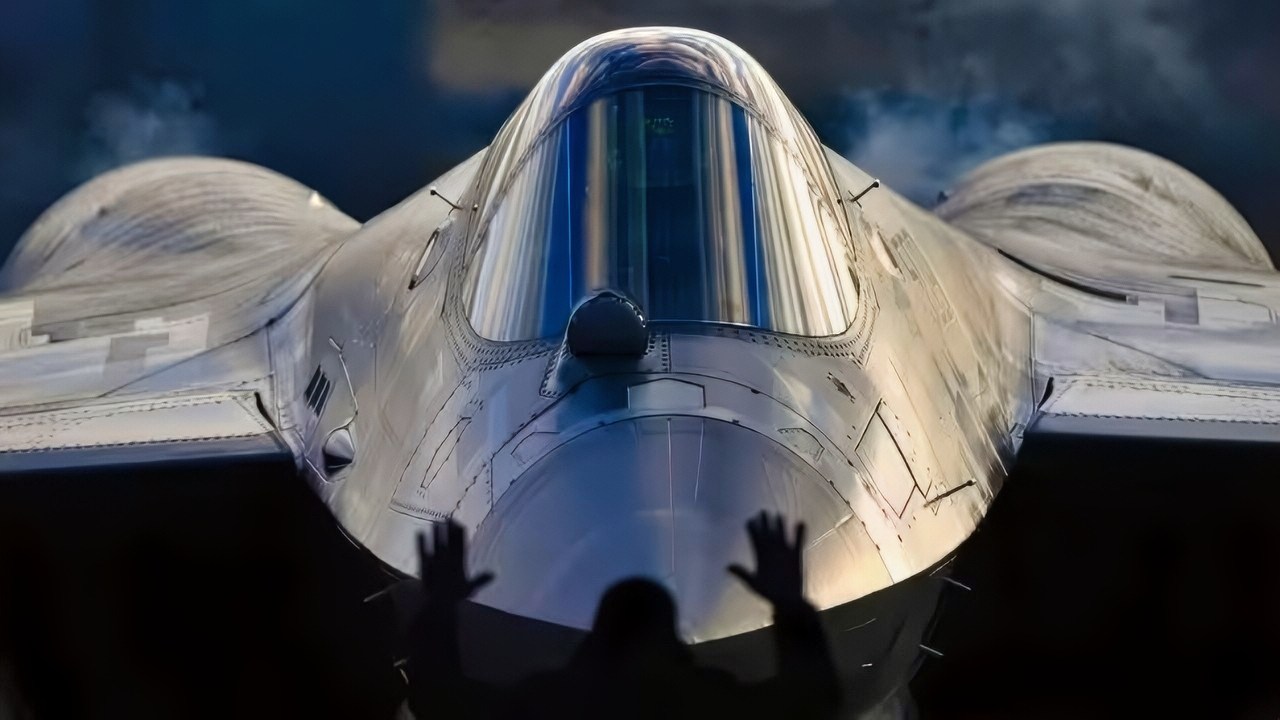
Su-57 Felon Fighter. Image Credit: X Screenshot.
Russia markets the Su-57 Felon as a world-beating fifth-generation fighter, the equal of the American F-22 and F-35, and a leap ahead of anything else in the sky.
The aircraft has appeared at air shows in Dubai and Kuala Lumpur, drawn breathless coverage in Russian state media, and been pitched to half a dozen foreign air forces as the affordable stealth jet they have been waiting for.
The reality, as of the middle of 2026, is that the program has been a near-total failure on the measures that actually define a stealth fighter.
Here are five reasons the Felon deserves the title of the worst stealth fighter on Earth.
One: It Is Not Actually Stealthy
The single most important quality of a stealth fighter is a small radar cross-section, and on this measure, the Su-57 fails badly.
The aircraft’s stealth shaping is undermined by basic manufacturing and design choices that its Western rivals solved decades ago.

Su-57 Felon Fighter Back in 2011. Image Credit: Creative Commons.

Su-57 Felon Fighter Stealth. Image Credit: Creative Commons.

Su-57 Felon Artist Image. Image Credit: Screenshot.
The Su-57’s airframe carries exposed rivets across much of its surface, particularly on the wings, and the entire aircraft is not coated in radar-absorbent material as the F-22 and F-35 are. The radar blockers it uses to mask the engine inlet guide vanes do not fully remove the radar return from the engine faces.
The numbers are damning, and they come from Sukhoi itself.
The manufacturer’s own patent documentation describes the Su-57 as having a frontal radar cross-section between 0.1 and 1 square meters, compared to roughly 0.05 square meters for the F-35 and 0.01 for the F-22.
Aviation analyst Dario Leone, founder of The Aviation Geek Club, has laid out the consequences in stark terms, noting that the Su-57 carries a radar signature comparable to that of a clean F/A-18 Super Hornet and about 1,000 times larger than that of the F-35. Because radar detection range scales with the fourth root of radar cross-section, that thousandfold gap translates into the F-35 detecting the Su-57 at roughly six times the range the Felon can detect the F-35, an advantage so lopsided that the Russian jet would be hopelessly outclassed before it ever knew it was in a fight.
A clean Super Hornet is not a stealth aircraft, and nobody pretends it is. A fighter with that kind of signature does not belong in the same conversation as the genuine fifth-generation jets it claims to rival.
Two: Russia Built Almost None Of Them
A stealth fighter that exists mainly in press releases is not a fighting force, and the Su-57 has been produced in such small numbers that it is almost meaningless.
The British defense think tank RUSI assessed that by the end of 2025, Russia had built approximately 21 Su-57s in roughly 15 years, with one of those airframes possibly already lost. Other trackers put the in-service figure somewhat higher, with the aviation monitor RuAviation estimating around 30 in service by the beginning of 2026 after a substantial new batch was delivered, but even the most generous count leaves Russia with a few dozen aircraft.
Set that against the global fifth-generation picture and the gap becomes absurd. The United States has built well over a thousand F-35s, with the jet flying in the air forces of more than a dozen allied nations. Russia, the country that wants the world to believe the Su-57 is a peer competitor to the F-35, has fielded perhaps two to three percent of that number after a decade and a half of effort.

Su-75 Checkmate and Su-57. Image Credit: Creative Commons.

Su-57 Fighter From Russia. Image Credit: Creative Commons.
Russia first flew the prototype in 2010 and only began limited serial production in 2020, and even that slow timeline has been undercut by sanctions, supply-chain problems, and a heavy, continued reliance on the older Flanker family that the Su-57 was supposed to supersede.
Three: The Factory Caught Fire And Stopped Production
The production problem went from chronic to acute on April 11, 2026, when a fire broke out at the Komsomolsk-on-Amur Aviation Plant in Russia’s Far East, the country’s only serial manufacturer of the Su-57.
The fire struck Shop No. 46, the facility that produces roughly 300 distinct polymer composite component types for the Su-57 airframe, including about 100 large-format structural panels such as aileron and flaperon panels, floor sections, and wingtip fairings. These are not parts that can be sourced from some alternative domestic supplier on short notice, because there is no alternative supplier.
Satellite imagery published days later confirmed the damage was severe. Images showed multiple collapsed roof spans at Shop No. 46, confirming structural damage that halted Su-57 production outright.
A program that was already building aircraft at a trickle had its single composite-components workshop knocked out of action, and the disruption directly threatens Russia’s hopes of landing a major Su-57 contract with India.
When your entire fifth-generation fighter line can be stopped by a fire in one building, you do not have a serious production capability.
Four: It Still Flies On A Reworked Soviet Engine
A fifth-generation fighter is supposed to be defined in part by its powerplant, and the Su-57 has spent its entire life waiting for an engine that keeps slipping.
The aircraft was meant to be powered by an all-new engine, originally called the Izdeliye 30, but for years, the Felons that entered service flew with the AL-41F-1, an interim engine that is a derivative of the Soviet-era AL-31F brought into service in 1984 to power the Su-27.
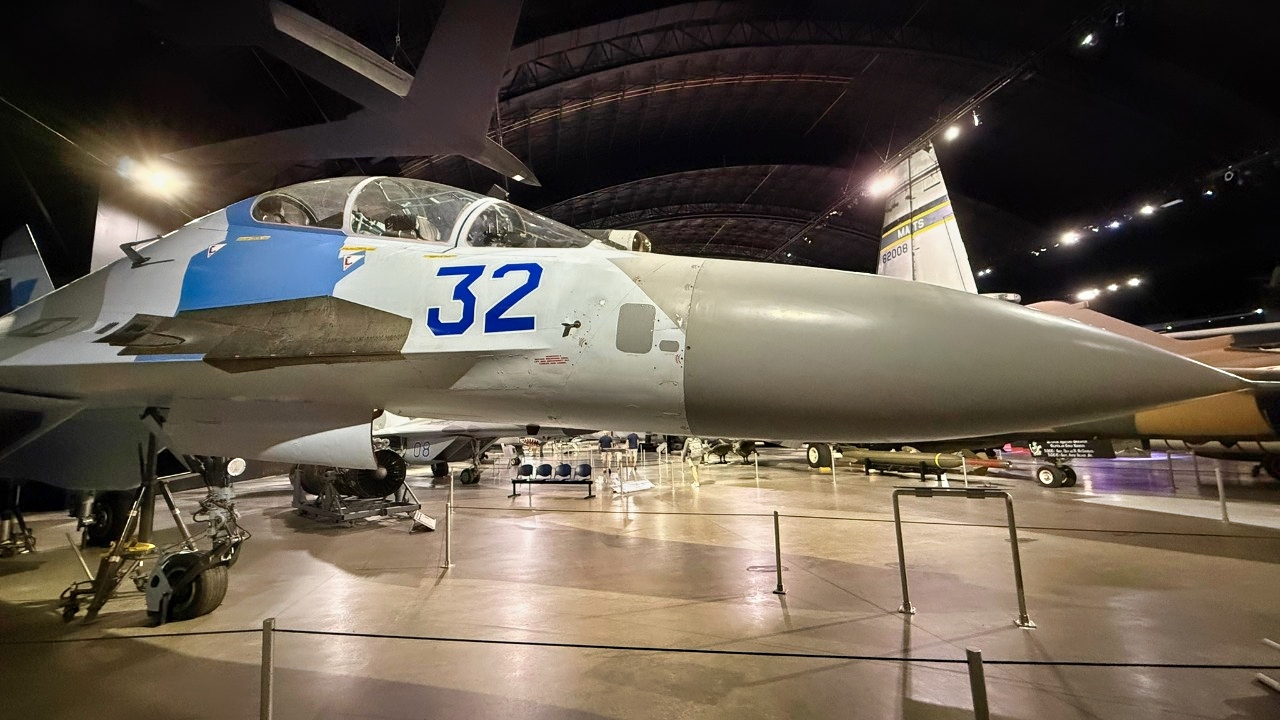
Su-27 Flanker Fighter from Russia. Image Credit: National Security Journal.
In other words, Russia’s most advanced fighter has been flying on a heavily modified version of an engine designed during the Brezhnev era.
The consequences are real. The performance and efficiency of that interim engine sit below even the oldest fifth-generation fighter engine, the American F119 that powers the F-22, and well below the more modern F135 on the F-35 or the WS-15 powering China’s J-20. Russia has been working to field a genuine new engine, now referred to as the Izdeliye 177, and has unveiled it in Dubai, claiming 14.5 tons of thrust and supercruise capability.
Whether the Russian Aerospace Forces will actually re-engine their existing fleet, and whether the new powerplant will deliver on its promises after years of delay, remains to be seen.
A stealth fighter that took more than a decade to get a proper engine into testing is one whose core technology never came together on schedule.
Five: Almost Nobody Will Buy It
The final measure of the Su-57’s failure is the export market, where Russia has spent years pitching the jet and has almost nothing to show for it.
Despite aggressive marketing by the state arms exporter Rosoboronexport, including announcements of new contracts at the DSA 2026 air show in Kuala Lumpur, Algeria remains the first and, to date, only confirmed foreign operator of the Su-57.
Russia has gone so far as to offer India local production with complete technology transfer, an extraordinary concession, and still has not closed the deal.
The reluctance is well earned, and India’s history with the program tells the story. New Delhi was once a development partner on the project, expected to invest billions, but India walked away from the partnership in 2018 over concerns about the aircraft’s performance, its stealth, its cost, and the workshare it was being offered. The Felon’s limited and cautious use in Ukraine has done nothing to reassure prospective buyers, with even Russia-friendly assessments acknowledging that the jet’s deployment has remained limited due to production and technical issues.
The countries that have watched the Su-57’s development, its tiny production numbers, its engine troubles, and its restrained combat record have largely concluded it is not worth buying. A weapon that even a longtime customer like India refuses to commit to, after being offered the keys to the factory, is a weapon the market has judged and found wanting.
The Su-57 Stealth Fighter Failure Is Clear
Russia designed the Su-57 to balance stealth against the supermaneuverability its engineers and pilots have always prized, and on that front, it is a genuinely capable aircraft. But a fighter that markets itself as a fifth-generation stealth jet has to actually be stealthy, has to exist in real numbers, has to come off a production line that works, has to fly on an engine worthy of the airframe, and has to convince someone to buy it.
The Felon fails every one of those tests at once. Russia has spent more than fifteen years and enormous national prestige building an aircraft that has a radar signature like a 1990s Super Hornet, exists in numbers you could park in a single hangar, flies on a reworked Soviet engine, came off a production line that a single fire shut down, and has been sold to exactly one foreign air force. That is not a world-beating stealth fighter. That is the worst one ever fielded.
About the Author: Harry J. Kazianis
Harry J. Kazianis (@Grecianformula) was the former Senior Director of National Security Affairs at the Center for the National Interest (CFTNI), a foreign policy think tank founded by Richard Nixon based in Washington, DC. Harry has over a decade of experience in think tanks and national security publishing. His ideas have been published in the NY Times, The Washington Post, The Wall Street Journal, CNN, and many other outlets worldwide. He has held positions at CSIS, the Heritage Foundation, the University of Nottingham, and several other institutions related to national security research and studies. He is the former Executive Editor of the National Interest and the Diplomat. He holds a Master’s degree focusing on international affairs from Harvard University.


