

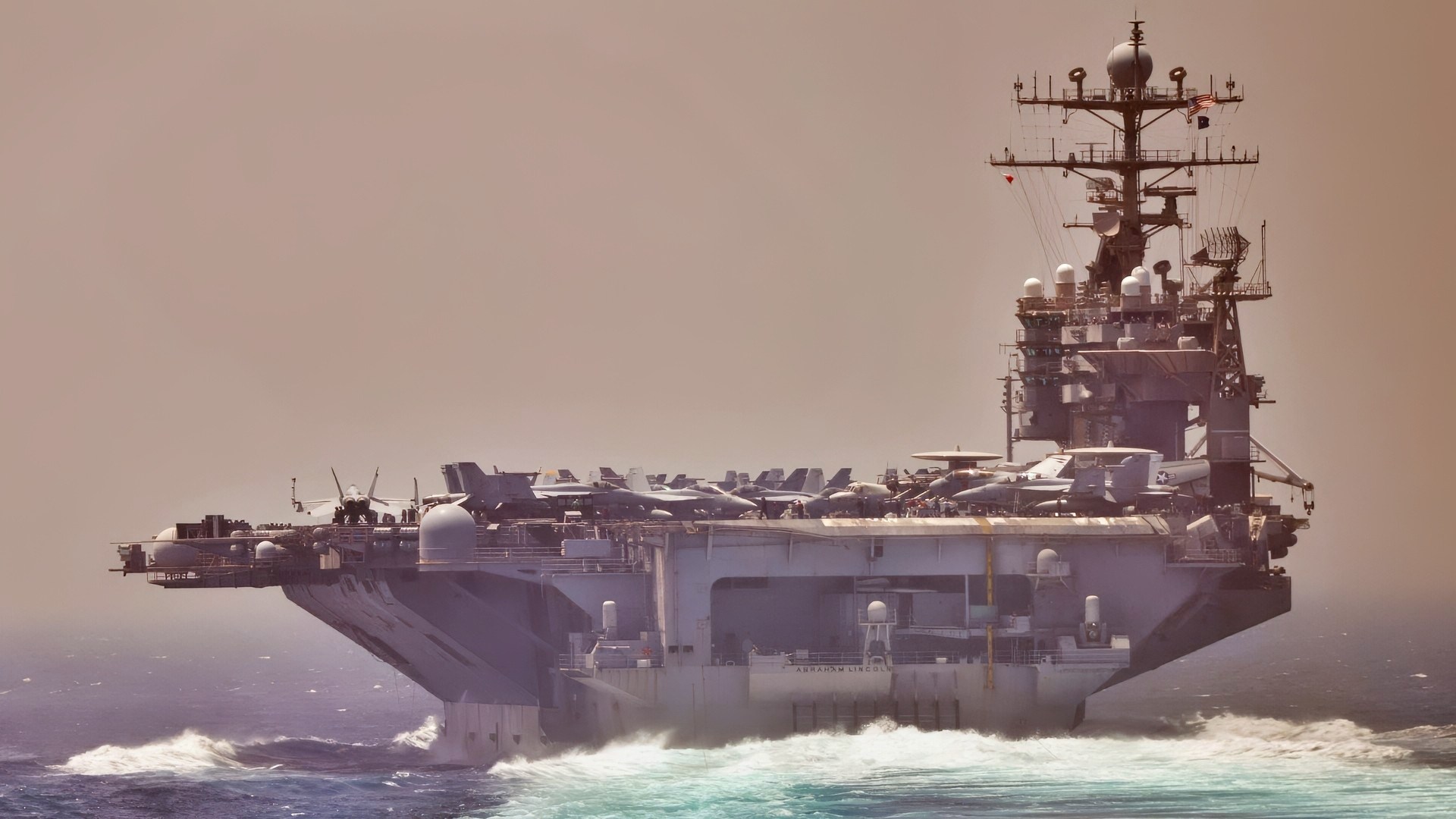
The Nimitz-class aircraft carrier USS George Washington is on the move. The supercarrier is en route to the Middle East, where it is set to relieve the USS Abraham Lincoln following one of the most strenuous carrier deployments in recent naval history.
The rotation will offer the Lincoln’s crew a route home after nearly nine months at sea.

USS Ronald Reagan (CVN 76), USS Kitty Hawk (CV 63), and USS Abraham Lincoln (CVN 72) cruise side-by-side in the Philippine Sea June 18, 2006, during exercise Valiant Shield 2006. The joint exercise consists of 28 naval vessels, more than 300 aircraft, and approximately 20,000 service members from the Navy, Army, Air Force, Marine Corps and Coast Guard. (U.S. Navy photo by Chief Photographer’s Mate Spike Call) (Released)

Arleigh Burke-class guided-missile destroyer USS Michael Murphy (DDG 112) sails alongside Nimitz-class aircraft carrier USS Abraham Lincoln (CVN 72) on Dec. 8, 2025. USS Abraham Lincoln (CVN 72), flagship of the Abraham Lincoln Carrier Strike Group, is underway conducting routine operations in the U.S. 7th Fleet area of operations, demonstrating the U.S. Navy’s long-term commitment to a free and open Indo-Pacific. (U.S. Navy photo by Mass Communication Specialist 3rd Class Nathaly Cruz)
The movement, however, will leave the western Pacific without a U.S. aircraft carrier.
It is uncertain how long the gap in the region will continue as the war with Iran rumbles on.
Pivot From Pacific Region
On Friday, the George Washington Carrier Strike Group crossed the Strait of Malacca between Malaysian and Indonesian territory and entered the Andaman Sea in the northeastern Indian Ocean.
The carrier is currently sailing alongside Carrier Air Wing 5, the cruiser USS Robert Smalls and the destroyer USS Shoup.
As recently as July 23, the George Washington was carrying out routine flight operations in the South China Sea, according to the U.S. Pacific Fleet.
Almost 9 Months At Sea
The rotation was planned, but it has arrived amid mounting concerns about the strain on the Abraham Lincoln and its crew.
On Monday, The Wall Street Journal reported that the carrier has been deployed for 266 days. It has now endured a record-breaking 240 days without a port call.
This has exceeded the deployment initially scheduled to end in May.
The open-ended situation in the Middle East has dragged it months beyond that.
The Lincoln has been at the heart of U.S. operations against Tehran, having launched more than 10,000 sorties in this year’s conflict.
The Navy has specifically acknowledged that fighting disrupted traditional supply hubs in the Middle East.
NPR and the Associated Press reported that the service prioritized food, followed by hygiene products and mail, as the war complicated supply routes.
Hegseth Blasts Carrier Food Shortage Claims
Democratic lawmakers have also publicized allegations of contaminated water, plumbing issues, and short supplies of food and hygiene goods on the ship, but Defense Secretary Pete Hegseth has framed reports about the carrier as “completely misrepresented.”
One Navy official told The Guardian newspaper that “extended deployments place a significant strain on our service members and their families, and we are grateful for the resilience and sacrifices they make,” although he stressed that the health of sailors was prioritized.
Earlier this month, the Navy Times and Stars and Stripes reported on alleged multiple attempts by crew to jump overboard. In response, the Navy has said all sailors have access to clean water and meals and claimed there has been no documented rise in self-harm or attempts to jump ship.
Western Pacific Left Without Aircraft Carrier
The USS George Washington’s departure could prove risky for the western Pacific.
The carrier is normally forward-deployed at Yokosuka, Japan. In the region, Washington is broadly attempting to deter Chinese aggression and reassure allies such as Japan and the Philippines.
China continues to invest in its own carrier force. Its third carrier, Fujian, entered service last November.
Unlike China’s older Liaoning and Shandong carriers, Fujian uses electromagnetic catapults rather than ski-jump ramps.
According to Reuters, after its commissioning, the system allows the ship to launch heavier and more varied aircraft, including the J-35 stealth fighter and KJ-600 airborne early-warning aircraft.
China Still Lags Behind U.S. Naval Power
Fujian is nowhere near rivaling the mature U.S. carrier force yet. China still faces the long, complex timeline of integrating the ship, its aircraft, and escorts into a workable combat formation.
But this hardly means Washington can afford to be complacent.
The United States still expects its carrier fleet to deter China in the Pacific, fight in the Middle East, and fulfill other global commitments.
Aside from that, ships and crews need reasonable time for maintenance and recovery to function well.
The Lincoln’s marathon deployment seems to be an example of how strained things can become amid competing demands.
In any war, trade-offs are inevitable.
The question is whether it will be worth it for the U.S. in the long run. Is it worth reducing its presence near China?
With no peace deal in sight, there is no sign of where exactly the war with Iran will wind up, or if the U.S. will achieve its objectives in it.
About the Author: Georgia Gilholy
Georgia Gilholy is a journalist based in the United Kingdom who has been published in Newsweek, The Times of Israel, and the Spectator. Gilholy writes about international politics, culture, and education.


