

This week, recently retired US Navy Adm. Mark Montgomery and his co-authors, Bradley Bowman and Elaine Dezenski, spoke to Radio Free Europe/Radio Liberty (RFE/RL) about their recent book, Axis of Aggressors.
Their theme is that the growing strategic partnership between the People’s Republic of China (PRC), Russia, Iran, and the Democratic People’s Republic of Korea (DPRK) is turning into the most pressing security challenge facing the United States and its allies.
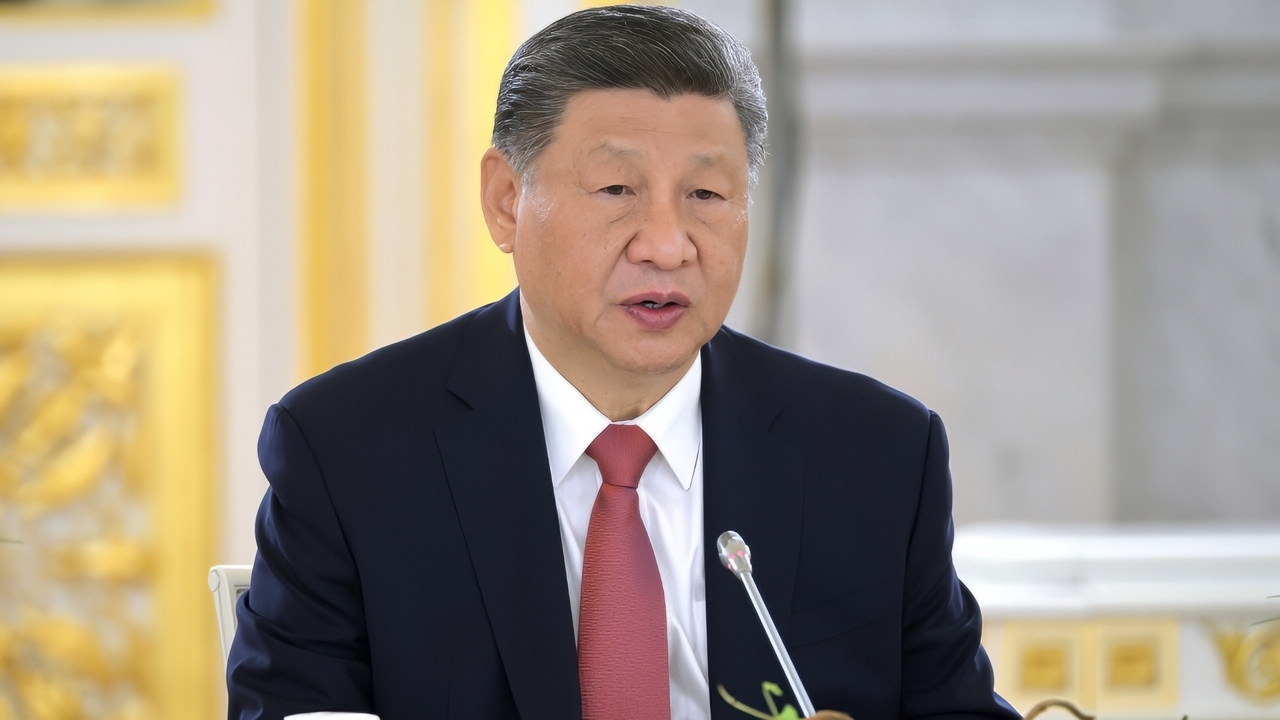
China’s Xi Jinping. Image Credit: Creative Commons.
Montgomery is the senior director of the Center on Cyber and Technology Innovation and senior fellow at the Foundation for Defense of Democracies (FDD).
He provides examples of how the West continues to underestimate both the scale of this axis of totalitarian dictatorships and the increasing risks they present to the Western alliance of nations.
Among other findings, their book documents more than 600 instances of cooperation among the four authoritarian states.
He and his co-authors argue that the coordination among these four repressive nations spans military, technological, economic, and cyber domains.
Montgomery spoke with the US state broadcaster about how these four leverage pressures were created on the US and others by conflicts occurring simultaneously in Ukraine and Iran.
He also puts forth suggestions for actions the US military must take in response.

Russian President Vladimir Putin (R) meets with North Korea’s leader Kim Jong Un in Vladivostok, Russia April 25, 2019.
US Inadequately Assessing the Axis Nations’ Coordination
“To a great degree we underestimate their level of coordination, and therefore our responses to their collective actions are sometimes underwhelming. In the US, you can see this with Ukraine,” he responded to one of the broadcaster’s first questions.
“Ukraine is clearly fighting Russia, Iran, North Korea, and China.
Iran is providing Shahed drones — not just thousands of drones, but also the technology to produce them domestically. The Russians are now producing their own Tehran-designed drones,” he explained.
“North Korea provided 12,000 soldiers, and people focus on that. But they also supplied 5 to 6 million rounds of artillery and mortar ammunition. That’s more than all of NATO has produced over the last few decades. Finally, China is backstopping Russia’s war effort by providing microelectronics for ballistic, hypersonic, and cruise missiles that are striking Kyiv today.”
“Ukraine has to fight all four countries. The US, even under the Biden administration, was very slow to provide the right weapon systems with the necessary range, and it never deployed US forces into Ukraine for training purposes. President [Donald] Trump has done even less, cutting security assistance by 99 percent compared to the Biden administration,” he continued.
Montgomery also criticizes the European policy re: Iran.
This terrorist state has killed more than 1000 US and 500 NATO-nation soldiers in Iraq and Afghanistan.
But Europe, he points out, still looks at the Washington v. Tehran conflict and then says, “these are two co-equal belligerents: Iran and the US. That’s ridiculous. Iran is backed by Russia. It’s backed by China. In the past, it has been backed by North Korea. Yet we still cannot get Europe to support us against Iran.”
Munitions, Electronics and Combat Data
Montgomery also raises several other points about US policy that he believes require significant course correction.
“We need more investment and higher defense spending. Even though we criticize European countries for freeloading, US defense spending has also declined — from around 4 to 5 percent of GDP at the end of the Cold War to roughly 3 percent, and even below that at the end of the Biden administration.”
“The bigger problem is munitions. Our stockpiles were already insufficient after 25 years of underinvestment. They’ve now been heavily stressed by support for Ukraine and operations involving Iran. [This] presents the more serious challenge in a simultaneous conflict.”
“One of the challenges with microelectronics is that many components are dual-use. A product can be exported to China for a legitimate civilian purpose and then repurposed for military use before being transferred to Russia. That makes sanctions very difficult to enforce.”
“For the US, for the broader West, and for Russia, Ukraine is a [combat data-gathering] laboratory. The difference is that the US is not taking full advantage of it.”
“The US maintains only a minimal military presence in Ukraine, largely associated with the embassy. We don’t have nearly enough personnel learning lessons directly from the battlefield. Russia, meanwhile, is aggressively passing those lessons to China, North Korea, and Iran.”
Montgomery also addresses how Russia is providing technology and training for large-scale helicopter air assault operations to the PRC.
This could enable a future cross-strait invasion of Taiwan by the PLA. These and other technologies being provided to Iran and the DPRK “are major transfers of military capability that Russia had never previously been willing to provide. They are part of the price Moscow is paying for support in its war against Ukraine.”
About the Author: Reuben F. Johnson
Reuben F. Johnson has thirty-six years of experience analyzing and reporting on foreign weapons systems, defense technologies, and international arms export policy. Johnson is the Director of Research at the Casimir Pulaski Foundation. He is also a survivor of the Russian invasion of Ukraine in February 2022. He worked for years in the American defense industry as a foreign technology analyst and later as a consultant for the U.S. Department of Defense, the Departments of the Navy and Air Force, and the governments of the United Kingdom and Australia. In 2022-2023, he won two awards in a row for his defense reporting. He holds a bachelor’s degree from DePauw University and a master’s degree from Miami University in Ohio, specializing in Soviet and Russian studies. He lives in Warsaw.


