

Last week, the White House vowed to unleash an “economic D-Day” on Iran amid the ongoing war.
Yet when Treasury Secretary Scott Bessent unveiled the campaign on Monday, a New York Times analysis suggested that Washington’s offensive amounted to a sanctions package, warning that much harsher measures could be around the corner.
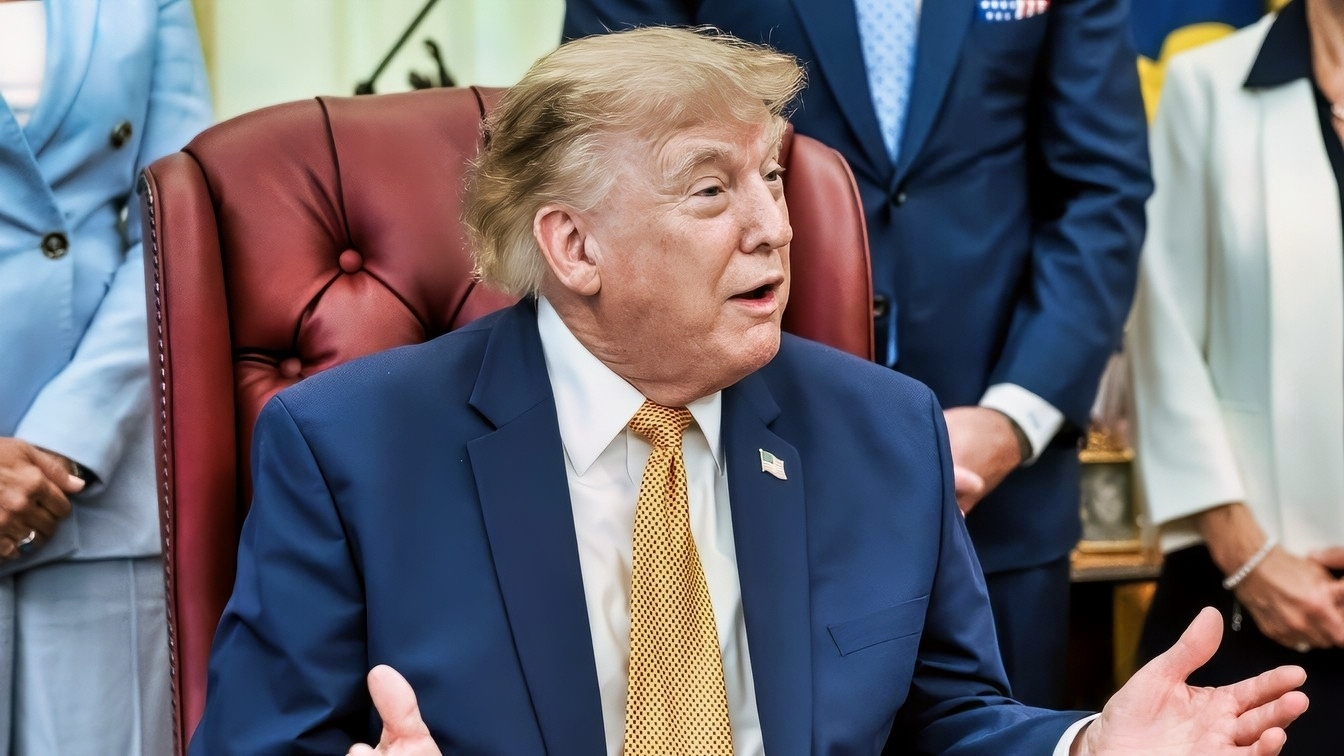
President Donald J. Trump, joined by Secretary of War Pete Hegseth and wife Jennifer Hegseth, signs an executive order creating a new White House commission focused on military families, Monday, August 3, 2026, in the Oval Office. (Official White House Photo by Molly Riley)
60 New Sanctions Announced
Announcing Operation Economic Outcast this week, Bessent branded it as a major bid to “sever every economic lifeline” aiding the Islamic Republic.
The measures sanctioned almost 60 new individuals, firms, and vessels linked to Iranian military and nuclear procurement, cyber operations, and oil revenue.
The Treasury Department also broadened the types of activity that may put foreign companies at risk of secondary sanctions.
Still, the boldest penalties have not yet been imposed on Iran’s key trading partners.
On Monday, Reuters highlighted the fact that of the financial institutions suspected of facilitating Iranian oil trade on the fresh sanctions list, precisely zero of them were Chinese — despite the fact that Beijing is the biggest buyer of Iranian oil. Several China-based firms were impacted, however.
When asked why Washington had given countries time to comply, Bessent said: “Why would I want to blow up the global financial system?”
The Treasury says nations will be given precise timelines to conclude the activity Washington has singled out.
Bessent stressed that any institution involved in evading the new sanctions could even be barred from the lucrative U.S. financial system.
Will Washington Follow Through?
Whether Washington is prepared to enter a prolonged dispute with China is an open question.
Kpler ship-tracking statistics suggest Beijing’s purchases of Iranian oil averaged about 1.4 million barrels per day last year.
The ongoing U.S. blockade of Iranian ports is already squeezing this trade.
Chinese intake is estimated to have plunged from 823,000 barrels per day in July to some 534,000 barrels per day so far this month.
Last week, Beijing slammed the U.S.’s new sanctions threats.
Its Foreign Ministry spokesperson Lin Jian said China would protect its interests and rejected the use of sanctions.
On Tuesday, Jian reiterated this stance, claiming: “Cooperation between China and Iran has always been conducted within the framework of international law.” He also said Iranian-Chinese ties “should not be interfered with or disrupted.”
Bessent has avoided specific questions over whether Chinese banks could be sanctioned, but told the press last week that, “no one is above the reach of U.S. sanctions.”
U.S. President Donald Trump is slated to meet with Chinese President Xi Jinping in September amid tensions over Taiwan and access to critical minerals.
Tehran Downplays U.S. Threats
On Monday, Iranian Economy Minister Ali Madanizadeh said his country was “fully prepared” for more sanctions, noting that a two-year plan to handle these pressures was in the works.
“We also have our own tools and know how to play the game,” he told Iranian state television.
This is hardly the full story. The Associated Press reports that Iran’s currency, the rial, had fallen to a record 2.02 million to the U.S. dollar on Monday.
The International Monetary Fund also said it predicts Iran’s economy will contract by over 5% this year. Inflation is already surging, and ordinary Iranians are struggling with high food prices.
UAE Suspends Iran Trade Ties
The UAE has already offered Washington an example of the isolation it wants to create.
Fresh economic pressure on Iran is already underway.
The United Arab Emirates (UAE) said on Wednesday that it had halted all trade and financial transactions with Iran after it said one of its vessels was struck by an Iranian-launched projectile. Bessent said the dramatic move was “not a coincidence.”
Prior to the war, the UAE was Iran’s biggest source of imports. In 2024, some 30% of Iran’s imports came from the UAE, worth about $21 billion.
Bessent said that “every branch” of the Iranian state-owned Bank Melli “must be shuttered.”
The New York Times described Monday’s raft of sanctions as more of a warning shot before a period of “quiet diplomacy.”
Sanctions obviously have their limitations. While they can inflict some damage, Iran is adept at working around them.
For decades, the regime has erected a sophisticated web of front companies, informal payment systems, third-country trade, and shadowy oil shipments.
About the Author: Georgia Gilholy
Georgia Gilholy is a journalist based in the United Kingdom who has been published in Newsweek, The Times of Israel, and the Spectator. Gilholy writes about international politics, culture, and education.


