

The U.S. and its allies’ recent efforts to move oil through the Strait of Hormuz appear to have hit a key benchmark. However, there are new reports that Iran is stepping up attacks on vessels in the area, indicating that the recovery is fragile and could be reversed.
According to data from the tracking firm Kplr, which Reuters cited, crude oil exports from the Middle East exceeded pre-war levels on four of the seven days in the final week of September.

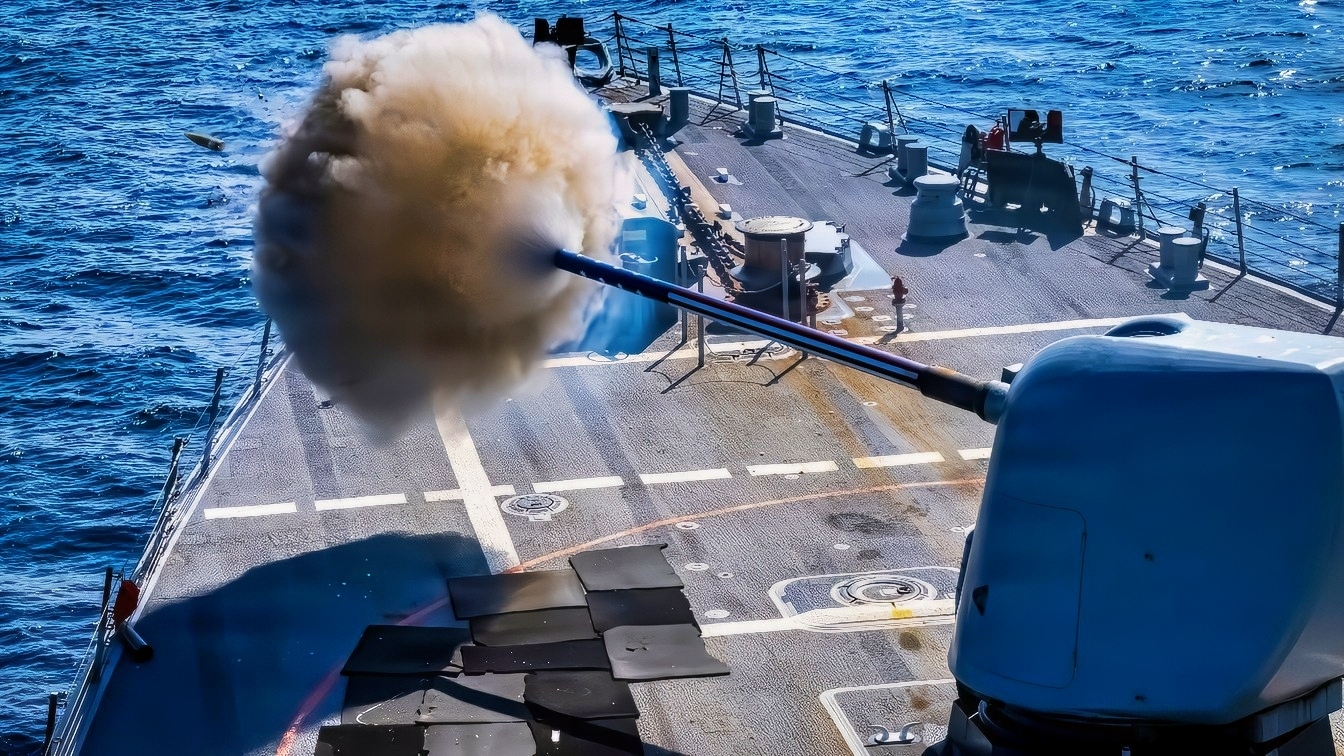
Arleigh Burke-class guided-missile destroyer USS Michael Murphy (DDG 112) sails alongside Nimitz-class aircraft carrier USS Abraham Lincoln (CVN 72) on Dec. 8, 2025. USS Abraham Lincoln (CVN 72), flagship of the Abraham Lincoln Carrier Strike Group, is underway conducting routine operations in the U.S. 7th Fleet area of operations, demonstrating the U.S. Navy’s long-term commitment to a free and open Indo-Pacific. (U.S. Navy photo by Mass Communication Specialist 3rd Class Nathaly Cruz)

Arleigh Burke-Class. Image Credit: Creative Commons.
Per Kplr, 19.5-22.5 million barrels of oil went through the Strait on September 24, 27, 28 and 29. The average amount of oil coming out of the Middle East in the 12 months before the war started was 18 million barrels per day.
It was enough for The New York Times to run a story this week about “The Return of Middle East Oil,” and renewed exports that threaten Iran’s leverage. The Times reported that while the U.S. has had some success getting through the Strait, oil prices won’t drop anytime soon.
Indeed, Brent Crude oil, as of Monday morning, was trading at $102.4, down from recent highs but still above $100, and up from a week earlier.
Iran Disagrees
However, Ali Fadavi, a senior commander with the Islamic Revolutionary Guard Corps (IRGC), said in an interview Sunday on Iranian state TV, as cited by Reuters, that the amount of oil going through the Strait is “negligible,” stating that only 3 to 4 million barrels of oil per day have been traversing the waterway.
The Kplr figures apply to the entire Middle East.
In the interview, the IRGC commander also said no U.S. ships are currently in the Strait of Hormuz, the Persian Gulf, or the Sea of Oman, and that American warships are “100 percent vulnerable” to attack.
Also over the weekend, Reuters reported, Mohammad Bagher Ghalibaf, the Iranian parliament speaker and chief negotiator, said that the Strait of Hormuz would remain closed until the U.S. accepts Iran’s plan, presented last week through Qatari mediators, to open the Strait in exchange for concessions.
Those concessions include unfreezing assets, lifting sanctions, and lifting the U.S. blockade. President Donald Trump had publicly rejected that offer over a week ago, but the diplomatic process has reportedly continued.
Attacks Have “Improved”
The Wall Street Journal reported Monday on the Strait of Hormuz, noting that a recent “wave of attacks” on vessels in and around the Strait has begun to threaten the recovery in energy exports.
Per the Journal, there were several factors in the recent resurgence in oil exports from the region, including U.S. naval protection, strikes that have knocked out Iranian radar capability, and “an elaborate system of shuttle runs,” led by the United Arab Emirates and other U.S. allies, in which tankers load and unload their crude oil on opposite sides of the Strait.
However, a new wave of strikes on vessels in the area has since occurred. The Journal cited the U.K. Maritime Trade Operations, which said at least seven vessels in and around the Strait of Hormuz have been struck since September 28. Kpler reported, per the Journal, that at least four of the seven vessels attacked had completed two or more round trips through the Strait since June.
On Saturday, the IRGC broadcast a warning to ships not to attempt the crossing. Shipping traffic is already beginning to slow, the Journal said.
“Don’t trust U.S. Navy,” the warning said, as reported by the Journal. “Don’t use south corridor at all and don’t put your life in danger.”
One U.S. official told the newspaper that Iran’s ability to target ships has improved in the last few weeks.
What’s Next?
These events come at a time when the conflict between the U.S. and Iran is at something of a standstill, as it hasn’t been a full-on shooting war for some time, yet an official ceasefire remains elusive.
President Trump, meanwhile, has spoken publicly about possibly seeking to “annihilate” Iran and has said more recently that military action could resume after the U.S. midterm elections on November 3.
About the Author: Stephen Silver
Stephen Silver is an award-winning journalist, essayist, and film critic, and contributor to the Philadelphia Inquirer, the Jewish Telegraphic Agency, Broad Street Review, and Splice Today. The co-founder of the Philadelphia Film Critics Circle, Stephen lives in suburban Philadelphia with his wife and two sons. For over a decade, Stephen has written thousands of articles on politics, national security, technology, and the economy. Follow him on X (formerly Twitter) at @StephenSilver, and subscribe to his Substack newsletter.


