

After transforming modern warfare with aerial drones, Ukraine is going one step further, using unmanned ground vehicles in conjunction with aerial drones and electronic warfare to push Russian forces back around the strategically important city of Lyman in eastern Ukraine.
An offensive launched by Ukraine’s Third Army Corps in May, but only reported publicly in September, has reportedly reclaimed 176 square kilometers of territory in northern Donetsk Oblast, according to corps commander Brigadier General Andrii Biletskyi.
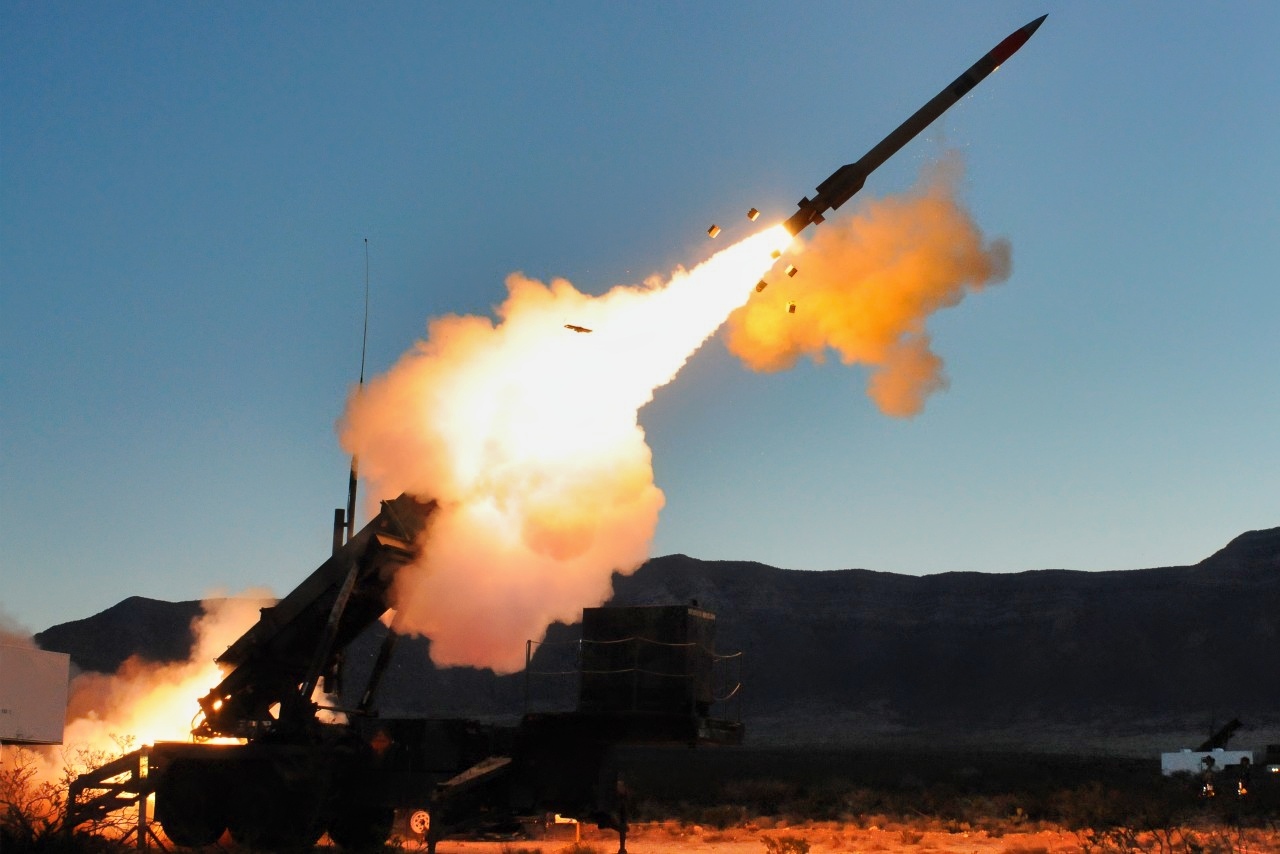
The PAC-3 MSE is a highly sought-after air defense munition due to its advanced capabilities and versatility. As a next-generation interceptor, it offers improved range, speed, and maneuverability, making it an effective counter to a wide range of threats, including tactical ballistic missiles, cruise missiles, and aircraft. (Official U.S. Army photo)
Patriot Missile. Image Credit: Creative Commons.
Known as Operation Vivaldi, the new tactic uses various unmanned assets and vehicles alongside remote-controlled explosive armored vehicles.
On September 28, Biletskyi announced the operation’s third phase was complete, claiming Ukrainian forces had liberated Nove, Ridkodub, and Katerynivka and restored full control over Karpivka and Novomykhailivka.
That latest phase alone has reportedly cleared an additional 51 square kilometers.
It might not be the massive breakthrough required to end the war, but it has reversed over a year of Russian advances in the area and significantly disrupted Moscow’s efforts to advance on Ukraine’s remaining major cities in Donetsk from the north.
The Secret Offensive
What’s so curious about Operation Vivaldi is how long Ukraine kept it quiet.
Ukraine did not publicly acknowledge the counteroffensive until September 15.
Third Army Corps deputy commander Major Maksym Zhorin said Ukrainian forces maintained strict information silence to prevent Russia from understanding what was happening.
Zhorin said secrecy was one of the “very important aspects” of the operation and “made it possible to mislead the enemy’s military leadership.”
He also described how Ukrainian troops recently concealed their advances using Protective Drone, a system that combines several electronic warfare systems.
According to the Third Army Corps, the method disrupted over 20,000 Russian drone missions.
“We were able to create a kind of curtain, a wall made by our electronic warfare units, through which enemy unmanned systems in some areas simply could not penetrate at all,” Zhorin said.
By September 15, Biletskyi says, the first phase had pushed out Russian troops from 75 square kilometers and liberated another 10 square kilometers, including the village of Serednie.
Ukrainian troops also pushed Russian forces out of Novoselivka, Oleksandrivka, Yarova, and areas surrounding Korovii Yar.
On September 20, the gains continued, with Ukraine announcing that it had retaken Shandryholove and Derylove, and established total control over Drobysheve.
How Ukraine Took Out Russian Drones
The surprise offensive was not just a ground attack — because before Ukrainian troops advanced, the Third Army Corps conducted an extensive campaign against Russian logistics and drone infrastructure behind the front lines.
The Institute for the Study of War says that Ukrainian drones first attacked Russian logistics as far back as 50 km behind the front lines, before extending operations as far as 120 km from the front.
Ukrainian forces then began targeting fuel supplies located in occupied Luhansk Oblast, disrupting the diesel supply for Russian troops that was necessary to power electronic warfare equipment.
At the same time, Ukraine used its own electronic warfare systems to suppress Russian drones.
The “Protective Drone” system neutralized 20,000 Russian drone sorties through the operation, and while that figure has not been independently verified, the ISW concluded in recent analyses that Ukraine achieved a significant degree of tactical drone superiority that helped Ukrainian forces maneuver around Lyman.
Once Ukraine made it difficult for Russia to watch the battlefield from above, it sent in robots.
Robots Go Behind Russian Lines
Ukraine used several robotic systems during the Vivaldi operation.
According to Major Serhii Tischenko of the Third Army Corps’ 96th Support Battalion, who spoke to Business Insider, unmanned ground vehicles were used under the cover of night to lay and clear mines before Ukrainian soldiers attacked during the daylight hours.
One of the robotic systems used could carry around 880 pounds, and Ukrainian forces used it to create minefields in just two days that might have taken two weeks to complete using humans.
Ukraine also deployed ground robots from the air.
Under what’s known as “Gryphons,” the Third Army Corps’ NC13 unit used heavy bomber drones to carry small kamikaze ground vehicles that would ultimately go more than 10 kilometers behind Russian lines.
The vehicles were dropped onto the battlefield and, once on the ground, they were remotely controlled and directed toward Russian positions from directions that would otherwise be inaccessible to Ukrainian ground forces.
And Ukraine went one step further, too.
Near Nove and Katerynivka, the Third Assault Brigade converted two old Soviet BTR armored personnel carriers into unmanned vehicles, packed them with explosives, and remotely drove them toward heavily fortified Russian positions.
The success of Operation Vivaldi shows that Ukraine continues to innovate to regain the initiative – and if Ukraine is using drones and robots in this way, so too will Russia, and so too will other forces in the future.
About the Author: Jack Buckby
Jack Buckby is a British researcher and analyst specializing in defense and national security, based in New York. His work focuses on military capability, procurement, and strategic competition, and he produces and edits analysis for policy and defense audiences. He brings extensive editorial experience, with a career output spanning over 1,000 articles at National Security Journal, and has previously authored books and papers on extremism and deradicalization.


