

Drone Warfare is Changing the Frontline in Ukraine… And it Could Have Repercussions for the World: Ever since the end of 2022, the frontline in Ukraine has barely shifted.
After failing to capture Kyiv in the war’s first six weeks, Russia pulled back its forces in April 2022. Counteroffensives in Kharkiv and Kherson pushed the invaders back even further in September that year. Since then, Russia has made only incremental gains across the country.
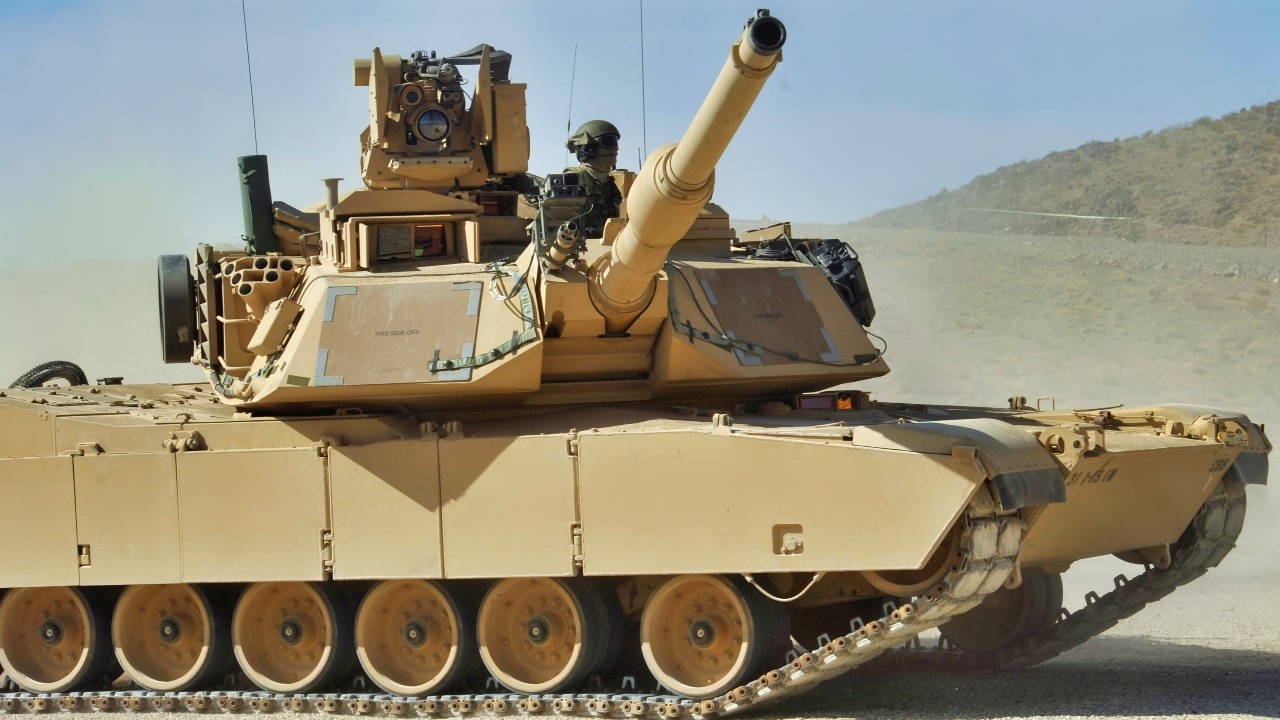
Australia is sending 49 of its retired M1A1 Abrams tanks to Ukraine, a move that bolsters Kyiv’s armored firepower but raises significant questions about survivability on the modern battlefield. While the donation is a welcome gesture, US officials have reportedly expressed private frustration, warning that Ukraine struggles to sustain the complex tanks and highlighting their vulnerability to cheap, top-attack FPV drones. The war in Ukraine has become a “drone war,” where even advanced main battle tanks are at constant risk. The effectiveness of these donated Abrams will ultimately depend on Ukraine’s ability to counter this pervasive threat.

T-84 Tank from Ukraine War. Image Credit: Creative Commons.
However, the 750-mile frontline is as dangerous as it ever was, with Ukrainian troops describing a 10–20-mile belt on either side of the frontline as the “Kill Zone.”
What is the “Kill Zone”?
“This Kill Zone is a belt of territory which is full of Russian drones, Russian mines, and also artillery,” said Sr. Lt. Taras Myshak, a spokesman for Ukraine’s 59th Separate Assault Brigade, in a Zoom interview with NPR.
Drones constantly buzz overhead, forcing Ukrainian troops to move incredibly slowly to avoid any sign of detection. Myshak said a one-kilometer walk could take as long as four hours. “Because all the time they hear the drone, and they have to hide and wait. Then the drone passes, and they can move,” he added.
One might imagine nighttime operations are safer, since the lack of visibility makes it harder for a drone operator to spot movement in the trees. However, the technological advancement of drones during Russia’s full-scale invasion of Ukraine means that many UAVs now carry thermal-imaging cameras capable of detecting body heat, removing the cover of darkness for approaching troops.
Ukraine operates similar systems against Russian troops on the other side of the frontline, resulting in a battlefield where both armies can see more than ever before, but where that constant visibility makes it extraordinarily difficult for either side to move enough troops and equipment to achieve a decisive breakthrough.
Changing Tactics
The greater need to avoid drone detection has changed the way soldiers reach and leave the frontline.
Troops increasingly move on foot or by bicycle rather than in armored vehicles, which are much easier to detect from above, while anti-drone nets have also appeared over roads and routes near the front to protect soldiers and vehicles.
Nevertheless, the constant danger has made traditional troop rotations tremendously difficult. Soldiers can remain in frontline positions for extended periods simply because replacing them requires another group to cross the same drone-covered terrain.
Likewise, moving wounded personnel in the opposite direction creates the same problem.
Changing Warfare
Russia’s full-scale invasion, through an increased use of drones on both sides, has shifted how warfare can be carried out.
Ukraine, possessing far fewer troops than its aggressor, relies heavily on drones with very few soldiers kept on the frontline, according to Ukrainian-based U.S. Marine veteran Rob Lee.
Noting that across much of the frontline Ukraine has fewer than 10 soldiers per mile, Lee added: “Those infantrymen are maybe two positions where it’s two to four people. They’re underground for the most part. They’re trying to remain hidden.”
Drones have therefore changed how warfare is fought in Ukraine. Larger troop concentrations or armored equipment are easily detected from the air, making it “very difficult” to bring vehicles to the frontline, according to Lee. This leaves smaller groups to probe advances, where a sparse but effective frontline of defense intercepts them.
Conflicts Shifting
Russia and Ukraine’s increased reliance on drones has become evident over the past few years, and it’s set to change warfare across the world. Former Ukrainian soldier Dima Putiata told NPR that when he first joined the armed forces, he thought they were unnecessary.
“When I saw that we have drones, I was not smart enough. I said, ‘No, we don’t need to have it. Let’s fight like men.’ I was a little bit maybe romantic in this way,” he said. “No one had drone operators. It’s just ‘Oh, you’re a driver? You can use it.’ Or, ‘Oh, can I use a drone? You can try.’”
He offers a grim prediction, having witnessed first-hand the effectiveness of drone warfare on the frontline. “With drones, this is the cheapest flying munition that can be massively produced. You can destroy a lot of stuff,” said Putiata. “It’s much cheaper than it used to be to have a war, unfortunately.”
About the Author: Shay Bottomley
Shay Bottomley is a British journalist. He has written for the Western Standard, Business Insider, Maidenhead Advertiser, Slough Express, Windsor Express, Berkshire Live and Southend Echo.