
Oil exports from the Middle East are returning to pre-war levels for the first time since the Iran war began more than seven months ago.
Excluding Iran, which exports nothing due to the ongoing U.S. naval blockade of Iranian ports, Gulf producers’ exports surged to 81% of pre-war levels throughout September.

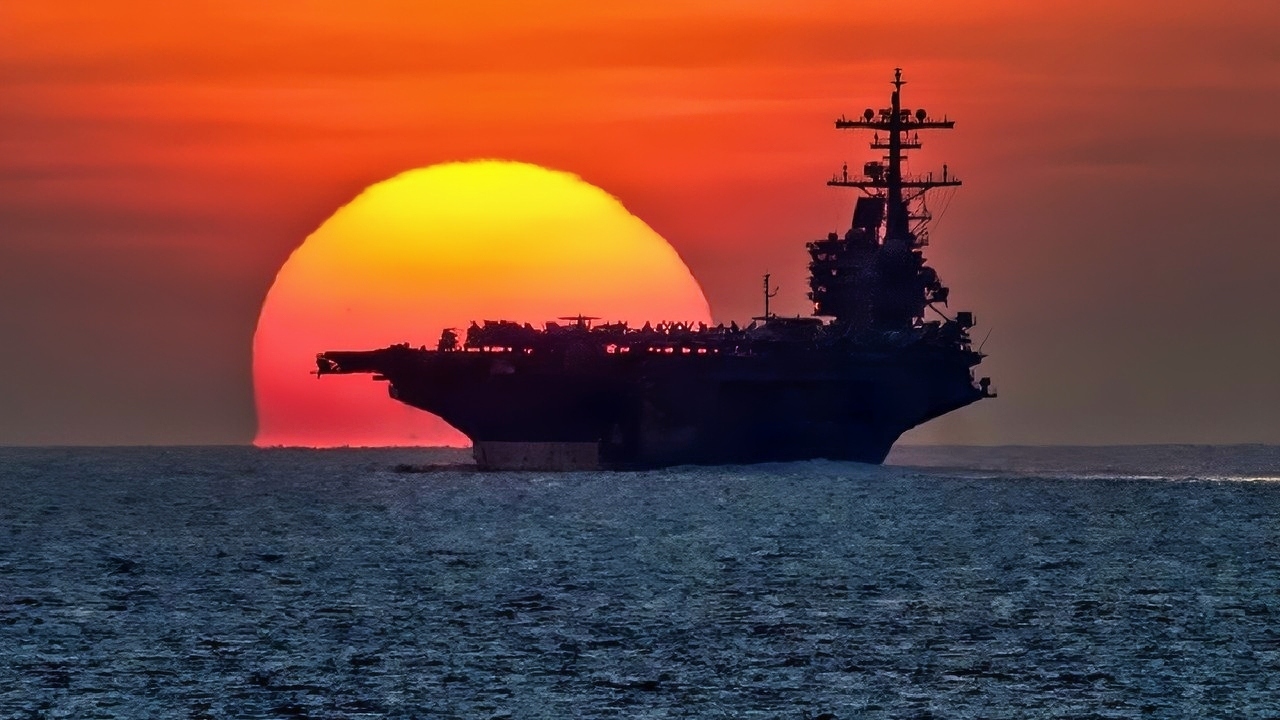
A U.S. Navy F/A-18E Super Hornet aircraft assigned to Strike Fighter Squadron (VFA) 14 participates in an air power demonstration near the aircraft carrier USS John C. Stennis (CVN 74) April 24, 2013, in the Pacific Ocean. The John C. Stennis Carrier Strike Group was returning from an eight-month deployment to the U.S. 5th Fleet and U.S. 7th Fleet areas of responsibility. (U.S. Navy photo by Mass Communication Specialist Seaman Apprentice Ignacio D. Perez/Released)

An Air Force F-22 Raptor executes a supersonic fly by over the flight deck of the aircraft carrier USS John C. Stennis. John C. Stennis is participating in Northern Edge 2009, a joint exercise focusing on detecting and tracking units at sea, in the air and on land.
This is despite continued attacks by Iran on commercial shipping in the Strait of Hormuz.
Exports Returning
Reuters reports that flows of crude, condensate and refined fuels, including LPG (liquefied petroleum gas), averaged 19.2 million barrels per day (bpd) from the Gulf producers, namely Saudi Arabia, Kuwait, Qatar, Oman, Bahrain, Iraq, and the United Arab Emirates.
In 2025, the average export was 23.6 million bpd.
While Saudi Arabia is exporting around four-fifths of its pre-war daily total, some countries such as the UAE and Oman are exporting even more than last year.
Iraqi exports are also recovering, while Kuwait and Qatar export half of their previous daily amount.
Interestingly, some oil types are exporting better than others. Crude and condensate flows recovered to 91% of pre-war levels last month, according to Vortexa data.
However, refined fuels such as LPG remain at 60% of pre-war levels and have not been exported as much.
Price Relief
Consumers and producers worldwide will be pleased that exports are returning to previous rates.
The supply reduction has raised oil and commodity prices, including diesel, which reached an all-time record high in the United States last month.
Diesel’s importance to the global economy cannot be overstated, particularly in food production.
When supplier costs rise, they pass them on to consumers, so grocery bills increase even for those who drive gasoline-powered vehicles.
While crude exports are increasing again, that does not necessarily mean diesel prices will drop suddenly.
“Daily flows are considerably more volatile than before the war, so the key question is whether recent levels can be sustained,” Claire Jungman, Director of Maritime Risk and Intelligence, told Reuters.
Crude is recovering quickly, with Saudi Arabia leading efforts to increase shipments from 4.2 million bpd in August to 6.6 million bpd in September, despite drone attacks that forced a key oil pipeline to close for much of the month.
The Kingdom’s exports surge has offset relative stagnation in crude shipments from other Gulf nations, with only the UAE significantly increasing its daily exports by 400,000 bpd from August to September.
How Are They Doing It?
This increase in oil exports has come even despite Iran’s insistence that the Strait of Hormuz remains closed.
Tehran has repeatedly attacked commercial shipping it sees as breaching its strait regulations, forcing exporters to adapt their methods.
For example, Saudi Arabia has resumed shipping through its East-West oil pipeline.
Constructed in the 1980s amid concerns of a conflict between Iraq and Iran, the Saudi Kingdom can bypass the Strait of Hormuz entirely by exporting through the Red Sea.
The United Arab Emirates enjoys a similar luxury, able to reroute oil to its Fujairah export terminal just outside the Strait of Hormuz.
It is also building a new pipeline expected to be completed next year.
Another tool at its disposal is the ability to conduct ship-to-ship transfers in open waters.
In short, ship-to-ship transfers allow a larger tanker, which is easier for Iran to target, to transfer to a smaller vessel.
Trackers are turned off to maintain secrecy before the smaller vessel brings the oil through the Strait of Hormuz.
This effectively lets exporters move oil through the strait with reduced risk of Iranian attack.
Keeping exports flowing is so crucial that Saudi Aramco is considering a $ 9-per-barrel discount, effectively paying buyers to absorb the higher freight and logistical costs of avoiding normal Gulf loading patterns.
Bad News for Iran
The recent data is nothing but bad news for Iran.
Not only are its exports officially nil, but Tehran’s one leverage point, the ability to restrict foreign oil exports, is vanishing.
The U.S. Naval blockade shows no sign of ending, either.
In fact, freeing up Iranian ports is a key proposal in a peace deal Tehran presented to the U.S., which the latter rejected late last month.
About the Author: Shay Bottomley
Shay Bottomley is a British journalist. He has written for the Western Standard, Business Insider, Maidenhead Advertiser, Slough Express, Windsor Express, Berkshire Live and Southend Echo.