

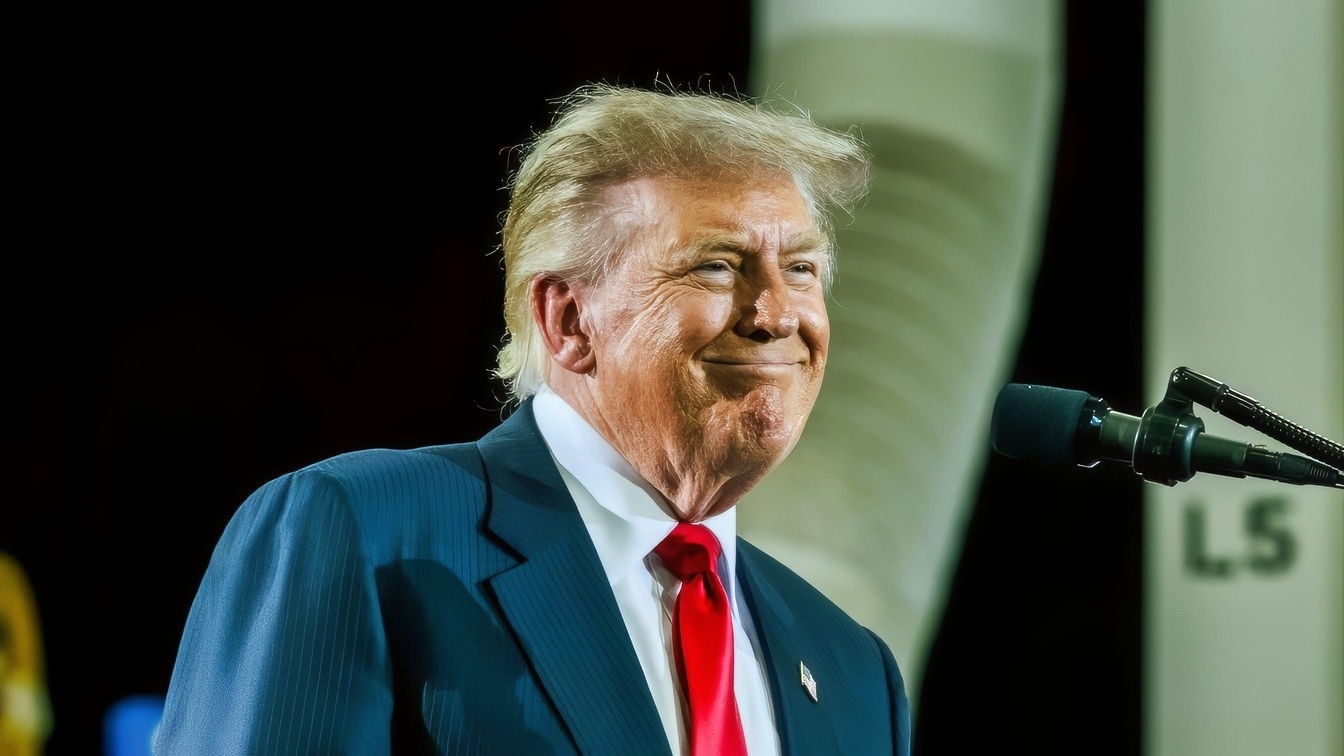
President Donald Trump generated an immediate backlash Monday after appearing to suggest Iran could “take out” Los Angeles or San Diego. Speaking at a campaign rally in Grand Island, Nebraska, Trump was defending the costs of the ongoing war with Iran when he made the statement. “It’s a small price to pay for keeping the world safe, keeping our country safe,” the president said. “They can take out a city.” He elaborated: “Let them take, let — let them take out Los Angeles. Let them take out San Diego. That’s — this is a very small price to pay, and it’s gonna be over very soon.”
When interpreted literally, the statement is astonishing.

President Donald Trump attends UFC 314 at the Kaseya Center in Miami, Florida, Saturday, April 12, 2025. (Official White House Photo by Daniel Torok)
California’s political leaders took offense instantly. But Trump’s syntax seems garbled. The White House says that the intended argument was almost the exact opposite of what he actually said: that the US is fighting Iran to prevent Iran from acquiring the capability to threaten American cities.
Communications Director Steven Cheung said Trump was arguing US cities would have been threatened if a nuclear Iran hadn’t been stopped.
So the first question here is political: what did Trump actually mean?
And the second question is military: does Iran actually possess the ability to attack a city like Los Angeles or San Diego?
Decoding Trump
Trump isn’t the most eloquent.
He often says things that are plainly hyperbole, intentional misdirection, or careless. As a result, it’s often difficult to decipher what the president intends to convey.
In the current instance, Trump was defending the Iran war in the face of spiking gasoline prices, domestic political opposition, and growing public concerns over the cost of another Middle Eastern intervention.
Trump’s argument appears to have been that the present economic costs are relatively small compared with the potential consequences of allowing Iran to become a nuclear power capable of destroying American cities.
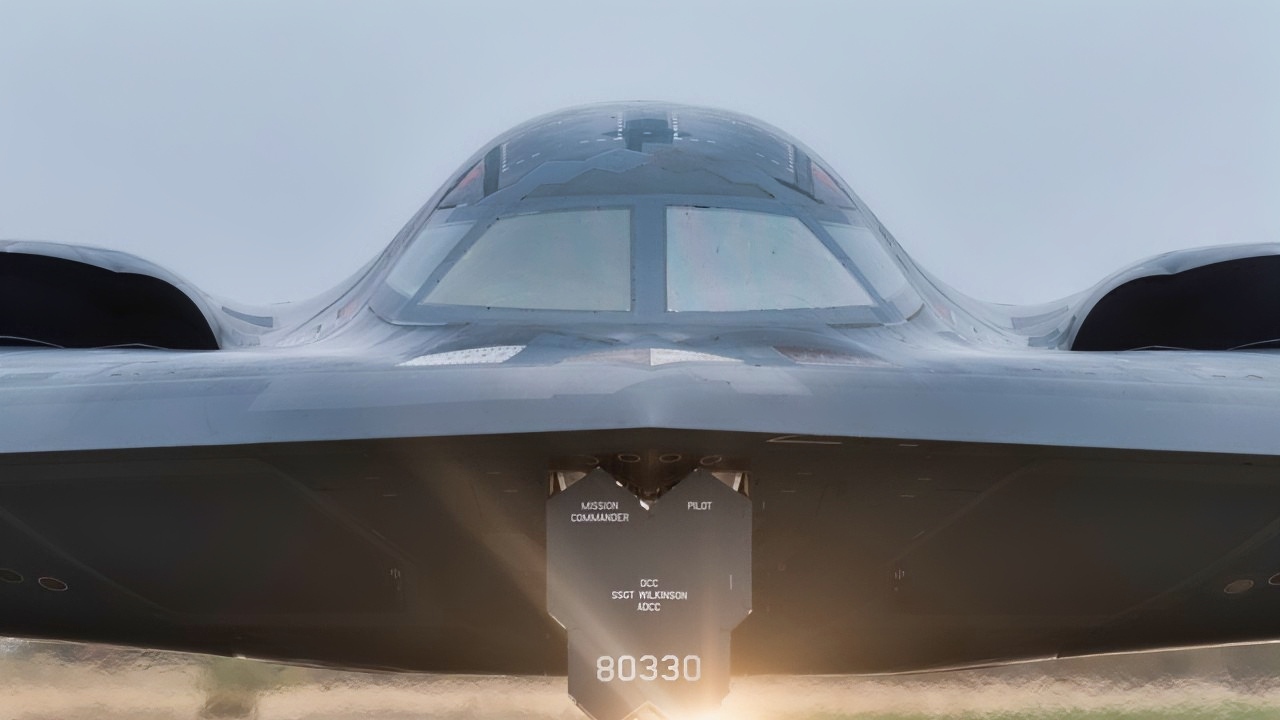
A B-2 Spirit Stealth Bomber, assigned to the 509th Bomb Wing, Whiteman Air Force Base, Missouri, taxis down a flight line, Oct 24, 2019. Total Force Airmen at Whiteman AFB are ready to execute the mission anytime, anywhere. (U.S. Air Force photo by Senior Airman Thomas Barley)
The speech wasn’t particularly coherent, and the wording wasn’t entirely clear. The phrase “they can take out a city” appears to allude to hypothetical danger, rather than grant permission.
The White House interpretation is therefore entirely plausible. But then again, it’s Trump. His rhetoric has long been designed to incite. It’s not beyond the realm of possibility that he meant the least generous interpretation.
Los Angeles and San Diego?
Could Iran launch a missile at California?
Iran possesses one of the world’s largest and most diverse ballistic-missile arsenals, having successfully demonstrated short-range ballistic missiles, medium-range ballistic missiles, cruise missiles, and increasingly sophisticated drones.
Those weapons absolutely create serious dangers to Israel, the Gulf States, and US forces in the Middle East. But California is another story. The distance from Iran to Southern California is over 7,000 miles.
Reaching California from Iran would require a legitimate intercontinental ballistic missile (ICBM), which Iran does not possess.
Trump’s use of the phrase “take out” implies nuclear capability. Iran does not currently possess nuclear capability. A conventional warhead delivered to a Californian city would cause immense damage and casualties—but would not “take out” the city.
To threaten destruction on a citywide scale, Iran would need a nuclear warhead, a reliable long-range delivery system, a reliable reentry vehicle, and targeting and command-and-control infrastructure. Iran isn’t there. So no, Iran does not have the technology to “take out” an American city.
Bad Rhetoric
While the scenario Trump alluded to isn’t currently possible, the phrasing deserves further examination.
During wartime, a president’s words carry more weight than in peacetime. Oftentimes, ambiguous campaign rhetoric can just be dismissed as political theater.
But wartime rhetoric is scrutinized more closely—by allies and adversaries alike. Here, Trump’s improvisational speaking style is less functional. While Trump’s meaning may have been innocuous, his words were concerning. It’s not ideal when the White House has to step in to explain what the commander-in-chief meant, regardless of what was said or how it was interpreted.
Still, when interpreted generously, it’s worth noting that Trump is using a preventive-war argument to justify intervention in Iran. The justification raises questions about Iran’s true capabilities and whether US intervention was necessary to prevent a worst-case scenario.
About the Author: Harrison Kass
Harrison Kass is a writer and attorney focused on national security, technology, and political culture. His work has appeared in Tablet, City Journal, The Hill, The Spectator, and The Cipher Brief. He holds a JD from the University of Oregon and a master’s in Global & Joint Program Studies from NYU. More at harrisonkass.com.


