
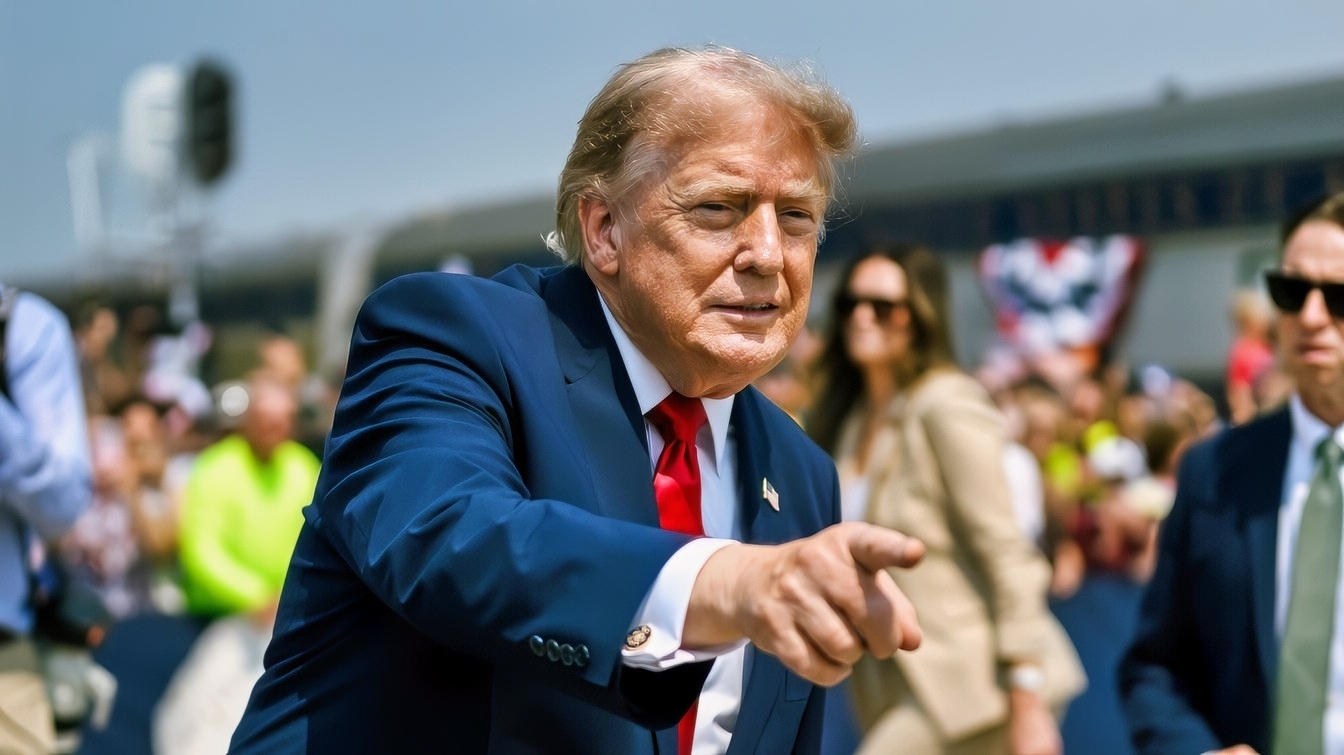
President Donald Trump never wanted the Iran war to last as long as it did. Still, Tehran knew that delaying negotiations as long as possible would force the president into the November midterms in the middle of a war, and those tactics have worked.
President Trump’s approval ratings have reached historic lows, and the Republican Party is widely expected to lose control of Congress in November. And with just two weeks to go, Iran is still taunting President Trump and seeking to exploit his political vulnerability.

A U.S. Air Force B-1B Lancer assigned to the 34th Expeditionary Bomb Squadron, Ellsworth Air Force Base, S.D., descends after conducting aerial refueling with a KC-135 Stratotanker assigned to the 506th Expeditionary Air Refueling Squadron in support of Bomber Task Force 25-1 over the Pacific Ocean, Mar. 4, 2025. Bomber Task Force enhances readiness, to include joint and multilateral, to respond to any potential crisis or challenge in the Indo-Pacific. (U.S. Air Force photo by Airman 1st Class Alec Carlberg)

A U.S. Air Force B-1B Lancer assigned to the 345th Expeditionary Bomb Squadron, decends for landing at Ørland Air Base, Norway, during a Bomber Task Force Europe deployment, Aug. 9, 2025. The BTF mission highlights how we deliver effects rapidly across dynamic and contested environments through integrated training. (U.S. Air Force photo by Staff Sgt. Tambri Cason)
Attacks against commercial shipping are rising, gasoline prices are going up too, and a new New York Times investigation published on October 20 reveals how Iranian officials are focusing squarely on the economic and political consequences of the war for Trump – even as Tehran prepares for the possibility of another major American offensive after the elections.
According to the New York Times, Iranian state media is now regularly highlighting President Trump’s declining poll numbers and the impact the war is having on the average American household.
The new findings come as shipping data show oil flows through the Gulf collapsing again, putting immense pressure on President Trump to wind the war down as quickly as possible.
Iran Targets Trump’s Political Weakness
Iranian leaders, grappling with political weaknesses and a collapsing national economy, see the November elections as an opportunity to pressure Washington further without directly confronting American military forces.
Iran may have leverage in negotiations until November 3, and every attack on commercial shipping is less likely to draw American retaliation because President Trump is concerned about how it could affect his polling numbers.
According to The New York Times, Iranian media outlets, including the semi-official Fars News Agency, have been focusing on American polling data showing growing frustration with President Trump’s economic performance.
The report also cited comments from Iran’s parliamentary speaker Mohammad Bagher Ghalibaf, who mocked rising American interest rates and high gasoline prices.
In September, Iran made it abundantly clear that it was looking to hurt Trump at the ballot box – and remove some of his legislative power in Congress by helping the Democrats win – when the Islamic Revolutionary Guard Corps published an open letter to Americans accusing Trump of misleading voters about the state of the economy.
The letter also called on Americans to reject President Trump’s agenda.
Iranian Officials Confirm New Shipping Tactics
While Iran looks to hurt Trump at home and convince its own people that the war is still worth fighting, its military is launching more aggressive and more frequent attacks against commercial vessels in and around the Strait of Hormuz.
Two senior Iranian officials confirmed to Reuters earlier this month that Tehran’s maritime operations have changed, and that they are working to increase pressure on the United States in the run-up to the November midterms.
One official told the outlet that Iranian forces have been using different methods to target vessels violating Tehran’s restrictions approximately 10 days prior.
After American strikes took out much of Iran’s military and surveillance infrastructure along its coast, Iranian forces are now deploying small and civilian boats to identify potential targets operating in the Strait of Hormuz visually.
Kpler data also shows crude flows through the region falling dramatically, with reports from October 19 showing roughly 8.5 million barrels per day moving through the waterway over the preceding week, down from a recent high of 20 million barrels per day, which was more than the pre-war average.
Iran Has Tried This Before: Donald Trump the Next Jimmy Carter
Iran has a history of attempting to influence American elections through prolonged confrontations with Washington – although not recently. Iran pursued a similar strategy during the 1980 presidential election, when President Jimmy Carter sought reelection against Republican candidate Ronald Reagan.
In November 1979, Iranian students seized control of the American Embassy in Tehran and took dozens of diplomats and Americans hostage.
The crisis continued throughout the following year and undermined President Carter’s presidency and contributed to widespread perceptions that his administration was incapable of dealing with Iran.
But declassified American intelligence assessments have since revealed that U.S. officials believed that Tehran was deliberately prolonging the crisis to influence the election.
Carter famously lost the election to Reagan on November 4, 1980, and the remaining 52 hostages were released on January 20, 1981, only minutes after Reagan was inaugurated.
So, could Iran be trying to use the same strategy? All the evidence suggests so, but Tehran faces a problem, a few, in fact. First, this is not a presidential election, and Trump will still be president after November.
He will, however, face the likelihood of spending the next two years bogged down by Democrat-led investigations and potentially another impeachment.
He will also lose legislative power if his party loses control of both chambers.
Second, Iran’s economy is collapsing, and its current strategy is unsustainable. Between the naval blockade and intensifying sanctions, Iran only has so much time before its economy completely collapses – and President Trump is betting that pressure will eventually be enough to bring them back to the negotiating table, or sufficiently serious to force the Iranian people to overthrow their own regime.
About the Author: Jack Buckby
Jack Buckby is a British researcher and analyst specializing in defense and national security, based in New York. His work focuses on military capability, procurement, and strategic competition, and he produces and edits analysis for policy and defense audiences. He brings extensive editorial experience, with a career output spanning over 1,000 articles at National Security Journal, and has previously authored books and papers on extremism and deradicalization.


