

With Ukraine now in the throes of winter, the country’s shortage of air defense interceptors is eminently clear — and underscores how difficult this winter has been, and will in all likelihood continue to be for Ukraine as a whole, but far removed from the front line, for the country’s civilian population in particular.
Peace Talks in Abu Dhabi
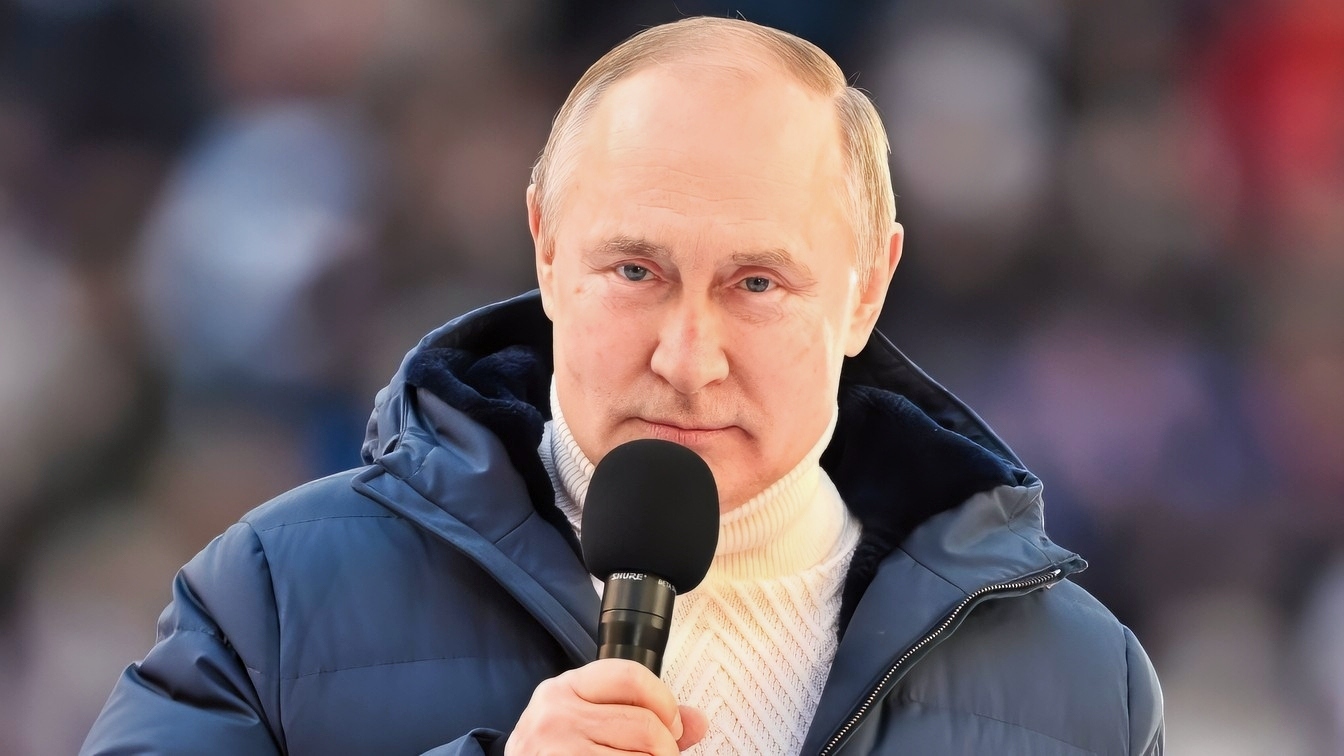
Putin in March 2022. Creative Commons Image.

Putin Meeting with Indian Leaders Creative Commons Photo 2021
Negotiations between Moscow and Kyiv, mediated by Washington, concluded in Abu Dhabi, the capital city of the United Arab Emirates, without a breakthrough.
It was hardly a surprise, given the polar opposite positions of Russian strongman Vladimir Putin and Ukraine.
While Moscow’s forces continue to grind themselves to a standstill against Ukraine in the country’s eastern Donbas region, there is seemingly no end in sight to the fighting there.
The conclusion was a far cry from the groundbreaking agreement American President Donald Trump promised in the run-up to negotiations.
Before the negotiations, Trump and members of his administration repeatedly appeared to take Russia’s side.
Last month, Starshield, the military-grade satellite communication service developed by Elon Musk’s SpaceX, slowed its connectivity speeds over Ukraine, imposing latency significant enough that Kyiv’s defenders could not use Starshield to intercept Russian munitions as it had in the past.
Intelligence sharing from Washington has also been throttled, a scale-back in information that left parts of the country’s military targeting and air defense apparatuses unable to respond adequately.
Bridge Strikes
Ukrainian forces struck the Kerch Strait Bridge, which spans the body of water separating Crimea and Russia on Monday.
Photographs and footage of the strikes appeared to show the span’s arch, below which ships can navigate, had fallen into the sea.
Russia began work on the bridge, the longest of its kind within Europe, following Moscow’s 2014 annexation of Crimea, the Ukrainian peninsula that juts into the Black Sea.
It is not the first time that Ukrainian forces have managed to strike the bridge.
Further reporting showed that at least one section of the bridge had collapsed — a striking hit and response to Russia’s targeting of Ukrainian bridges spanning the Dnipro River.
In Winter’s Grip
Meanwhile, Ukraine faces an exceedingly difficult situation on the home front.
Although Moscow’s forces are stymied on the battlefield, they have directed their ire instead at Ukraine’s civilian population in hopes of exacting some gains from a populace which cannot fight back.
A recent data leak by a pair of hacker groups revealed the staggering scope of Russian losses in Ukraine.
A breach of Russia’s statistical service, a state organization, has produced some of the most detailed, high-quality data related to the deaths of Russian service members accrued during the course of fighting — figures that some experts believe could be over half a million deaths alone, a figure that does not include those wounded or missing in action.
It’s an enormous figure — and represents greater losses suffered by troops dispatched from Moscow in all the wars fought since the Second World War combined.
But despite the incredible losses, Russia’s war machine still lobs munitions at Ukraine.
Last week alone, Russia launched over 2,300 attack drones, nearly 1,600 aerial bombs, and 15 missiles of different types against cities and towns across Ukraine, striking apartment blocks, bridges, trains and railway stations, as well as water treatment facilities and heating and power infrastructure too.
The numbers underscore how urgently Ukraine needs adequate air-defense interceptors, and how difficult it has been to source the all-important munitions for Ukraine’s defenders.
Posting to X, formerly Twitter, Ukrainian President Volodymyr Zelensky gave an overview of the acute situation that Ukraine’s civilians are facing in the face of a concerted aerial onslaught, one sent and directed by the Kremlin.
“The Russians are targeting substations with “shaheds.” And many of these strikes are getting through because restrictions on the operating speed of Starshield terminals along the front line and in the temporarily occupied territories are still there,” the Ukrainian President wrote.
“Our interceptor drones lose connection with their operators at a speed of 161 kilometers per hour (100 miles per hour) and simply cannot catch up with Russian jet-powered “shaheds.” We are counting on these restrictions being lifted. The protection of lives and Ukraine’s energy infrastructure ahead of winter directly depends on this.”
About the Author: Caleb Larson
Caleb Larson is an American multiformat journalist based in Berlin, Germany. His work covers the intersection of conflict and society, focusing on American foreign policy and European security. He has reported from Germany, Russia, and the United States. Most recently, he covered the war in Ukraine, reporting extensively on shifting battle lines in Donbas and writing about the war’s civilian and humanitarian toll. Previously, he worked as a Defense Reporter for POLITICO Europe. You can follow his latest work on X.


