

Earlier this week, the Ukrainians launched a massive drone strike on the Kerch Strait Bridge connecting Russian-controlled Crimea with the Russian Federation.
This strike was about more than targeting a key artery connecting the Crimean Peninsula to the rest of Russia.

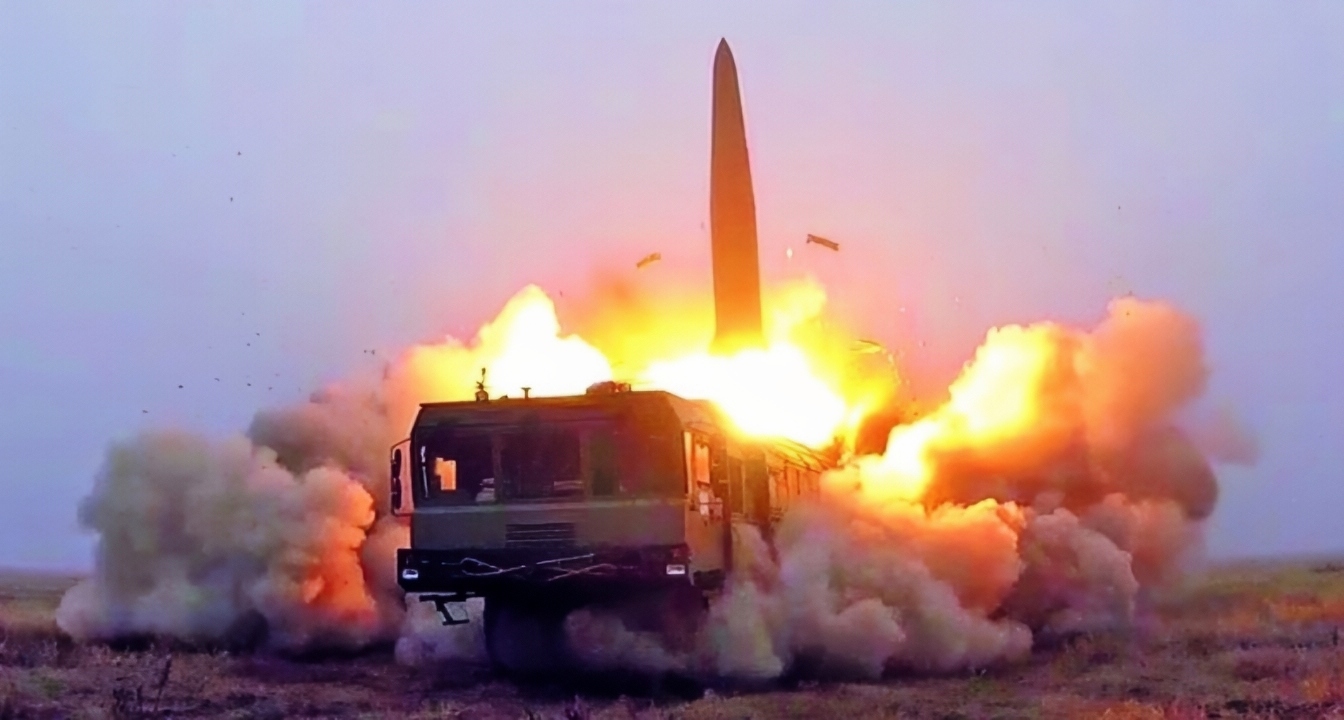
Iskander-M. Image Credit: Creative Commons.
It was a symbolic strike aimed at Russian President Vladimir Putin himself.
That’s because the bridge was a major infrastructure project that Putin himself spearheaded.
The Kerch Strait Bridge was expensive, and it was meant to symbolize the reunification of Crimea with Russia just four years after the Russians had annexed Crimea in 2014.
Putin vowed massive retaliation immediately after the strikes on the Kerch Strait Bridge.
The Attack
Early on Friday, November 20, Russia launched one of its largest missile and drone attacks of the war against Ukraine. The attack targeted key Ukrainian infrastructure across the country, striking three major bridges in Kyiv.
These strikes can be placed in the wider context of the back-and-forth between Kyiv and Moscow, in which the two sides are pummeling each other’s key infrastructure with drones.
So, the question is which side can best sustain these attacks–and which side’s attacks are doing greater damage?
The Ukrainians claim that they’ve knocked out more than 50 percent of Russia’s refining capacity because their attacks on Russian energy production have been so successful.

Tu-160M Bomber from Russia. Image Credit: Russian Military/Creative Commons.
That figure has not been independently verified.
Some Western sources claim the number is closer to 33 percent. Then again, the Russians totally deny that the attacks have impacted them at all.
Meanwhile, the Russian war machine grinds on throughout the front in Eastern Ukraine. Slowly but surely, it seems, Russian forces have encircled the remaining Ukrainian Fortress Cities that serve as the last significant line of defense.
The Ukrainians have counterattacked repeatedly.
Both sides claim victory.
The point is that the Ukrainian attacks have not yet achieved their desired impact in stunting the Russian war machine.
But the Russian attacks on Ukrainian infrastructure have clearly created massive concern in Kyiv.
Ukrainian energy personnel are racing to decentralize their power infrastructure, after a wave of devastating Russian drone and missile strikes on power distribution centers.
Russian attacks have also concentrated on turning off Ukraine’s water supplies.
It has gotten so bad in Ukraine that the mayor of Kyiv and President Volodymyr Zelensky are feuding over disaster response and preparedness, with Kyiv’s mayor calling on as many residents of Kyiv as possible to leave the city and move west, as the chances that there will be no water or energy available in the coming winter months are high.
Russia’s recent counterattack targeted three major crossings over the Dnipro River, with Ukrainian officials confirming they were damaged, and Kyiv city officials being forced to shut down traffic.
The bridges connect the eastern and western sections of Kyiv, so their closure has greatly complicated life in the capital. Russia’s bombardment damaged additional electrical generation facilities, important railway infrastructure, and other industrial installations.
Three Kyiv water utility workers were killed in the attack, and the Russian strikes disrupted water pressure in four districts of the capital city.
No Peace In Our Time?
All this is happening against the backdrop of the Trump administration’s desperate attempts to reach a negotiated settlement in the war in Ukraine.
The president’s son-in-law, Jared Kushner, led the American delegation in these talks.
According to Kushner, Russia indicated a willingness to include Europe in future negotiations and was even open to NATO-like security guarantees for Ukraine.
Of course, we have no independent verification of these claims.
It seems highly unlikely that the Russians would accept NATO-like security guarantees for Ukraine given that the entire reason Putin initiated the war against Ukraine was to roll back NATO and prevent the military alliance from offering such guarantees to Ukraine.
Then again, multiple sources indicate that Putin now believes his forces can achieve victory on the battlefield over the next six to nine months, so perhaps he was humoring his American interlocutors while buying time for his frontline forces to do their work.
Whatever happens with the negotiations, they seem to be on the back burner compared to what the Russians and Ukrainians are doing.
The war is their priority, not peace negotiations.
The difference is that one side will achieve victory over the other.
While the Ukrainians are gallantly fighting, it still does not look as though they will outlast the grinding that the Russian military is subjecting its frontline forces to.
These infrastructure attacks are peripheral to the battlefield, where the real winner of the war will be determined.
About the Author: Brandon J. Weichert
Brandon J. Weichert is the Senior National Security Editor. He also manages The Weichert Brief on Substack. Weichert is the co-host of The Mario Nawfal Show on Twitter/X. He is the author of four bestselling national security books, most recently A Disaster of Our Own Making: How the West Lost Ukraine (Encounter Books). His next book, Fortress Americas: A New Monroe Doctrine (Tucker Carlson Books), is due out December 8. Follow him via Twitter/X @WeTheBrandon.


