

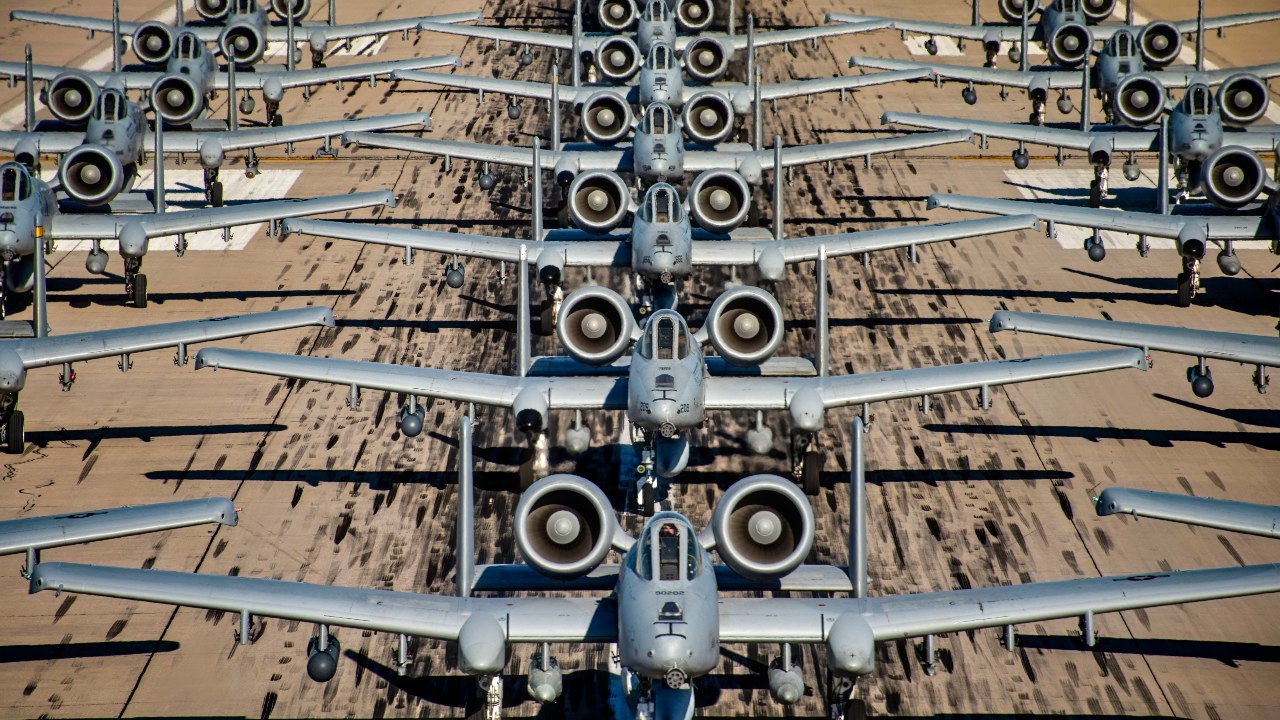
With the A-10 Warthog facing retirement, questions have been raised as to what exactly we should do with the retired frames.
Some have suggested that the A-10 should be sent to Ukraine to fight against the Russians.
The Warthog was designed to provide close air-support against heavily armored units so on paper, sending the A-10 sounds like a great idea.
However, the A-10 Warthog is an aging aircraft and may encounter numerous hurdles in the skies of Ukraine.
Arguments in Favor of the A-10 Wathog in Ukriane
The A-10 Warthog is specifically designed for close air support and is equipped with the GAU-8 Avenger 30mm cannon, which can fire 3,900 rounds of depleted uranium bullets per minute.
This cannon is capable of penetrating heavy armor, making the A-10 highly effective against tanks and armored vehicles.
During Operation Desert Storm, the A-10 was credited with destroying over 900 tanks. Given the significant losses of Russian armor in Ukraine, the A-10 could further exploit these vulnerabilities.
The A-10 is built to withstand substantial damage and continue flying. It features a titanium “bathtub” that protects the pilot and critical systems from ground fire up to 23mm. The aircraft can survive hits from armor-piercing and high-explosive projectiles, making it highly resilient in combat.
This durability is crucial in environments where air defenses are a constant threat.
The A-10 Warthog has undergone several upgrades, enhancing its capabilities. The addition of the GBU-39 Small Diameter Bomb (SDB) allows the A-10 to perform standoff attacks from over 60 miles away. This versatility enables the A-10 to engage in various missions, including Suppression of Enemy Air Defenses (SEAD) and maritime strike operations. Its ability to operate from short and unimproved runways further enhances its battlefield flexibility.
Compared to more advanced fighter jets, the A-10 has relatively low operating costs. The flight hour per hour for an A-10 is estimated to be between $5,900 and $11,500. The Warthog was also designed with ease of maintenance in mind, minimizing the time required to make repairs. This makes it an economically viable option for sustained operations, especially for a country like Ukraine that may have budget constraints.
The Case of the Su-25
The Soviet Union built a subsonic heavily armored fighter with the primary function of conducting CAS. This aircraft, the Su-25 Frogfoot, has been flying for both Russia and Ukraine for the duration of the war, and to great effect. Often called the “Soviet A-10,” the Su-25 shows that dedicated CAS aircraft are still relevant, even in near pear conflicts with heavy AD presence. After more than three years of combat, Ukraine’s Supply of Su-25s has been severely depilated, sending the A-10 would plug the CAS gap Ukraine has and fill a much-needed role.
Why Sending the A-10 Warthog Might Not Work
While Ukraine could certainly benefit from the A-10, there are a couple of reasons why sending it to Ukraine could end in disaster.
One of the primary challenges for the A-10 in Ukraine is the lack of control over the airspace. The A-10 operates best in environments where friendly forces have air superiority. The Russian Air Force still operates widely along the front line. With Russian planes in the sky, the A-10 would have a difficult job performing it mission. Without control of the skies, the A-10 would be highly vulnerable to Russian air defenses.
Despite its durability, the A-10 is not invincible. It is particularly vulnerable to modern air defense systems, including MANPADS (Man-Portable Air Defense Systems) and advanced surface-to-air missiles. Russian SHORAD (Short Range Air Defense) systems like the Panstir-S1 and the Tor-M1 pose serious threats to any Ukrainian aircraft. These threats could result in significant losses if the A-10 Warthog were deployed in Ukraine.
Moreover, the A-10’s design prioritizes durability and firepower over speed and agility. While it offers excellent maneuverability at low speeds and altitudes, it is not designed for rapid maneuverability and evasion. With a top speed of around 420 mph, the Warthog could be easy pickings for AD systems or MANPADS operators. For comparison, the Su-25 has a top speed of around 600 mph, not too much faster, but even a bit more speed can make all the difference on the battlefield. In a conflict where rapid maneuverability is crucial, the A-10’s slower speed and limited agility could be a disadvantage.
Deploying the A-10 to Ukraine would require substantial logistical support. This includes maintenance, spare parts, and trained personnel to operate and repair the aircraft. Training pilots for the A-10 could take as long as a year or even longer, precious time that Ukraine simply does not have. Ensuring that Ukraine has the necessary infrastructure to support the A-10 is one of if not the most significant hurdles.
The A-10 Warthog Won’t Fight In Ukriane
The A-10 Warthog is a formidable aircraft, boasting a well-balanced combination of firepower, maneuverability, and survivability. However, the A-10 is becoming more and more obsolete. In an environment against modern air defense systems and enemy aircraft, the Warthog would operate well outside its comfort zone and likely would not perform well.
Additionally, the training and logistics challenges of operating the A-10 would take time and resources to overcome, an investment that may not be worth it in the long run.
About the Author
Isaac Seitz, a Defense Columnist, graduated from Patrick Henry College’s Strategic Intelligence and National Security program. He has also studied Russian at Middlebury Language Schools and has worked as an intelligence Analyst in the private sector.


Pingback: Zapad-25: Could Russia and Belarus Be Plotting Another Ukraine Invasion? - National Security Journal