

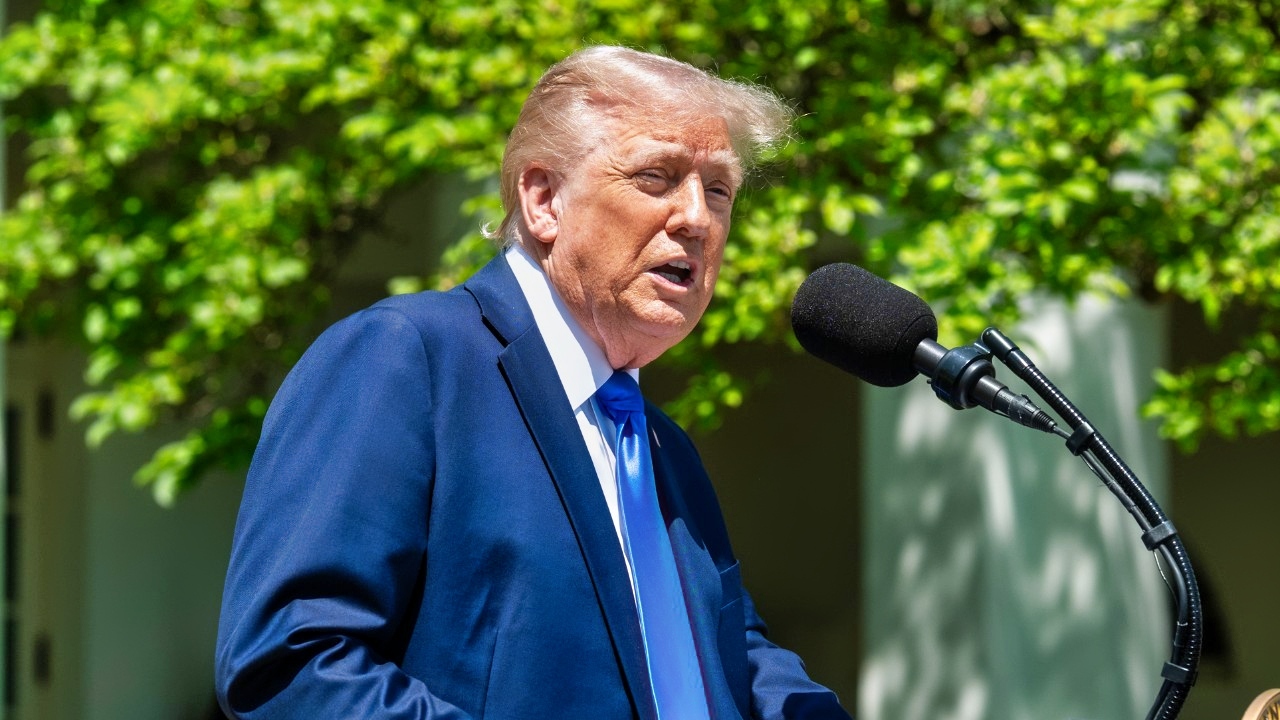
Impeachment Won’t Save a Dying Order: It’s been just over 100 days since Donald Trump was sworn in for a second term, and already the calls for his impeachment have returned with all the old urgency.
To many, it feels like déjà vu – another round of breathless headlines, legal commentary, and appeals to constitutional rectitude. But this time, something is different. Not only is the country more fragmented, more bitterly polarized, more exhausted – but the very idea of impeachment now rings hollow.
Not because Trump is untouchable. Not because the allegations against him are trivial. But because the constitutional mechanism of impeachment is a woefully inadequate response to the kind of world-historical transformation we are living through.
Yes, Impeach Donald Trump…
And yes – mea culpa, mea culpa, mea maxima culpa – I myself have called for Trump’s impeachment in the past.
I believed, then, that certain lines had been crossed and that the republic’s integrity required a forceful response. I still believe there are moments when impeachment is necessary. But I also believe, more firmly than ever, that invoking impeachment now is to mistake the symptom for the disease, the froth for the current, the man for the moment.
This is where Antonio Gramsci becomes indispensable. Writing in a fascist prison during the interwar years, Gramsci tried to understand how the old order dies and a new one is born. “The crisis,” he wrote, “consists precisely in the fact that the old is dying and the new cannot be born; in this interregnum, a great variety of morbid symptoms appear.” Trump is one such symptom – morbid, yes, but also clarifying. He is not the cause of our crisis. He is a clear signal that we are in one.
To grasp the scale of this crisis, we need to borrow not just from Gramsci but from the great historian Fernand Braudel. Braudel divided history into three levels: the événementielle, the conjuncture, and the longue durée. The first is the surface noise – the daily drama of politics, headlines, scandals, and personalities. Impeachment belongs squarely in this realm. It is an event, a response to an alleged transgression, framed in legal terms but carried out in the theater of partisan combat.
The second level, the conjuncture, is where economies shift, institutions buckle, alliances collapse, and social formations realign. It is slower-moving than the daily news cycle but faster and more volatile than the centuries-long structures of the longue durée. This is the level where the crisis Gramsci described takes root. It is the domain of epochal change – what historians sometimes call regime change in the deeper sense, not just of governments but of orders.
Trump Is a Problem
Trump did not cause the rupture at the conjunctural level. He reflects and manifests it. The real transformations – economic, geopolitical, cultural – were already well underway when he descended that golden escalator in 2015.
The slow death of the post-Cold War consensus, the decline of American hegemony, the rise of a new multipolar order, the collapse of trust in liberal institutions, the unraveling of social cohesion, the discrediting of globalism – these are not the forces that Trump made possible, they are the forces that made Trump possible. They are not reversible through legal proceedings. They are not addressable by constitutional mechanisms. They are deeply structural. And we need to come to grips with that.
Consider what impeachment actually does. It seeks to isolate a figure from the office they hold, to remove a leader deemed unfit for command. But what if the real unfitness lies not in the man, but in the system that produced him? What if the deeper problem is that the American constitutional order, built for a different era, can no longer contain the conflicts and contradictions of the present one? What if Trump is not a break with the system but its logical outcome?
Gramsci spoke of “passive revolution,” the process by which elites absorb the energy of popular unrest to reconstitute a modified version of the old order. Impeachment, in this light, becomes not a revolutionary act of democratic renewal but a reactionary attempt to restore legitimacy to a failing structure. It is a kind of ritual: a way of pretending that the system still functions, that the republic still governs itself, that we can isolate the rot to one man, surgically remove it, and carry on as before.
But we cannot. We are no longer in that kind of world. The collapse of the post-Cold War order, the exhaustion of neoliberal globalization, the breakdown of American domestic consensus – these are not matters for the courts. They are not matters for Congress. They are not even, at this point, primarily matters for presidents. They are tectonic shifts at the conjunctural level, and they require a political imagination that has not yet emerged.
A Changing America and A Changing World
What we are living through is not a constitutional crisis. It is a crisis of political form. The institutions that once mediated social conflict, produced consent, and managed economic dislocation no longer perform those functions. The two-party system, the administrative state, the media ecosystem, even the electoral process itself – all are losing coherence.
As the Irish poet William Butler Yeats put it in 1919, the center no longer holds – in today’s case, because the center is no longer connected to anything real. Trump did not destroy these things. He reflected and manifested their decay.
And so we come back to impeachment. Not as a legal question, but as a category mistake. Impeachment presumes a normal order that has been violated. It assumes the possibility of return, of restoration. But the post-Cold War order – and the post-WWII Bretton Woods system it was built on – is already largely gone. The old world is dying, and the new is struggling to be born. Impeachment does not address this fact. It obscures it. It diverts attention from the harder, more necessary task of confronting the real nature of the transformation we are undergoing.
To think politically today requires that we descend from the surface of events to the deeper terrain of conjunctural analysis. This is not easy. It demands we give up the comfort of familiar frameworks and accept the vertigo of historical rupture. It means recognizing that Trump is neither a deviation nor an aberration, but a harbinger. And it means acknowledging that if we want to prevent what comes next from being worse, we must think beyond the man who embodies the present.
This is not a call to inaction. Nor is it a call to surrender. It is a call to reorient. Impeachment is a juridical tool. What we need is a much bigger political project. Not just to oppose Trump, but to understand the crisis that produced him – and to build something capable of replacing the order that is collapsing around us.
That is the real work. That is the only work that matters now.
About the Author: Dr. Andrew Latham
Andrew Latham is a non-resident fellow at Defense Priorities and a professor of international relations and political theory at Macalester College in Saint Paul, MN.


Pingback: The Donald Trump Collapse Has Begun - National Security Journal
Pingback: Polls Look Bad: The Economy Could Sink Trump - National Security Journal
Pingback: 'Unfit to Serve a President': Trump Faces New Impeachment Problems - National Security Journal