

Some Iranian leadership is being surprisingly honest about the dire state of the country’s economy, with one of the most senior security officials in Tehran warning that the Islamic Republic is going through one of the most difficult periods in its history.
Mohsen Rezaei, secretary of Iran’s Supreme National Security Council, delivered the assessment during a high-level government meeting on Saturday, October 3, attended by President Masoud Pezeshkian and senior ministers.
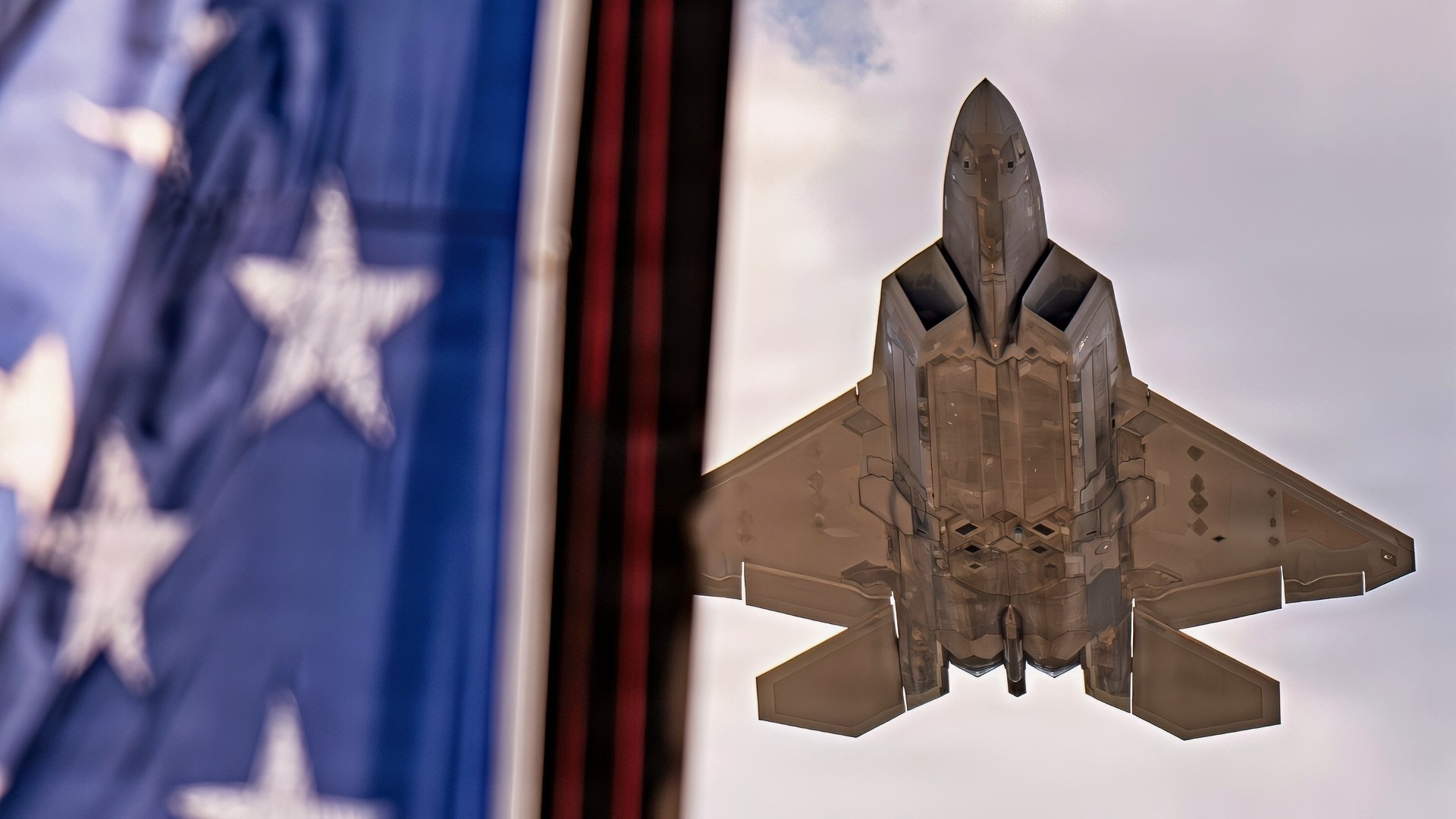
U.S. Air Force Capt. Nick “Laz” Le Tourneau, pilot and commander of the F-22 Raptor Aerial Demonstration Team, performs an aerial demonstration during the 52nd Annual SUN ‘n FUN Aerospace Expo in Lakeland, Florida, April 18, 2026. Capt. Le Tourneau showcased the unmatched capabilities of the F-22 to the SUN ‘n FUN crowds by performing multiple series of combat maneuvers. (U.S. Air Force photo by Staff Sgt. Mary Bowers)

F-22 Raptor Flying in the Dark Clouds. Image Credit: Creative Commons.
Iranian state media did not publish Rezaei’s comments in full, but said the security chief described the country’s current economic circumstances as among the most difficult it has ever faced.
He also reportedly pledged the Supreme National Security Council’s continued support.
It comes as the war approaches its eighth month, following the first round of U.S. and Israeli strikes on February 28, and as Washington continues to tighten the screws on its economic sanctions campaign.
Iran’s Currency Is Collapsing
One of the clearest economic indicators that Iran is hurting is the rial’s value, which has plummeted to record lows. On September 29, the currency fell to 2.5 million rials per U.S. dollar on the unofficial trading market—but just 27 days earlier, it had already hit a record low of 2.2 million.
And the collapse has serious consequences, with imported goods — or, at least, what’s left of them — becoming increasingly expensive for Iranian consumers.
Businesses and manufacturing operations that rely on imported products to operate are also paying higher prices and passing them on to consumers.
On September 29, Reuters reported that Iranians are cutting discretionary spending, exhausting their savings, and, in some cases, even leaving major cities for cheaper parts of the country.
The private sector is slashing jobs, and the economic outlook looks dim if the war doesn’t end soon.
Public anger is brewing, too.
Public Anger
Demonstrations over unpaid wages and pensions have taken to the streets—including telecommunications retirees who held protests in Tehran and 16 other cities on September 21.
Nurses in Kermanshah also protested over unpaid wages the following day.
This is by no means the first time Iran has seen mass protests or economic instability, but the war is making the situation substantially worse.
Trump Is Isolating Iran
This is exactly what the Trump administration is attempting to achieve through its economic sanctions plan.
On August 24, Treasury Secretary Scott Bessent launched Operation Economic Outcast, an economic campaign designed to cut Tehran off from the rest of the world – specifically, the international financial system.
The U.S. is also making it harder for Iran to evade sanctions through third parties by sanctioning businesses or entities that continue to facilitate transactions with Iran.
And the campaign keeps expanding, too.
On October 1, the Treasury Department announced new sanctions against Iran’s automotive and rail industries, targeting the country’s two largest automakers, Iran Khodro and SAIPA, along with three major railway companies and foreign suppliers in Turkey, the UAE, Indonesia, and Hong Kong.
Iran Khodro and SAIPA alone account for more than 90% of Iran’s domestic automobile market.
The decision to sanction rail industries matters because Iran has increasingly relied on overland routes to export oil, chemicals, fertilizers, and other goods as the U.S. naval blockade restricts its ability to export by sea.
Washington also targeted the Russia-linked A7 financial network, which the Treasury Department says Tehran has used to move money and evade sanctions.
Iran’s Oil Minister Is Out
Signs suggest the economic pressure is also causing political turmoil in Tehran.
On Sunday, October 4, Iranian Oil Minister Mohsen Paknejad resigned after more than two years in the position. President Masoud Pezeshkian accepted the resignation and appointed Hamid Bovard, chief executive of the state-owned National Iranian Oil Company, as the new acting oil minister.
Mehdi Tabatabaei, the communications deputy in the president’s office, said that Paknejad had requested permission to step down some time ago for personal reasons; however, Pezeshkian initially asked him to remain in the job. His departure cannot, therefore, be blamed on the economic fallout with certainty.
The timing is notable, however.
Paknejad is leaving right as Iran’s most important industry faces historic pressure from the war and U.S. sanctions.
Before he stepped down, Paknejad was maintaining that revenue from oil that had already been sold was still reaching the country and that it would continue to do so — but that doesn’t change the fact that Iran can no longer move oil out of the Strait of Hormuz.
Washington is also tightening restrictions on Iran’s remaining transportation and financial networks.
About the Author: Jack Buckby
Jack Buckby is a British researcher and analyst specializing in defense and national security, based in New York. His work focuses on military capability, procurement, and strategic competition, and he produces and edits analysis for policy and defense audiences. He brings extensive editorial experience, with a career output spanning over 1,000 articles at National Security Journal, and has previously authored books and papers on extremism and deradicalization.


