

The war in Ukraine has delivered perhaps the most important armored warfare lesson since World War II. Remarkably, neither the American M1 Abrams nor the German Leopard 2 has performed as Western planners envisioned when designing the tanks during the Cold War. Built for fast-moving armored offensives under the cover of NATO air superiority, these tanks now face a battlefield saturated with 21st-century tech, including FPV drones, loitering munitions, constant aerial surveillance, and precision artillery.
The result: tanks are struggling to survive. And while the war has not proven the tank obsolete, it has proven that armor alone is no longer enough to survive on a drone-saturated battlefield.
The Original Vision
The Abrams and the Leopard were built for large-scale mechanized warfare —breaking through enemy lines, exploiting gaps, and fighting Soviet armor—in Kursk-like showdowns.
The design philosophy incorporated massive frontal armor, powerful 120mm guns, advanced fire control systems, and superior crew survivability. The assumption was that the tank’s primary threat would come from enemy tanks, anti-tank missiles, or direct-fire engagements. Ukraine has proven otherwise.
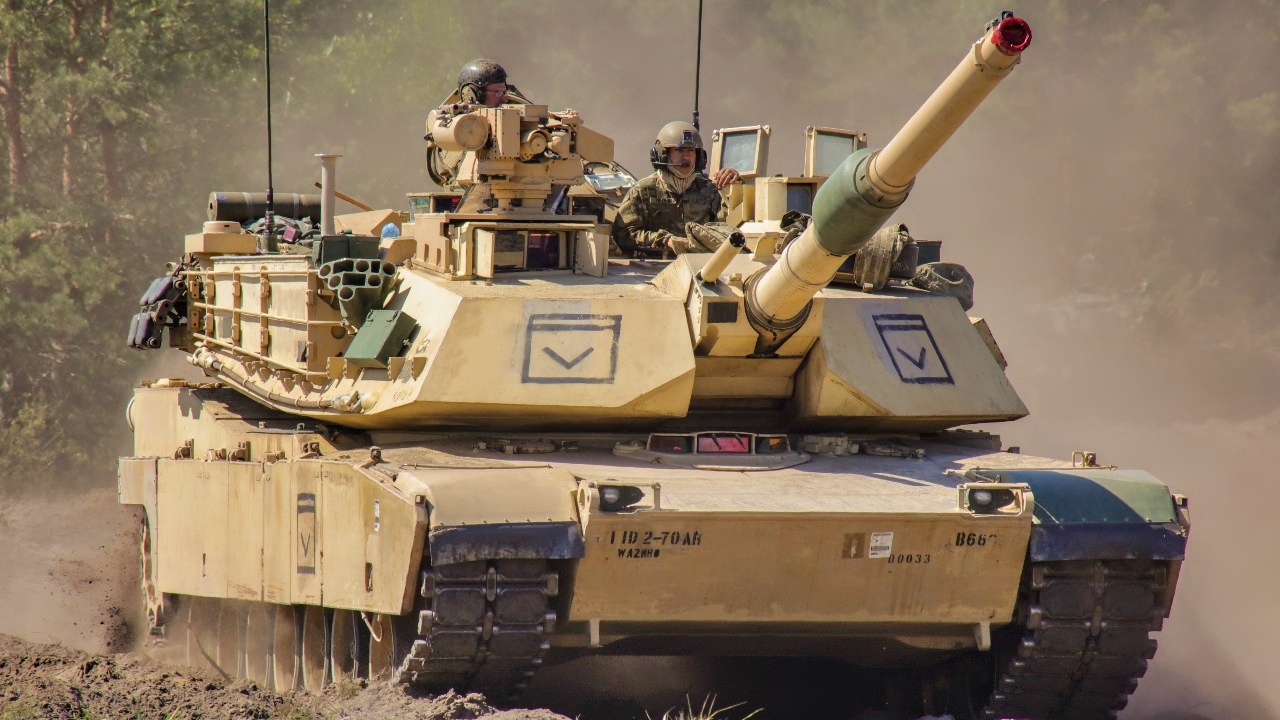
U.S. Soldiers assigned to 2nd Battalion, 70th Armor Regiment, 2nd Armored Brigade Combat Team, 1st Infantry Division supporting the 4th Infantry Division, maneuver an M1A2 Abrams tank while participating in a combined arms rehearsal during Anakonda23 at Nowa Deba, Poland, May 14, 2023. Anakonda23 is Poland’s premier national exercise that strives to train, integrate and maintain tactical readiness and increase interoperability in a joint multinational environment, complimenting the 4th Inf. Div.’s mission in Europe, which is to participate in multinational training and exercises across the continent while collaborating with NATO allies and regional security partners to provide combat-credible forces to V Corps, America’s Forward deployed corps in Europe. (U.S. Army National Guard photo by Sgt. 1st Class Theresa Gualdarama)
Rise of the Drones
In Ukraine, drones have proven a vexing problem for tanks. The cost asymmetry here is striking: multi-million dollar tanks are struggling to survive against off-the-shelf quadcopters.
The main problem is that these tanks were designed with the strongest armor on the front and the weakest armor on the top. For example, the M1 Abrams’ frontal armor can withstand enormous punishment, but the turret roof armor is dramatically thinner.
This format made sense for head-to-head engagements with other tanks.
But modern FPV drones attack from above, meaning that a drone costing hundreds of dollars can legitimately threaten modern tanks worth millions. For generations, the tank was forced to confront threats in front of it, but now, the concern is flying overhead.

An M1A2 Abrams tanks, assigned to 1st Battalion, 16th Infantry Regiment, 1st Armored Brigade Combat Team, 1st Infantry Division, maneuver into fighting position during a battalion live-fire range during Agile Spirit 19 at Orpholo Training Area, Georgia, August 9, 2019. AgS19 is a joint, multinational exercise co-led by the Georgian Defense Forces and U.S. Army Europe which incorporates a command post exercise, field training and joint multinational live fires. (U.S. Army photo by Staff Sgt. True Thao)
The M1 Abrams Tank Experience
The US supplied Ukraine with the M1A1 Abrams tanks. The gift has not gone smoothly. The tank’s gas turbine engine created a significant logistics burden. Problems included enormous fuel consumption, demanding maintenance, specialized spare parts, and sensitive electronics. The conditions in Ukraine haven’t helped either—mud, moisture, and harsh field conditions.
This environment has proven difficult for a platform designed to operate amid extensive NATO support infrastructure. The result is that Ukraine has been forced to use the Abrams as a niche battlefield asset rather than as a foundational asset.
The Leopard 2 Tank Experience
European countries supplied Ukraine with hundreds of Leopard variants. The Leopard has benefited from strong crew survivability, excellent optics, a powerful gun, and a diesel engine that has been much easier to support logistically.

A U.S. Army M1A2 SEPv2 Abrams assigned to Alpha Company, 1st Battalion, 67th Armor Regiment, 3rd Brigade Combat Team, 1st Armored Division prepares to move off the live fire range after completing the day portion of Table VI Tank Gunnery conducted at McGregor Range, New Mexico, Sept. 29, 2023. Gunnery Table VI evaluates crews on engaging stationary and moving targets while utilizing all weapons systems in offensive and defensive positions, ensuring our crews are trained and ready for any mission. (U.S. Army photo by Spc. David Poleski)
However, the tank’s mechanical complexity has posed challenges for crews operating under constant combat pressure. Still, the Leopard has earned praise for protecting crews even when vehicles were disabled; many damaged Leopards lost mobility, but their crews survived.
Introducing the Frankentank
One of the most notable developments from the war: Ukrainian crews using heavily modified tanks.
With both the Abrams and the Leopard, Ukraine has added homemade features like anti-drone cages, steel mesh screens, improvised armor, and Soviet-era Kontakt-1 ERA blocks. Why? To defeat top-down drone attacks. The irony is that some of the world’s most sophisticated tanks have required battlefield improvisations, like cheap mesh screens, to survive against modern threats.

M1 Abrams Tank. Image Credit: Creative Commons.
Doctrinal Shift
Traditionally, tanks were massed to punch a hole in an enemy’s front line, creating a breakthrough that could then be exploited. That hasn’t worked in Ukraine, where concentrated armor is easy to spot.
Specifically, drones locate the concentrated armor, artillery targets it, and then FPVs rain down from above. So a new doctrine has developed. Now, tanks are increasingly being operated individually or in pairs from concealed positions.
They function more as mobile snipers than as armored spearheads. Moving forward, what seems clear is that passive armor is no longer sufficient.

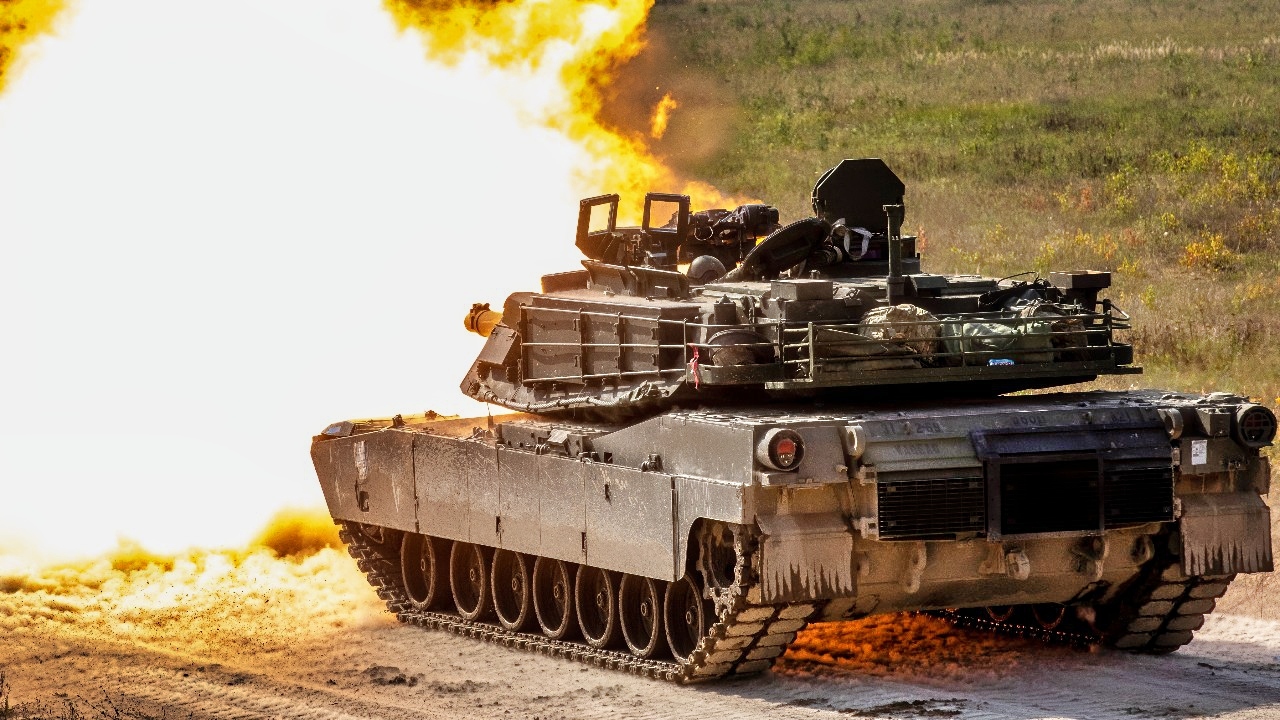
A M1A2 SEPV3 Abrams Tank fires at multiple range targets during a range warfighter exercise, April 11, 2021, Fort Hood, Texas. The visit with foreign allies allows the U.S. Army to boost interoperability of staff members and warfighting capabilities with the M1A2 SEPv3 Abrams Tank. (U.S. Army photo by Sgt. Melissa N. Lessard)
In the future, active systems—e.g., radar, sensors, interceptors—will be required to enhance survivability and destroy threats before impact from above.
And instead of tanks, militaries increasingly want lighter vehicles with better mobility and integrated anti-drone defenses. And while the war in Ukraine has not proven the tank fully obsolete, expectations have changed: expensive armor no longer automatically dominates the battlefield.
About the Author: Harrison Kass
Harrison Kass is a writer and attorney focused on national security, technology, and political culture. His work has appeared in City Journal, The Hill, Quillette, The Spectator, and The Cipher Brief. He holds a JD from the University of Oregon and a master’s in Global & Joint Program Studies from NYU. More at harrisonkass.com.


Catapult
June 12, 2026 at 7:42 pm
Very interesting that the world’s superpowers and their surrogates (like Ukraine) are forced to relearn a lesson that Nazi Germany found out in WWII: technologically sophisticated and expensive armor fails when swarmed by much cheaper, easy to deploy weapons like drones, FPVs or mines. DUH!
FRED ADAMS
June 13, 2026 at 2:25 pm
Ironic that this modern armor lesson is being learned only miles away from the site of the world’s greatest tank battle. The Maginot effect extends from defensive position into offensive warfare! That is the important lesson, and Ukraine’s ability to adapt around the design deficiencies is exemplary.
Increasingly extensive design efforts driving modern armor and aircraft development must be accompanied by prescience, it seems. That being not possible, rapid adaptability must be given its proper place in the design criteria.