

Speaking at the White House on Tuesday, July 21, U.S. President Donald Trump indicated that the U.S. military is preparing another major attack on Iran, this time targeting one of the country’s most secretive nuclear sites.
“If we left right now, it would take Iran 20, 25 years to rebuild. Okay? And we’re not finished at all,” he said.
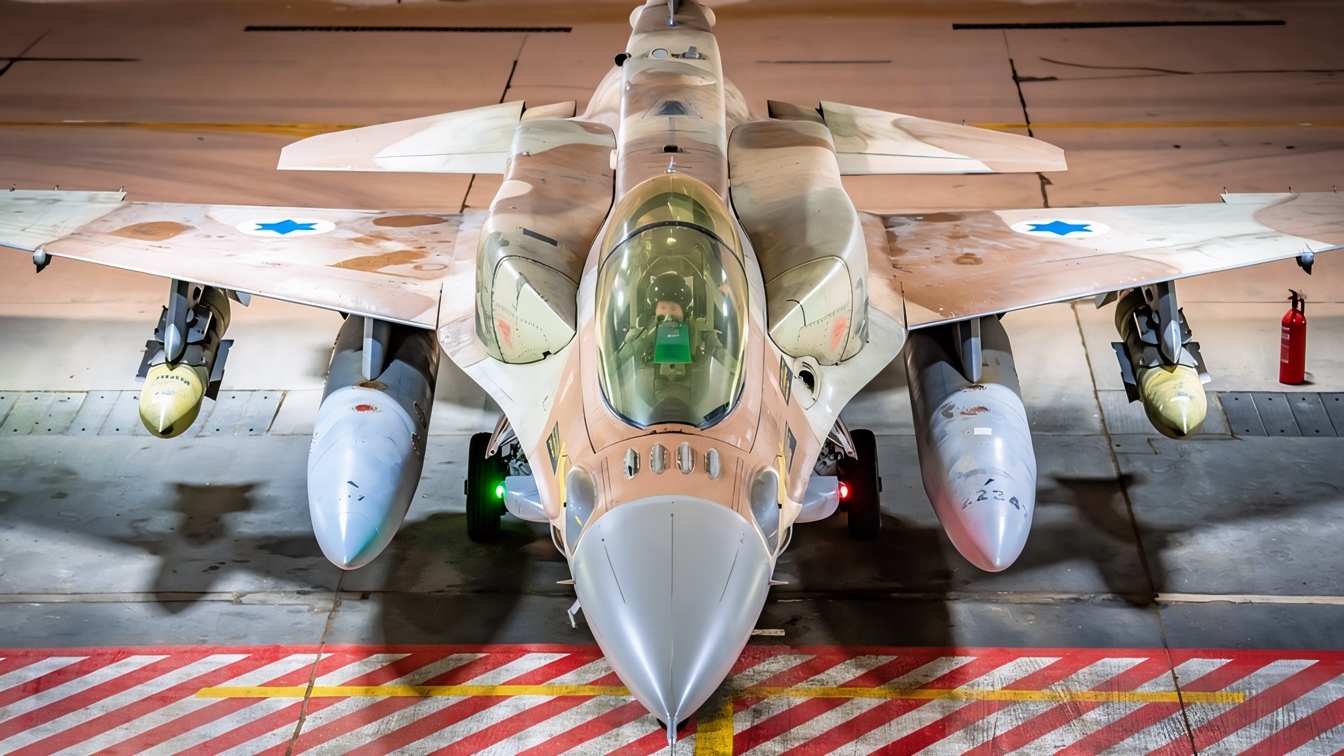
Israeli F-16I Fighter. Image Credit IDF

F-16I Sufa. Image Credit: Creative Commons.
Speaking to reporters during a meeting with Lebanese President Joseph Aoun, the president said that he was looking at targeting a mountain complex known as Pickaxe Mountain “pretty soon.” The comments come after reports described how Israeli intelligence believes that Tehran has moved thousands of centrifuges into the facility since last autumn.
“We’ll be hitting that area very, probably pretty soon, and there’s not a thing they can do about it,” Trump said, adding that he does not believe Iran can do anything to prepare for the attack.
“Normally, I wouldn’t say that. If I thought they could do something about it, I would never say that. But we’ll be hitting that area pretty soon, and very heavily.”
Iran’s Nuclear Hiding Place? What Is Pickaxe Mountain?
Pickaxe Mountain, known as Kuh-e Kolang Gaz La in Persian, is a fortified underground nuclear complex still under construction beside Iran’s Natanz nuclear facility, roughly 135 miles south of Tehran.
Iran first acknowledged the project was underway while in communication with the International Atomic Energy Agency in October 2020, several months after an explosion attributed to Israeli sabotage destroyed Natanz’s above-ground advanced centrifuge assembly plant in July that same year.
Tehran said that the new facility would replace the damaged workshop, but satellite imagery has since revealed a far more ambitious project than originally declared.
The complex is understood to consist of multiple tunnel entrances, featuring security perimeters and support buildings carved into the mountainside.
The underground halls are believed to sit as deep as 140 meters, or 450 feet, beneath solid rock. That depth makes the site considerably deeper than the Fordow enrichment plant, which was successfully hit by U.S. strikes last year.
And because Iran has never allowed IAEA inspectors inside the underground complex, very little is known about what has been installed there – although Western intelligence believes it is intended to protect critical elements of Iran’s nuclear program from future airstrikes.
What Israel Said
According to an Israeli intelligence assessment reported by The Wall Street Journal, Tehran has spent several months transferring sensitive nuclear-related equipment into the Pickaxe Mountain site as part of an effort to preserve and eventually rebuild its nuclear program following devastating U.S. strikes last year.
According to U.S. and Israeli officials familiar with the intelligence, centrifuges were moved into tunnels that were excavated as deep as 140 meters beneath solid rock.
The intelligence does not indicate where the centrifuges came from, but the alleged transfer has raised concerns in the U.S. and Israel that Iran is attempting to establish a more fortified enrichment facility that would survive even the most extreme bombardments by the U.S. military.
The International Atomic Energy Agency (IAEA) has never been permitted to inspect the underground facility, meaning neither inspectors nor Western governments are able to independently verify what equipment may have already been installed inside.
Nonetheless, Washington is confident that its conventional forces can reach it.
Notably, Pickaxe Mountain was not targeted during last year’s Operation Midnight Hammer and has not been struck during this year’s U.S. and Israeli air campaign, either.
Although nearby facilities at Natanz were struck repeatedly, satellite imagery shows excavation at the mountain has continued, with new tunnel entrances, reinforced portals and ongoing construction activity visible throughout 2026.
It is generally believed, therefore, that Iran has deliberately accelerated work in the mountain facility after concluding that above-ground facilities and shallower underground facilities are too vulnerable to U.S. bunker-busting weapons.
What the intelligence does not indicate, however, is that Iran is currently enriching uranium inside the facility.
Hegseth Says Pickaxe Mountain Is Reachable
Defense Secretary Pete Hegseth was questioned directly about how the U.S. would tackle the Pickaxe Mountain site during a Senate Appropriations Committee hearing on Tuesday, July 21. Republican Senator John Kennedy of Louisiana asked Hegseth whether the United States could destroy whatever Iran had placed inside the mountain, referencing concerns about the depth of the site limiting U.S. abilities.
“Do we have the ability to destroy whatever is underneath Pickazxe Mountain?” Kennedy asked.
Hegseth did not specify what weapons the United States would use, but did indicate that it could be possible – and indeed that it might involve the use of classified capabilities.
“A lot of our capabilities are classified, but if anybody in the world can reach anything on this, on God’s green earth, it’s the United States military,” he said.
The response suggests that the Pentagon believes that the depth of Pickaxe Mountain does not make it an insurmountable obstacle – although it remains unclear whether the U.S. would rely on a single capability to cause the damage, or a combination of asymmetric tactics and sheer force to deliver the impact necessary to render Pickaxe Mountain useless for the regime.
About the Author: Jack Buckby
Jack Buckby is a British researcher and analyst specializing in defense and national security, based in New York. His work focuses on military capability, procurement, and strategic competition, producing and editing analysis for policy and defense audiences. He brings extensive editorial experience, with a career output spanning over 1,000 articles at 19FortyFive and National Security Journal, and has previously authored books and papers on extremism and deradicalization.


Wayne
July 23, 2026 at 1:23 pm
blow up the entrandces