


The Soviet Union built 6 Typhoon-class nuclear ballistic missile submarines during the Cold War. The Typhoon-class was the largest nuclear submarine ever built. Each measured 175 meters in length and displaced 48,000 tons submerged. Each carried 20 R-39 Sturgeon intercontinental ballistic missiles. The R-39 weighed 90 tons — twice the weight of the U.S. Trident II missile. Each R-39 carried up to 10 multiple independently targetable reentry vehicles. A single Typhoon-class submarine could potentially deliver 200 nuclear warheads in a single launch sequence.
The Typhoon-Class Submarine Could Destroy an Entire Country in 1 Launch

Typhoon-Class Submarine. Image Credit: Creative Commons.

Russia’s Typhoon-Class Submarine. Image Credit: Creative Commons.
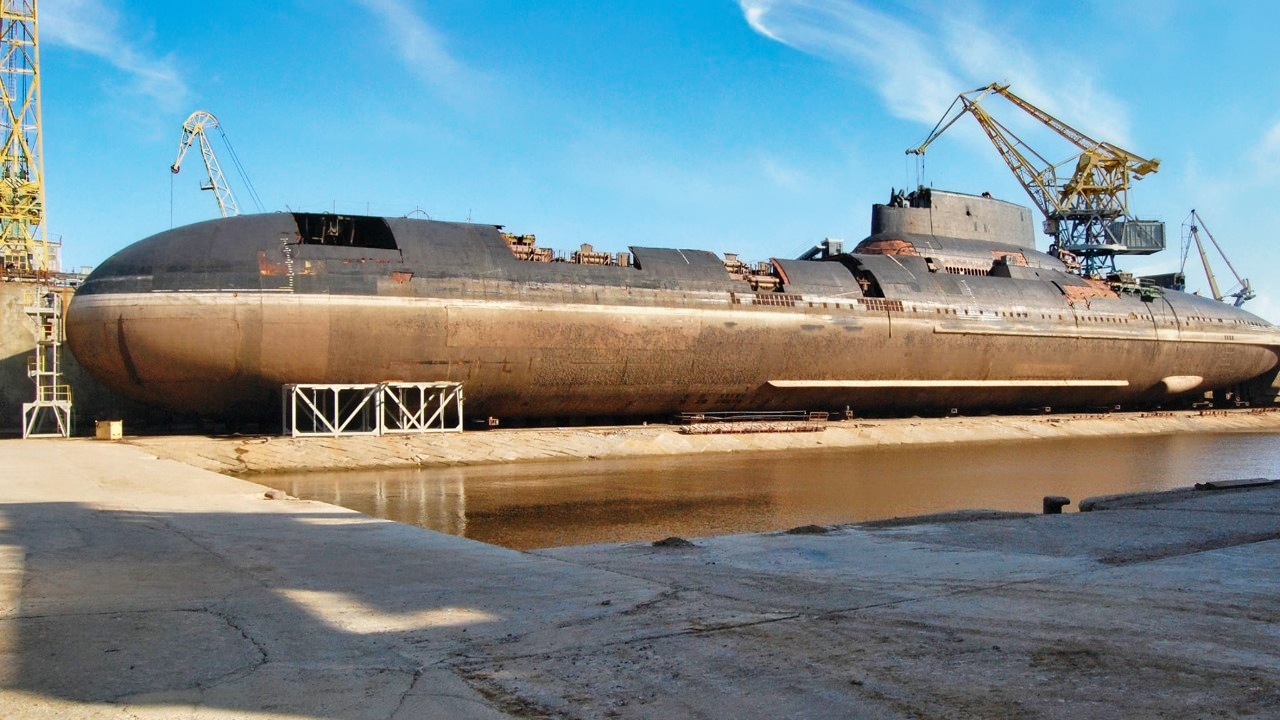
Typhoon-Class Submarine. Image Credit: Creative Commons.
Of all the nuclear submarines built by the Soviet Union, none were more terrifying to the West than the Project 941 Akula, NATO reporting name: Typhoon-class (not to be confused with the Project 971 Shchuka-B subs, which NATO calls Akula-class submarines).
The Typhoon-class submarines are the largest nuclear ballistic missile submarines ever built, measuring 175 meters in length and displacing 48,000 tons when submerged. What made the Typhoons so terrifying was not their size, but their armaments. When fully loaded, a single submarine could carry enough nuclear armaments to level a small country in a matter of minutes.
Development of Project 941
Development on Project 941 began in the early 70s. During this time period, the United States and the Soviet Union were locked in a fierce competition to field the most ballistic missile submarines.
The U.S. Navy had recently accepted the Ohio-class submarines into service, which were, and still are, some of the most capable SSBNs in the world. The Soviets developed the Typhoon-class not so much in response to the Ohio-class as to the missiles it carried. The submarines carried new Trident C-4 and Trident II D-5 solid-fuel ballistic missiles.
In response, the Soviets developed the R-39 Sturgeon solid-fuel missile, which carried a larger payload but weighed almost twice as much as the Trident II. This massive missile required an equally massive undersea missile carrier, hence why the Project 941 submarines assumed their massive size.
Construction of the Typhoon-class began at the Sevmash shipyard in Severodvinsk, a major center for Soviet naval production. The lead vessel, TK-208, later named Dmitry Donskoy, was commissioned in 1981.
Over the course of the decade, six submarines of this class were completed. Each one measured about 175 meters in length and displaced approximately 48,000 tons when submerged, making them the largest submarines ever constructed. Their massive scale was required to carry the absurdly heavy R-39 missiles and to operate in harsh Arctic conditions for long periods.
Designing the Typhoon-class
The Typhoon-class was built with a multi-hull arrangement. Instead of relying on a single pressure hull, the submarine featured two large parallel pressure hulls situated side by side.
Above these sat a smaller central hull that housed the command center and additional compartments for torpedoes and machinery. This configuration was chosen for several reasons.
It improved survivability, since damage to one hull would not necessarily compromise the entire vessel. It also enhanced stability, particularly important when navigating under thick ice, and increased buoyancy, making the submarine more resilient in emergencies. The broad beam created by this arrangement gave the Typhoon a distinctive appearance both above and below the waterline.
Operating beneath the Arctic ice cap was one of the Typhoon-class’s primary missions. The Arctic provided a natural shield against enemy detection, allowing the submarines to remain concealed while still being within striking distance of major targets in North America.
To function effectively in this environment, the submarines were equipped with reinforced sails capable of breaking through layers of ice several meters thick. Advanced sonar systems helped crews navigate safely under the ice, while specialized systems allowed the vessels to surface through frozen seas when necessary. These capabilities made the Typhoons uniquely suited to their strategic role and gave them a significant advantage in maintaining stealth.
Why the Typhoon-class Terrified the West
The offensive power of the Typhoon-class submarines was centered on their ballistic missile armament. Each carried twenty R-39 intercontinental ballistic missiles, known in NATO as the SS-N-20 Sturgeon.
These missiles were enormous, weighing around 90 tons each, and were equipped with multiple independently targetable reentry vehicles, or MIRVs. A single missile could carry up to ten nuclear warheads, allowing one submarine to potentially deliver as many as 200 warheads in a single launch sequence.
This level of firepower made the Typhoon one of the most formidable components of the Soviet nuclear arsenal. In addition to their primary missiles, these submarines were equipped with torpedoes and other defensive systems, enabling them to protect themselves from enemy vessels if required.
The Typhoon-class submarines were highly advanced for their time. They were powered by two nuclear reactors that drove steam turbines connected to twin propeller shafts, giving them a virtually unlimited operational range. Submerged speeds could reach approximately 22 to 27 knots.
Although their size made achieving complete acoustic stealth more challenging, efforts were made to reduce noise through sound-dampening measures and improved machinery design.
Their sonar systems and defensive countermeasures helped them avoid detection, but much of their security stemmed from operating in remote Arctic waters, where tracking them was inherently difficult.
Post-Cold War Deactivation
The end of the Cold War brought significant changes to the strategic environment, and the Typhoon-class submarines were among the systems affected. With the dissolution of the Soviet Union in 1991, economic constraints and arms reduction agreements reduced the need for such massive vessels.
Maintaining them was costly, and their missile systems eventually became outdated. As a result, most of the submarines were decommissioned during the 1990s and early 2000s. Several were dismantled with assistance from international programs aimed at reducing nuclear threats, including cooperative efforts involving the United States.
The lead submarine, Dmitry Donskoy, had a longer service life than the others. It underwent modernization and served as a test platform for newer missile systems, such as the Bulava. For years, it remained the only operational unit of its class, though in a limited capacity.
Eventually, even this vessel approached retirement as newer, more efficient submarines, such as the Borei-class, took over its role in the Russian Navy.
The decommissioning of the Typhoon-class was met with immense pushback in Russia, but as the R-39 was phased out and maintenance costs rose, the Navy had no choice but to scrap the last of the Typhoons.
About the Author: Isaac Seitz
Isaac Seitz, a Defense Columnist, graduated from Patrick Henry College’s Strategic Intelligence and National Security program. He has also studied Russian at Middlebury Language Schools and has worked as an intelligence Analyst in the private sector.


