

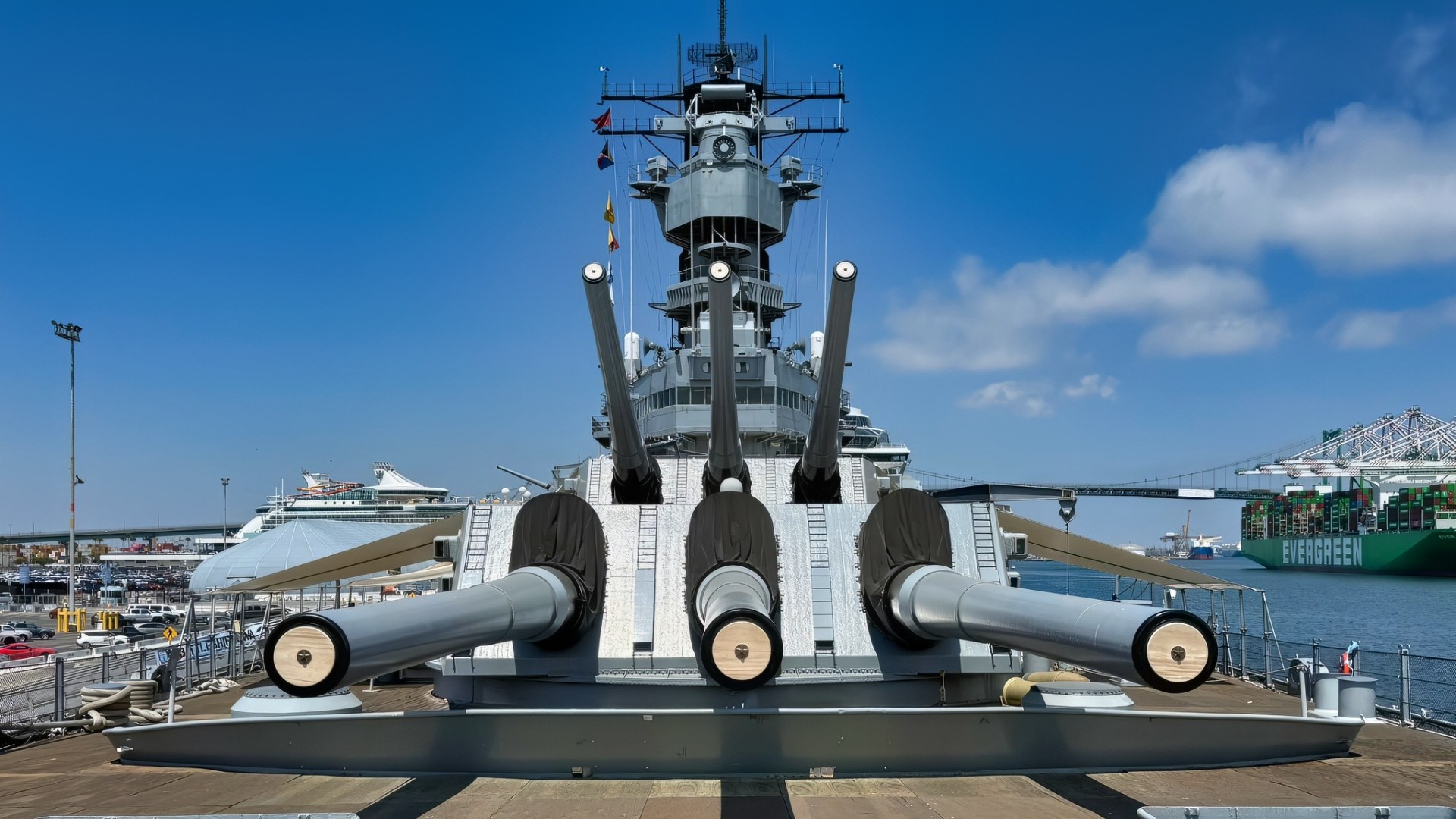
Is it time to bring back the Iowa-class battleships? The U.S. Navy could always use more firepower. They could resume their use of Tomahawk cruise missiles and eliminate numerous targets on land. The Iowa-class could counteract enemy surface vessels. They could also launch newer weapons that would go beyond simply using land-attack cruise missiles. They might serve as freedom-of-navigation capital ships, flying the flag high in Europe, the Middle East, or the Indo-Pacific.
High Price Tag for Recommissioning, and They Are Still Obsolete

16-Inch Iowa-Class Guns. Image Credit: National Security Journal.

Iowa-Class 16-Inch Shell Menu. Image Credit: National Security Journal.

Iowa-Class 5-Inch Guns. Image by Harry J. Kazianis/National Security Journal.
But bringing them back might pose more problems than it would solve. The enormous cost of taking the huge vessels out of mothballs or museums would be substantial. The manpower needs would be immense, and the entire renewal project would take significant time. They would be obsolete by the time they hit the water again.
Outfit Them With Mk 41 VLS
One idea to modernize the Iowa-class is to give them Mk 41 Vertical Launching System (VLS) cells. The VLS cells have conducted thousands of successful missile launches over the years. “Mk 41 VLS has been deployed by 13 navies on more than 26 ship classes on more than 180 ships,” according to Lockheed Martin.
Then Arm the Iowa-class to the Teeth with Missiles
The Mk 41 VLS can fire the Evolved Sea Sparrow missile. This is a medium-range surface-to-air missile designed to protect a carrier strike group. For better anti-aircraft abilities, the VLS could launch three different Standard Missile (SM) interceptors.
To take out enemy ships, VLS can fire Long-Range Anti-Ship missiles (LRASMs). A deployment of the Future Cruise/Anti-Ship Weapon would be possible on the Iowa-class.
However, a VLS system for the Iowa-class battleships was considered in the 1980s, and it was determined that it would require too much work and man-hours. President Ronald Reagan favored using the battleships but outfitting them only with Tomahawks.
The Navy Would Not Need the Trump-class Battleship
Another idea for bringing back the Iowa-class battleships is for them to make the future Trump-class battleships unnecessary. The USS Defiant is a missile barge designed to dominate Russia and China.
But the new ships will cost $14 to $17 billion each. The president’s national security team would like to buy three Trump-class battleships now, and perhaps 15 by 2055. These could be the most expensive ships ever built.
The Navy has already requested a line item expenditure of $1 billion for FY2027 to begin research and development on the USS Defiant. Could the Iowa-class rejuvenation be cheaper?

Iowa-Class Battleship Secondary Guns. Image Credit: Harry J. Kazianis/National Security Journal.
Iowa-class Could Bring Thunder and Lightning to an Amphibious Operation
Another use case for the Iowa-class would be to deploy them to bombard shorelines to support an amphibious attack. But there will probably never be a huge amphibious landing like the one in Normandy again.
However, Marines do need naval gunfire to make it ashore safely, and battleships could bring their heavy guns to bear in a ground attack.
The Marines would probably be better suited to use close-air support from aircraft to create a beachhead, relying on ground-strike fighters and bombers rather than shore bombardment from ships and naval gunfire. Missiles would be used to prep the battlefield for the Marines, but old-fashioned deck guns could not do the job.
The 16-inch guns on the Iowa-class vessels deliver plenty of firepower, but they lack pinpoint accuracy. It would be better to rely on modern precision-guided munitions. The battleships could accidentally misfire, causing collateral damage and harming civilians.
How About Small Diameter Bombs?
Navalgazing.net has a good idea for what the battleships might use. The Navy could outfit the Iowa-class with Small Diameter Bombs (SDB). These could be “quad-packed” into VLS cells.
“The SDB is a 250 lb GPS-guided glide bomb, intended for attacking targets where minimal collateral damage is required. It’s a favored weapon for attacks on light targets, and the variant in question can reach out nearly 80 miles,” according to Navalgazing.
Are You Ready for the Price Tag?
Bringing back the Iowa-class could cost more than $2 billion per ship, according to Navalgazing. That just doesn’t make sense when the Navy could buy more Virginia-class submarines or Arleigh Burke-class guided missile destroyers with that money.
Where Are the 16-inch Shells Going to Come From?
Another problem is the defense industrial base. Would there be enough shipyard workers to conduct a massive refit and maintenance period to bring back the Iowa-class? Also, shells for the guns are difficult to come by.
The Navy stopped making them years ago. In late 2017, the 16-inch shells were disposed of.
So, the Iowa-class could be armed to the teeth. The shore bombardment actions could be supplemented with modern weapons from the VLS. But bringing back the Iowa-class would be prohibitively expensive.
Shore attacks can also be conducted by fighters and bombers. The 16-inch guns are not as accurate as today’s precision-guided weapons. Moreover, there simply aren’t the shipyards or workers available to bring the Iowa-class out of retirement. There are some good ideas for their return, but not enough advantages to outweigh the disadvantages.
CORRECTION: We have adjusted sourcing related to the costs of a possible Iowa-class reboot. We apologize for any confusion.
About the Author: Brent M. Eastwood, PhD
Author of now over 3,500 articles on defense issues, Brent M. Eastwood, PhD, is the author of Don’t Turn Your Back On the World: A Conservative Foreign Policy and Humans, Machines, and Data: Future Trends in Warfare, plus two other books. Brent was the founder and CEO of a tech firm that predicted world events using artificial intelligence. He served as a legislative fellow for US Senator Tim Scott, advising the senator on defense and foreign policy issues. He has taught at American University, George Washington University, and George Mason University. Brent is a former US Army Infantry officer. He can be followed on X @BMEastwood.


