

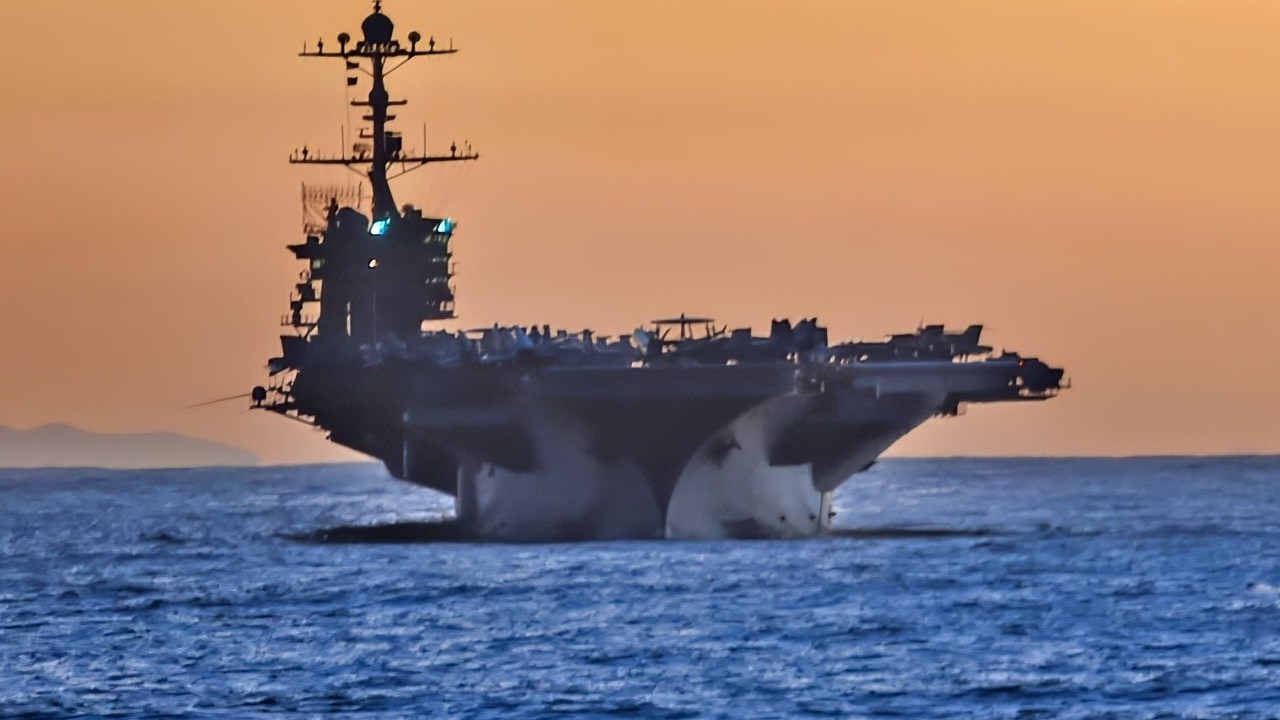
The USS John C. Stennis Entered Newport News Shipbuilding in May 2021 — The RCOH Won’t End Until October 2026 at the Earliest
The USS John C. Stennis (CVN-74) is named for Senator John C. Stennis of Mississippi and is the seventh of the Nimitz-class of nuclear-powered supercarriers in the United States Navy.
She was commissioned on December 9, 1995. Her temporary home port is Norfolk, Virginia, for her scheduled refueling and complex overhaul (RCOH), which began in 2019. After her overhaul is completed, she is expected to return to Bremerton, Washington.
The major Refueling and Complex Overhaul (RCOH) at Newport News Shipbuilding in Virginia isn’t expected to be done and have the carrier returned to the fleet until October 2026, making it one of the longest in recent history.

(April 14, 2018) An MH-60S Sea Hawk helicopter assigned to the “Chargers” of Helicopter Sea Combat Squadron (HSC) 14, prepares to onload cargo during a replenishment-at-sea between the aircraft carrier USS John C. Stennis (CVN 74) and the fleet replenishment oiler USNS Henry J. Kaiser (T-AO 187). John C. Stennis is underway with Carrier Air Wing (CVW) 9 conducting routine, tailored ships training availability and final evaluation problem. (U.S. Navy photo by Mass Communication Specialist 3rd Class William Ford/Released)
The Stennis’ RCOH Is More Than A Year Overdue
Stennis’ RCOH was slated for completion in August of last year. That will now be at least 14 months late. The five and a half years that it will take come at a precarious time for the Navy.
The U.S. is currently conducting massive airstrikes on Iran, and the USS Gerald R. Ford is in the midst of an 11-month deployment before it conducts its own maintenance and refit operations.
The typical RCOH for a carrier consists of replacing nuclear fuel in the reactors, modernizing electronics, repairing structural components, upgrading combat systems, and improving crew living spaces.

A U.S. Navy F/A-18E Super Hornet aircraft assigned to Strike Fighter Squadron (VFA) 14 participates in an air power demonstration near the aircraft carrier USS John C. Stennis (CVN 74) April 24, 2013, in the Pacific Ocean. The John C. Stennis Carrier Strike Group was returning from an eight-month deployment to the U.S. 5th Fleet and U.S. 7th Fleet areas of responsibility. (U.S. Navy photo by Mass Communication Specialist Seaman Apprentice Ignacio D. Perez/Released)
The Stennis delay means it will remain in the final testing phase. At the same time, the USS Harry S. Truman (CVN-75) begins its own multi-year RCOH in June 2026, creating a situation in which two carriers are in deep maintenance simultaneously.
Compounding the issues are the well-documented persistent problems in the U.S. shipbuilding industry.
The USS John C. Stennis Specs
The Stennis is 1,092 feet long and soars some 20 stories above the waterline. As a self-contained city, the Stennis has virtually the same amenities as any American city with a comparable population.
It features a daily newspaper, radio and television stations, a fire department, a library, a hospital, a general store, a laundry, two barbershops, and even a post office with its own zip code.
The carrier is powered by two Westinghouse A4W nuclear reactors (HEU 93.5 percent), four steam turbines, and four propeller shafts, each with five blades. This produces 260,000 shp (190 MW)
The top speed of the Stennis is 30 knots (35 mph) or higher, and she has an unlimited range until her nuclear fuel rods need replacement every 20–25 years. The carrier is crewed by 6,500 officers and crew (with embarked airwing).
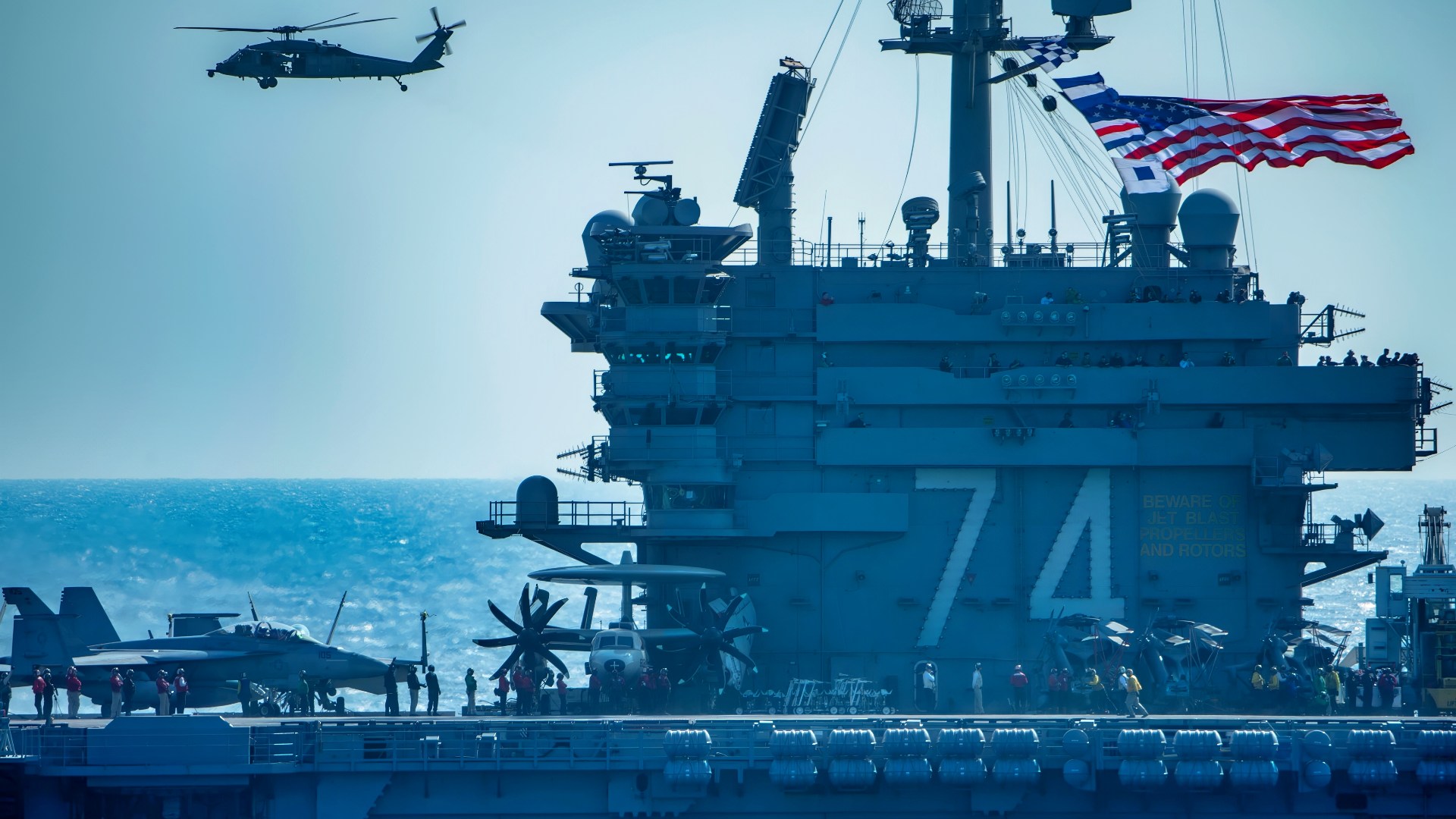
ARABIAN SEA (Dec. 14, 2018) The Nimitz-class aircraft carrier USS John C. Stennis transits the Arabian sea with the Essex Amphibious Ready Group (ARG) and 13th Marine Expeditionary Unit (MEU). The John C. Stennis Carrier Strike Group, Essex ARG, and 13th MEU are conducting integrated operations in the Arabian Sea to ensure stability in the Central Region, connecting the Mediterranean and the Pacific through the western Indian Ocean and three strategic choke points. (U.S. Navy photo by Mass Communication Specialist 3rd Class Tyler Diffie)
Sensors and Processors
The Stennis has an enormous number of sensors to protect the ship.AN/SPS-48E 3-D air search radar, AN/SPS-49(V)5 2-D air search radar, AN/SPQ-9B target acquisition radar, AN/SPN-46 air traffic control radars, AN/SPN-43C air traffic control radar, AN/SPN-41 landing aid radars, 4 × Mk 91 NSSM guidance systems, 4 × Mk 95 radars
Electronic warfare & decoys include the AN/SLQ-32A(V)4 countermeasures suite, and the SLQ-25A Nixie torpedo.
Stennis Armament
The carrier is armed with four Mk 57 Mod3 Sea Sparrow Missile launchers, two RIM-116 Rolling Airframe Missile launchers, and three Phalanx CIWS anti-aircraft systems.
The USS John C. Stennis is capable of carrying approximately 85 to 90 fixed-wing aircraft and helicopters. However, the exact number can vary depending on the specific air wing and mission requirements.
USS John C. Stennis (CVN 74) History
In 1999, the Stennis ran aground in a shallow area adjacent to the turning basin near North Island in San Diego Harbor.
Silt clogged the intake pipes to the steam condensing systems of the nuclear reactor plants, causing the carrier’s two nuclear reactors to be shut down (one reactor by crew, the other automatically) for 45 minutes. She was towed back to her pier for maintenance and observation for the next two days. The cleanup cost was about $2 million.
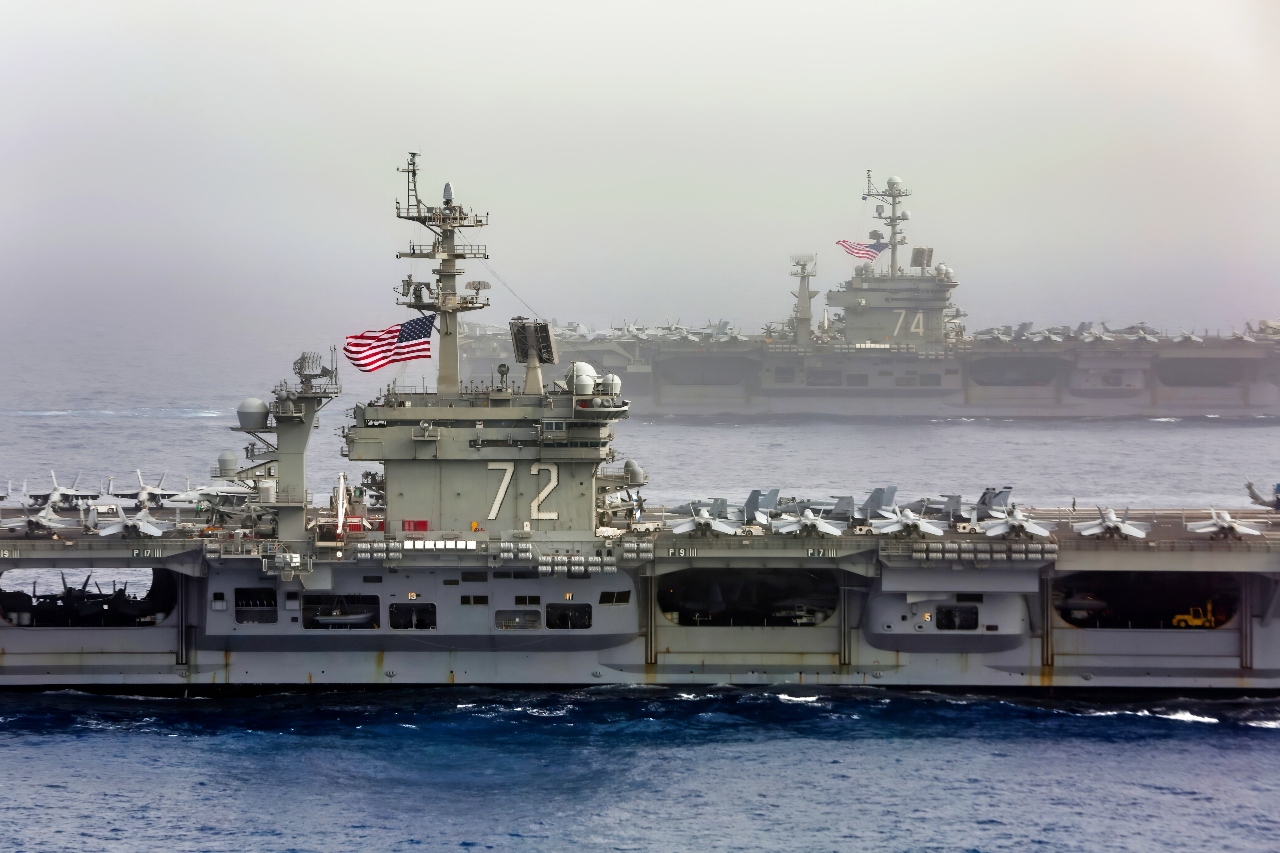
(April 24, 2019)
The Abraham Lincoln and John C. Stennis carrier strike groups conduct carrier strike force operations in the U.S. 6th Fleet. Together, the strike groups will complete high-end warfighting training, enhancing interoperability with key allies and partners in the European theater. (U.S. Navy video by Mass Communication Specialist 1st Class Brian M. Wilbur/Released)
In the early spring of 2001, the Stennis was the site of the world premiere of the film “Pearl Harbor,” which was billed as “the world’s largest and most expensive outdoor theater.” Special, enormous screens were erected on the flight deck, along with bleachers that seated 2,000 people.
Post 9/11 Deployment
After the terrorist attacks in the United States during 9/11, the Stennis deployed to the Persian Gulf in November 2001, in support of air operations during Operation Enduring Freedom.
In mid-January 2007, the Stennis’ carrier strike group set sail for the Persian Gulf as part of an increase in U.S. military presence. She arrived in the area in mid-February, joining USS Dwight D. Eisenhower in the United States Fifth Fleet area of operations.
This marked the first time since 2003 that two aircraft carrier battle groups were present in the region simultaneously.
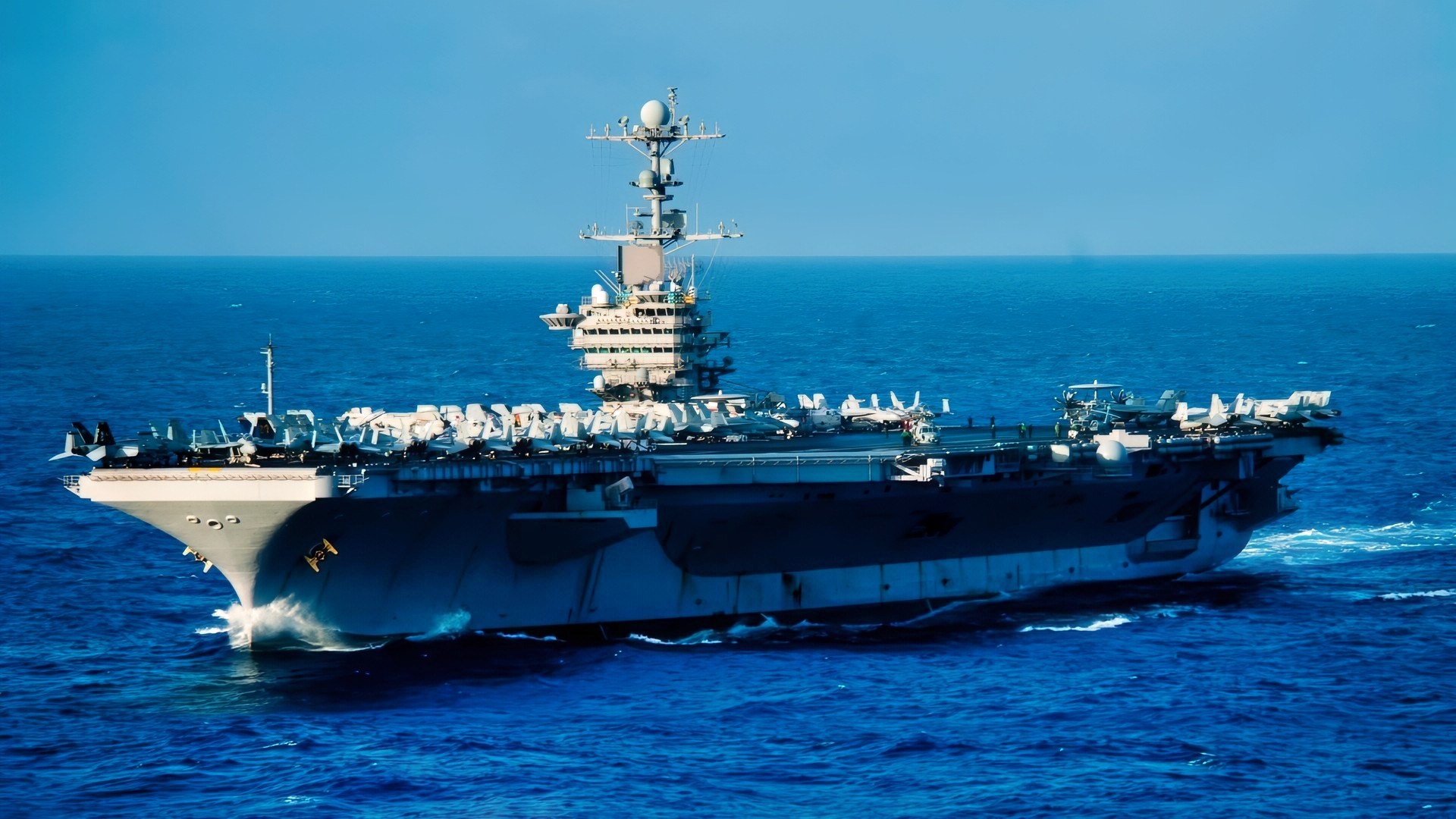
PACIFIC OCEAN (Feb. 9, 2012) The Nimitz-class aircraft carrier USS John C. Stennis (CVN 74) transits the Pacific Ocean. John C. Stennis is operating in the U.S. 7th Fleet area of responsibility while on a seven-month deployment. (U.S. Navy photo by Mass Communication Specialist 3rd Class Kenneth Abbate/Released)
Later, on May 23, 2007, the Stennis, along with eight other warships, including the aircraft carrier Nimitz and amphibious assault ship Bonhomme Richard, passed through the Strait of Hormuz. U.S. Navy officials said it was the largest such move since 2003.
In December 2011, the Stennis flew the final command-and-control mission for U.S. forces over Iraq, which was conducted by an E-2C Hawkeye from Carrier Airborne Early Warning Squadron 112 (VAW-112). The mission launched from the carrier at 7:32 am and returned at 11:04 am, both local times. This mission effectively ended U.S. naval support for Operation New Dawn.
In early May 2021, the USS John C. Stennis went into Newport News for her midlife Refuel and Complex Overhaul (RCOH). The overhaul is expected to be completed by October 2026.
About the Author: Steve Balestrieri
Steve Balestrieri is a National Security Columnist. He served as a U.S. Army Special Forces NCO and Warrant Officer. In addition to writing on defense, he covers the NFL for PatsFans.com and is a member of the Pro Football Writers of America (PFWA). His work was regularly featured in many military publications.


Mutalib
April 3, 2026 at 4:32 pm
This carrier would be a cinch for PLA Rocket Forces to identify, track, target and sink.
How.
By using space satellites to pinpoint its latest location, and as it nears the right place of ambush, like say, the ‘singapore strait’ (this actually exists), hit the vessel with a wave of cj-1000 missiles.
What’s the cj-1000 projectile.
It’s a hypersonic long-range missile that makes Russia’s tsircon look like a kindergarten kid by comparison.
It’s like meeting mike Tyson in thre carpark, after mike suddenly finds his wallet’s gone missing.
Compare that to a Kindy child.
Vetmike
April 4, 2026 at 8:25 am
What crap. Five plus years and still out of the fight.