

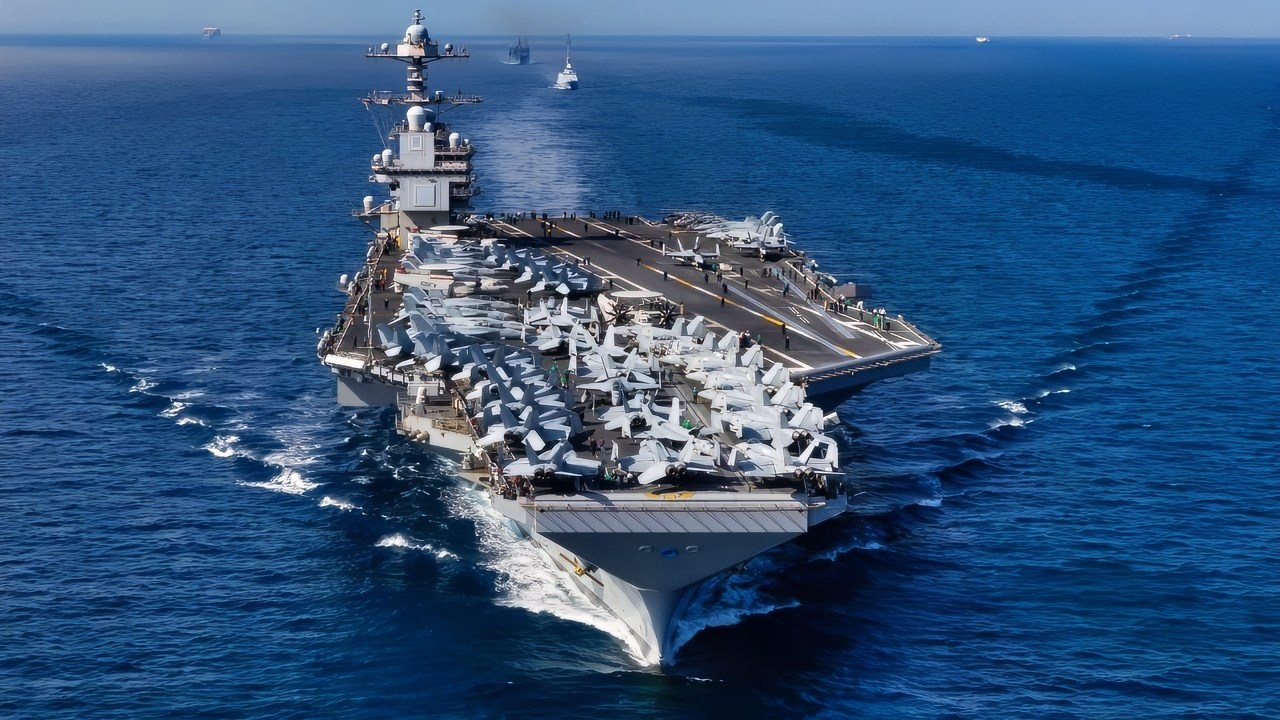
Summary and Key Points: America’s Ford-class aircraft carriers are built to anchor sea power for decades, but the industrial base meant to sustain them is under heavy strain.
-Maintenance backlogs, too few dry docks, worker shortages, aging infrastructure, and inconsistent funding are stretching repair timelines and disrupting deployments.

(April 14, 2018) An MH-60S Sea Hawk helicopter assigned to the “Chargers” of Helicopter Sea Combat Squadron (HSC) 14, prepares to onload cargo during a replenishment-at-sea between the aircraft carrier USS John C. Stennis (CVN 74) and the fleet replenishment oiler USNS Henry J. Kaiser (T-AO 187). John C. Stennis is underway with Carrier Air Wing (CVW) 9 conducting routine, tailored ships training availability and final evaluation problem. (U.S. Navy photo by Mass Communication Specialist 3rd Class William Ford/Released)

USS Ford Aircraft Carrier U.S. Navy Photo
-Government reporting cited a $1.8 billion carrier and submarine maintenance backlog and found most major maintenance periods finished late, with carriers averaging delays measured in months.
-The stress shows up in deferred repairs, spare-parts gaps, and shipyard capacity constraints—problems made riskier by Ford-class technical complexity and production delays.
Ford-Class Carriers Are the Future—So Why Can’t the Navy Keep Them Fixed and Ready?
The Gerald R. Ford class of aircraft carriers is the US Navy’s replacement for the Nimitz-class supercarriers. They are expected to last the next 50 years, providing the Navy continues sea dominance around the globe.
The US relies on its carrier strike groups for global power projection. China is also building new carriers to project its seapower.
However, like the Nimitz-class carriers, the Ford-class carriers have numerous issues.
Weaknesses in US Navy aircraft carrier maintenance stem from a backlog of repairs, a shortage of dry docks and skilled workers, and a lack of funding, leading to significant delays in maintenance periods and deployments.
This situation is compounded by aging infrastructure, workforce capacity, and performance issues, while newer carriers like the Ford-class also face technical challenges with their electromagnetic systems.
Maintenance Issues, Backlogs, Delays, Drydocks
A significant backlog of repairs is a major issue, with a $1.8 billion maintenance backlog noted in a 2022 GAO report.
Seventy-five percent of planned maintenance periods for aircraft carriers and submarines were completed late between 2015 and 2019, with an average delay of 113 days for carriers, reports the GAO.
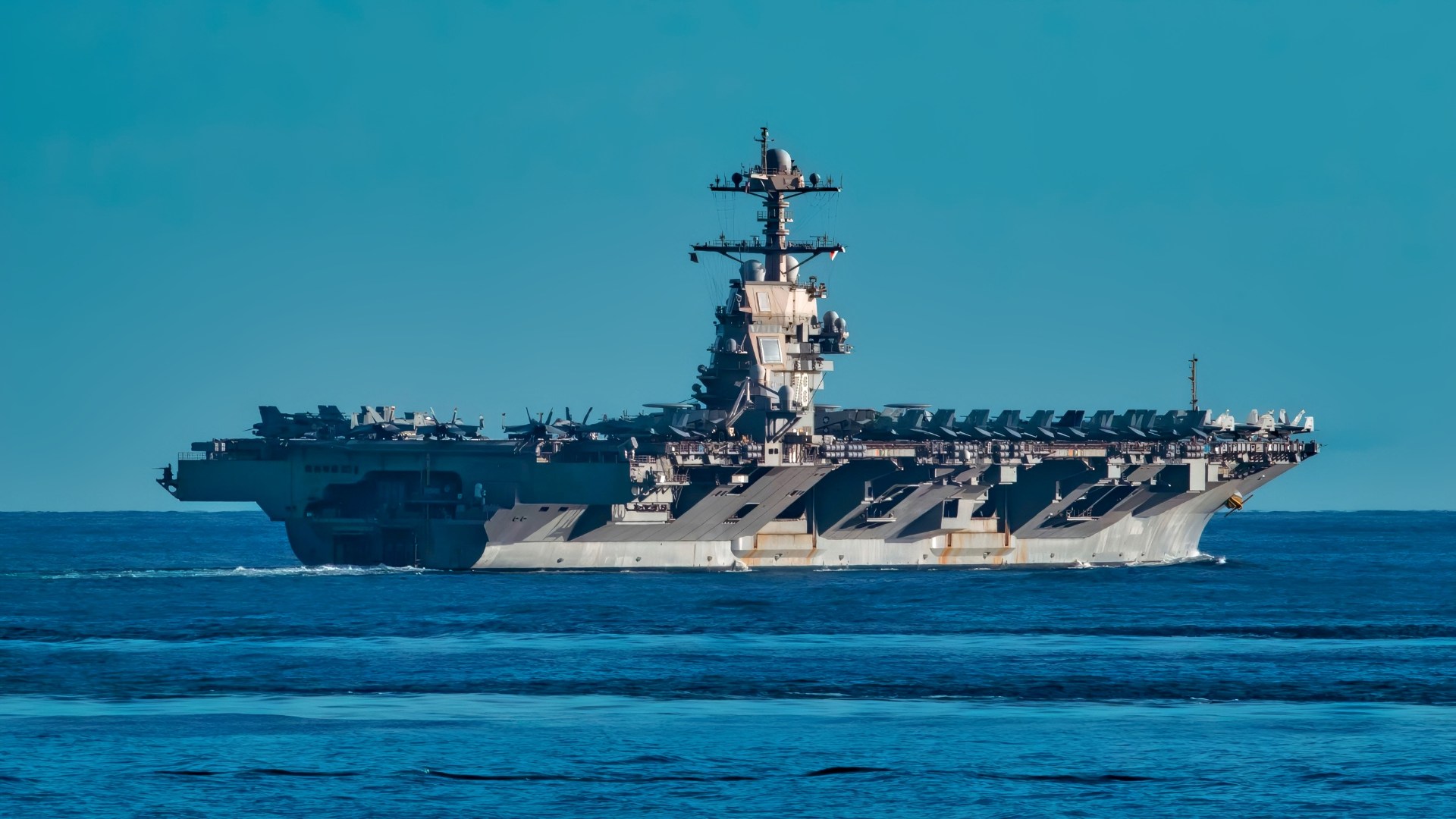
The Arleigh Burke-class guided-missile destroyer USS Winston S. Churchill (DDG 81) sails alongside the world’s largest aircraft carrier the USS Gerald R. Ford (CVN 78), Sep. 24, 2025. Winston S. Churchill, as part of Carrier Strike Group 12, is on a scheduled deployment in the U.S. 6th Fleet area of operation to support the warfighting effectiveness, lethality and readiness of U.S. Naval Forces, Europe-Africa, and defend U.S. Allied and partner interest in the region. (U.S. Navy photo by Mass Communication Specialist Seaman Hector Rodriguez)
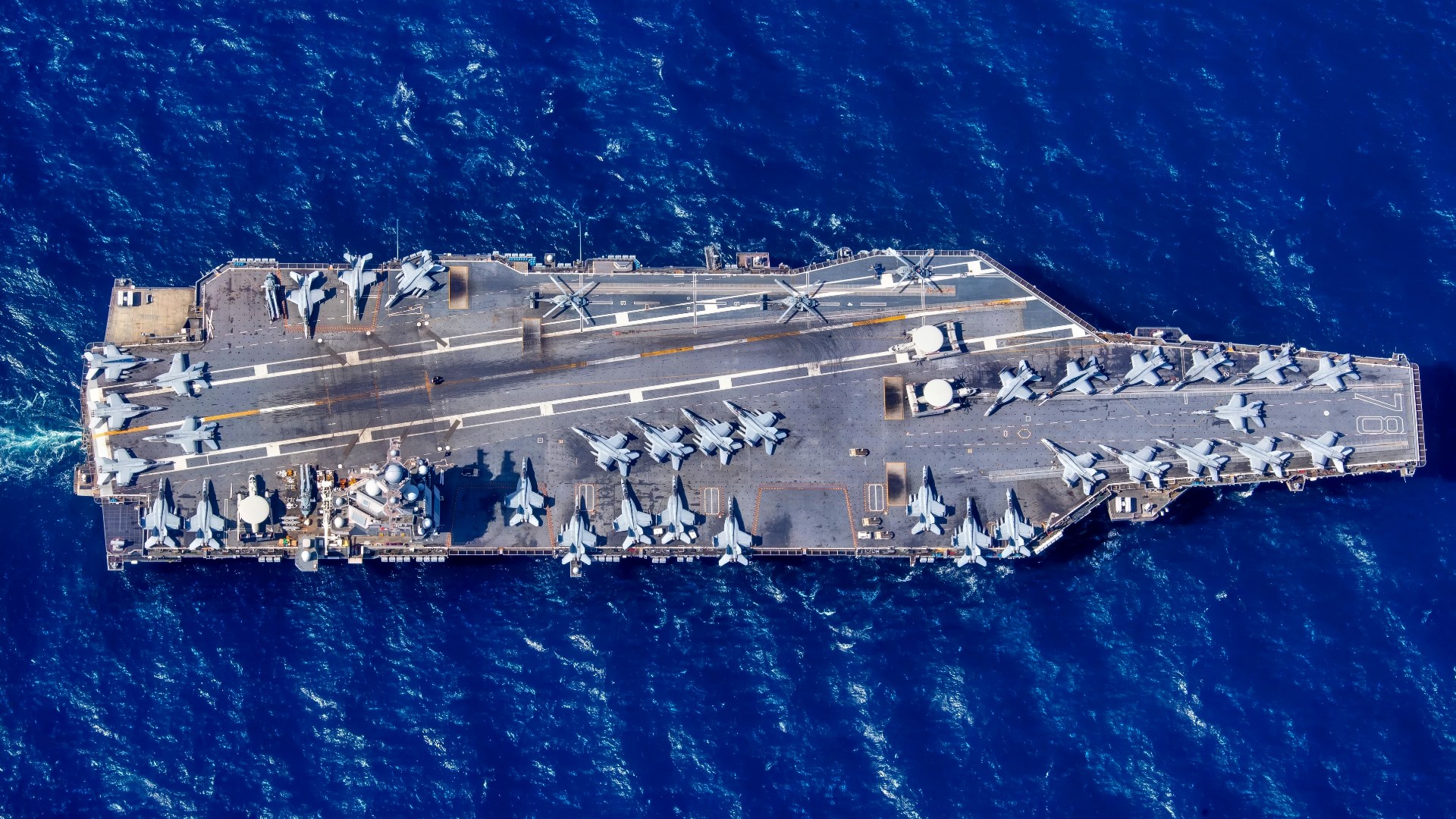
The first-in-class aircraft carrier USS Gerald R. Ford (CVN 78) transits the Atlantic Ocean, March 19, 2023. Ford is underway in the Atlantic Ocean executing its Composite Training Unit Exercise (COMPTUEX), an intense, multi-week exercise designed to fully integrate a carrier strike group as a cohesive, multi-mission fighting force and to test their ability to carry out sustained combat operations from the sea. As the first-in-class ship of Ford-class aircraft carriers, CVN 78 represents a generational leap in the U.S. Navy’s capacity to project power on a global scale. (U.S. Navy photo by Mass Communication Specialist 2nd Class Jackson Adkins)
A prime example of maintenance issues is the recent collision involving the USS Harry S. Truman. Eight months after a February collision with a cargo ship in the Mediterranean, the aircraft carrier USS Harry S. Truman continues to operate with visible hull damage.
The Navy has deferred complete repairs until the ship’s scheduled mid-life Refueling and Complex Overhaul (RCOH), expected to begin in 2026. This kind of issue is unacceptable for the Navy’s power projection platforms.
The decision to delay permanent repairs, while logical, also highlights the severe strain on the U.S. naval industrial base, which is struggling with maintenance backlogs and shipyard capacity issues.
US Shipyards Are In Poor Shape
Shortage of dry docks is a significant issue. The Navy faces a shortage of dry docks, which are essential for conducting major repairs, reports Small Wars Journal.
Workforce issues: There are shortages of skilled workers and challenges with shipyard workforce performance and capacity, which can lead to reliance on overtime and delays.
Inadequate funding for repairs is a key issue that hinders fleet maintenance. A significant cause of delays is unplanned work that is discovered only after maintenance planning has been completed.

An F/A-18F Super Hornet, attached to the “Blacklions” of Strike Fighter Squadron (VFA) 213 and a F/A-18E Super Hornet, attached to the “Golden Warriors” of Strike Fighter Squadron (VFA) 87 fly over the world’s largest aircraft carrier, USS Gerald R. Ford (CVN 78), the Arleigh Burke-class guided-missile destroyer USS Mahan (DDG 72), April 11, 2025. The Gerald R. Ford Carrier Strike Group is underway in the Atlantic Ocean completing integrated naval warfighting training. Composite Training Unit Exercise (COMPTUEX) is the Joint Force’s most complex integrated training event and prepares naval task forces for sustained high-end Joint and combined combat. Integrated naval training provides America’s civilian leaders and commanders highly-capable forces that deter adversaries, underpin American security and economic prosperity, and reassure Allies and partners. (U.S. Navy photo by Mass Communication Specialist 2nd Class Maxwell Orlosky

The world’s largest aircraft carrier USS Gerald R. Ford (CVN 78) steams in the Adriatic Sea, June 23, 2023. Gerald R. Ford is the U.S. Navy’s newest and most advanced aircraft carrier, representing a generational leap in the U.S. Navy’s capacity to project power on a global scale. The Gerald R. Ford Carrier Strike Group is on a scheduled deployment in the U.S. Naval Forces Europe area of operations, employed by U.S. Sixth Fleet to defend U.S., allied, and partner interests. (U.S. Navy photo by Mass Communication Specialist 2nd Class Jackson Adkins)
The Navy is facing significant maintenance backlogs and deferred depot work, and the service is constantly dealing with projects that go over budget. A Government Accounting Office report found that Navy ships leave port lacking 35 percent of the required spare parts.
It shows the uncomfortable truth that U.S. shipyards are in poor condition. They face a shortage of skilled labor, aging infrastructure, inconsistent government demand, supply chain problems, and a shrinking industrial base.
Other Program And Production Issues
Introducing 23 new technologies at once in the Ford-class carriers increased the risk of delays and cost overruns.
Also, the Newport News shipyard has struggled with a high attrition rate, consistently delaying the delivery of the carriers.
Cost overruns abound. The lead ship, USS Gerald R. Ford, was delivered years behind schedule and significantly over its initial budget.
These factors have affected readiness. The technical and production issues have directly impacted the carrier’s ability to meet its full operational capability and sortie generation goals.
US Deindustrialization Was Another Poor Post-Cold War Decision
The Navy faces serious challenges in ship repair and maintenance and in new shipbuilding, primarily due to the nation’s deindustrialization after the Cold War.
At the end of the Cold War, Secretary of Defense Les Aspin and his deputy, Bill Perry, invited the CEOs of the nation’s largest defense companies to the Pentagon for a meeting in the Secretary’s dining room, now known as the “Last Supper.”

(July 28, 2017) An F/A-18F Super Hornet assigned to Air Test and Evaluation Squadron (VX) 23 approaches the aircraft carrier USS Gerald R. Ford (CVN 78) for an arrested landing. The aircraft carrier is underway conducting test and evaluation operations.(U.S. Navy photo by Erik Hildebrandt/Released) 170728-N-UZ648-161
Dr. Stephen Wills wrote recently that “The nation told its young people to stay away from trade education and send everyone to college. These are national, not Navy, problems with which the nation still wrestles.”
In that 1993 meeting, Perry presented the group with the message That Defense budgets would shrink and that the industry would need to consolidate to survive. Industry took that warning to heart, with the number of prime defense contractors shrinking from 51 to 5 by 2003 due to rampant mergers and acquisitions.
The National Defense Industrial Strategy (NDIS) is the U.S. Department of Defense’s (DOD) plan to create a more resilient and responsive defense industrial ecosystem by focusing on four priorities: resilient supply chains, workforce readiness, flexible acquisition, and economic deterrence.
Released in January 2024, it was one of the few issues that the previous Trump and Biden administrations mirrored each other. The strategy aims to ensure the U.S. can meet current and future threats by addressing the risks posed by global adversaries and strengthening the capabilities of both domestic and allied industrial bases. Implementation plans are being developed to put the strategy into action.
Dr. Emily Pesicka wrote that, “The Sea Services are at a crossroads. Deferred maintenance is not just a problem to be solved in the abstract—it is an existential threat to America’s ability to project power, maintain global stability, and deter aggression from China and Russia. The warnings are clear, the stakes are high, and the time for action is now.”
About the Author: Steve Balestrieri
Steve Balestrieri is a National Security Columnist. He served as a US Army Special Forces NCO and Warrant Officer. In addition to writing on defense, he covers the NFL for PatsFans.com and is a member of the Pro Football Writers of America (PFWA). His work was regularly featured in many military publications.


Tom Lowe
November 29, 2025 at 7:45 am
No aircraft carrier could withstand a hypersonic missile barrage. They are utterly obsolete dinosaurs. Better to spend the money on good long range missile technology. Meantime, our nukes are well over fifty years old …. Delta Dawn, are you out there?
chuck
November 29, 2025 at 3:51 pm
sounds like somebody is in the know….while we are aiding and abetting illegals by the billions….nobody is minding the store!
SteveStevensen
November 29, 2025 at 9:33 am
I worked at Newport News Shipbuilding and Drydock as a reactor plant test engineer. It takes a very special combination of academic, practical, and leadership skills to succeed in this role.
The same thing goes for the skilled trades who weld submarine hulls together, design and manufacture every kind of specialized, unique equipment such as control rod drives, distillation plants, and oxygen generators.
Nothing is off-the-shelf. And when demand drops because of lack of government contracts or a lull in the work, these impossibly difficult to replace skill sets get up and leave, and don’t come back.
Plus, kids want video-game jobs, not jobs where you have to study reactor physics and operations for months, go into a reactor compartment with radiation, straddle a reactor coolant pipe with a shut down reactor right behind you, while listening with a stethoscope for reactor coolant isolation valves to “latch”.
Kids don’t want to work 12 hour shifts in a stinky trailer in hangar bay, with no promise of future work, future ships, or promotion.
I predict that within a decade we’ll have half the availability of carriers that we have now due to nobody wanting to work in the industry.
gary gwilliam
November 29, 2025 at 10:16 am
When you contract out overhauls to the lowest bidder, and on top of delays, you get inadequate working knowledge, and marginal grade workers who are tied and bound to a workers union. The same happens in the military aircraft maintenance contract side of the military.
Mike Rowley
November 29, 2025 at 10:42 am
All due to WEAK military support from Clinton, Obama and Biden…all would prefer to give the US Taxpayers money to foreigners and illegals.
Steven
November 29, 2025 at 12:19 pm
Next generation will likely be dominated by drones, both air and sea borne.
Surface ships likely won’t be able to survive more than the initial day at sea, due to satellite and space based imagery and targeting.
Likely the bulk of the fleet, at least the forward based components will need to be submersibles of some type.
This will likely be way more expensive and way more difficult to crew.
It may be that the entire maintenance schedule will need to be abandoned, similar to what is happening in land based construction.
It’s easier and cheaper to demolish an old building and build another with modern construction methods.
New construction (ship building), may involve automated printing the ship, new materials such as poured concrete, similar to building a sky scraper.
Technologies such as building supertankers and container ships need to be introduced into building a new Navy.
Electronic arrays, crew quarters, power plants, weapons platforms, all need to be containerized for “lego” construction methods, everything containerized so it can be plugged in or removed for upgrades, maintenance, damage control and survivability.
The Navy is in danger of pricing itself out of the market.
It needs to build cheaper and better with design for maintenance as well as performance.
It also needs to be disposable, not the crews, but the materials, because likely the next war, at least against peer opponents, won’t be survivable.
Howard L Wilder
November 29, 2025 at 3:20 pm
I agree with Tom Love’s post. As a former Sonar Petty Officer on Anti-Submarine Frigates in our Navy, I can tell you that there are only two types of ships in ANY navy: Targets and Submarines. Carriers are nothing but gigantic targets. The benefits of destroying one outweighs the risks. What would sinking an American super carrier cost, in terms of not just the many lives, (especially with a full complement, including Air Wing), but the cost of the Carrier, the Cost of all the planes, their munitions, their fuel, the lubricants, the equipment in all the maintenance bay spaces, and the nuclear power plant. They’re nothing but kickback projects to the shipyards who have juice with the government. That, and the Navy doesn’t want to lose it’s air wing, which has no need of its own private air-force. The only vessels that the US needs are Boomers and more hunter-killer Submarines, whether manned or a new generation of semi-autonomous units that can stay submerged for years. We all know it’s going to happen. Think of the national disaster the loss of even a single nuclear carrier would involve. Several thousand sailors, with the inevitable pregnant female(s) would be difficult to manage and could very well start WW3. What political leader could hope to say: “Okay, look, we lost the USS Eisenhower, its entire air complement and more than half of its crew… but let’s not overreact. I’ve been assured by the Chinese that this was an unfortunate accident, and so I’ve ordered the Ambassador to the United States to give them a stern lecture during the upcoming Security Council meeting next year.”? Carriers today are in the same place Battleships were at the start of WW2; an anachronism that wastes resources and manpower, and whose destruction would be far more valuable to an opponent than for their usefulness.
John
November 30, 2025 at 4:18 pm
Having been in a Navy technical rate in the 70’s, can say with some lookback that with the military outsourcing maintenance, contracts that require contractors to repair equipment, military technical schools being shut down/dumbed down, it’s no wonder ship maintenance is suffering. An added bonus of our highschool ‘graduates’ being bartely literate let alone little emphasis placed on actually educating our children and you have the prefect receipe for todays problems. Are we great yet?
K Mcmaugh
December 1, 2025 at 9:15 am
Typical military demand for more and more and more. The Dept of War’s budget will be 1 T from 700 billion. It is always never enough. So, what I do is invest in defense stocks, I doubled my investment. Should have brought a lot more.
Robert B Bailey
December 1, 2025 at 3:51 pm
Trump needs to get our ships & carriers fixed and up to date, we have been way behind on taking care of our navy and watching other countries go ahead of us.
Robert B
USMC
RP Scott
December 3, 2025 at 1:10 am
The biggest mistake was selling off shipyards like Long Beach after the Cold War. We would have been best served by mothballing them like we do ships. Long Beach and Alameda to name a few would be humming right now. I blame Clinton for this predicament.
Buckaroo
December 5, 2025 at 8:38 am
Failure to invest in a future that required educated work force beginning with the Reagan administration and neo-liberal policies that defunded infrastructure investment, and made getting and education more and more unaffordable and voters who kept sending these bastards back to DC are all to blame. We are reaping what we’ve sown.