

According to reports citing multiple senior European officials, the United States is preparing to scale back several major military contributions to NATO in Europe, including its fighter-jet presence on the continent. The reports suggest that Washington intends to put greater responsibility for European defense on its allies. According to the New York Times, the American plans would reduce its warship presence and limit NATO’s ability to launch long-range strikes and conduct surveillance operations.
The report suggests that as many as 50 F-16 and F-15E fighter jets will be pulled, and more than 10 reconnaissance aircraft will also be withdrawn. Additionally, eight aerial refueling tanker jets previously made available to Europe would also be redeployed.
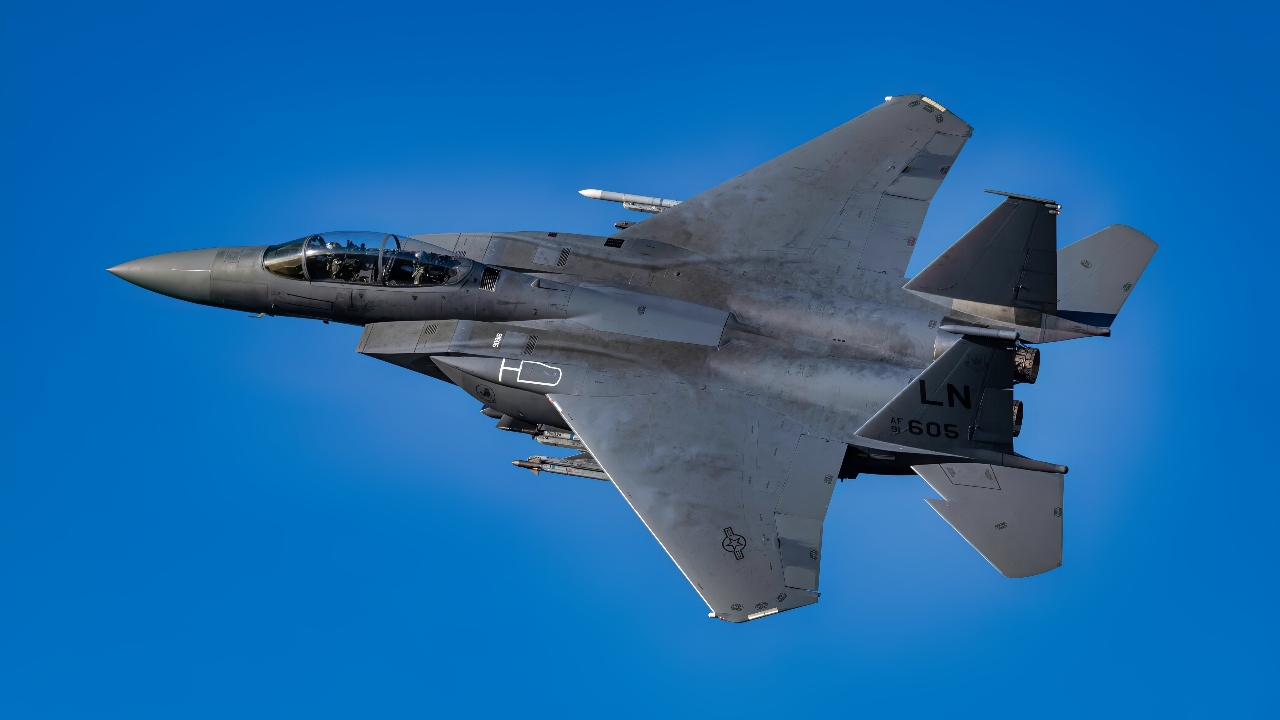
An F-15E Strike Eagle pulls out of a low approach and prepares to land at Royal Air Force Lakenheath, Jan. 5, 2022. The Strike Eagle is currently the second largest fighter aircraft in the U.S. Air Force’s inventory behind the new F-15EX. (U.S. Air Force photo by Senior Airman John Ennis)

A U.S. Air Force F-15E Strike Eagle conducts a combat air patrol in the Air Force Central Command area of responsibility, June 10, 2025. These patrols are conducted in order to deter aggression and aid stability within the region. (U.S. Air Force Photo by Staff Sgt. John C.B. Ennis)

An F-15E Strike Eagle assigned to the 494th Fighter Squadron launches for a training sortie April 11, at Royal Air Force Lakenheath, England. The 494th conducts routine training daily to ensure RAF Lakenheath brings unique air combat capabilities to the fight when called upon by United States Air Forces in Europe-Air Forces Africa. (U.S. Air Force photo/ Tech. Sgt. Matthew Plew),
Fighter Aircraft Could Be Reduced
The United States currently allocates approximately 150 F-16 and F-15E fighter aircraft for alliance operations and contingencies, but under the reported plans, that figure would fall to around 100.
And while the proposal would not technically constitute a wholesale withdrawal of American airpower from the continent, it would reduce the pool of aircraft available to NATO commanders during a potential major crisis.
Both the F-16 and F-15E have played major roles in alliance operations over the last several decades, providing a combination of air superiority and strike capabilities.
The news also comes as the United States continues to push European NATO members to increase their defense spending, and as major European powers continue to reassess their own defense strategies following more than four years of war in Ukraine.
Germany, Poland, Britain, and Romania have all announced new investment plans for military procurement and spending, while a new poll published on June 10 shows that most Europeans now support increased defense spending.
Surveillance and Tanker Fleets Impact
The proposed restructuring, according to the sources, also reportedly includes reconnaissance and maritime patrol aircraft, with the number assigned to NATO operations dropping from 26 to 15.
Those aircraft are typically used to perform missions ranging from anti-submarine warfare and intelligence gathering to monitoring maritime activity across the North Atlantic and European waters.
Their role has also become more significant in recent years, too, as NATO has intensified its focus on defending undersea infrastructure and monitoring Russian naval activity.

An F-15E Strike Eagle stands static on the flightline before morning takeoffs at Royal Air Force Lakenheath, England, Jan. 5, 2021. The 48th Fighter Wing conducts daily flying operations in order to ensure the Liberty Wing can deliver unique air combat capabilities when called upon by its NATO allies. (U.S. Air Force photo by Senior Airman Madeline Herzog)
Perhaps the most consequential news is the reported decision to remove all eight American aerial refueling tankers, which will no longer be able to provide quick support to NATO operations in Europe.
It’s significant because aerial refueling aircraft allow combat aircraft to dramatically extend their range, enabling NATO forces to sustain operations over long distances without relying on forward bases.
Without American refueling aircraft, NATO planners will now become more dependent on European tanker fleets, which are comparatively small.
Submarines and Aircraft Carriers May Move, Too
According to the New York Times’ sources, several American warships, an aircraft carrier, and a submarine will also be redeployed, along with the carrier’s airwing.
NATO spokesman Allison Hart told Reuters in response to the news that, historically, “there has been an over-reliance on U.S. forces and capabilities” on the continent.
The news reflects similar comments made by U.S. President Donald Trump and Defense Secretary Pete Hegseth in recent years. Hart also said that the balance of responsibility will continue to shift as Europe and Canada invest more in their defense – words that could, in theory, mean that the United States pulls additional assets in the future.
“This would strengthen NATO’s defense by reducing reliance on a single ally and reflect a broader change happening within the alliance,” Hart said in an emailed statement, Reuters also reported.
Hegseth Blasts “Freeloading” Countries
The reports follow harsh words from Defense Secretary Hegseth, who, speaking at the Shangri-La Dialogue security conference in Singapore last month, warned that America’s traditional alliances could no longer rely on sentiment or history alone.
“You can’t just say, ‘Oh, we’ve been friends for a long time, so let’s work together.’ It’s: ‘We’ve been friends for a long time, so you’d better have the same capabilities we do, because if we don’t, our alliance is meaningless,” Hegseth said.
The defense secretary, speaking at an event organized by the London-based International Institute for Strategic Studies, also said that the United States would move allies who comply with U.S. demands “to the front of the line.” Hegseth also strongly implied that there would be punishment for countries that do not comply or refuse to increase their own defense spending. He had positive things to say about Vietnam, Japan, and South Korea, all of which have committed to increasing their defense spending.
“We will prioritize working with model allies,” Hegseth said, adding, “We are moving them to the front of the line. Expedited arms sales, deep industrial base collaboration, expanded intelligence sharing, the list goes on, the benefits [are] many. But for those who believe they can continue to free ride on the generosity of the American taxpayer, hear us now. … The era of the United States subsidizing the defense of wealthy nations is over.”
About the Author: Jack Buckby
Jack Buckby is a British researcher and analyst specializing in defense and national security, based in New York. His work focuses on military capability, procurement, and strategic competition, producing and editing analysis for policy and defense audiences. He brings extensive editorial experience, with a career output spanning over 1,000 articles at 19FortyFive and National Security Journal, and has previously authored books and papers on extremism and deradicalization.


